Hiển thị các bài đăng có nhãn 12 Days of Christmas. Hiển thị tất cả bài đăng

Chủ Nhật, 25 tháng 12, 2011

On the twelfth day of Christmas, my true love gave to me... Twelve Drummers drumming...
Sciaenops ocellatus


And we've reached the final day! Huzzah! Today's animal is the Red Drum, also known as the Channel Bass or Spottail Bass. This particular species is the only member of its genus, and can be found in the Atlantic Ocean and Gulf of Mexico.

Red Drums are fast growing fish, and can reach 11in long in only a year. They can reach length of up to 5ft overall! By 3 years they have reached sexual maturity, and the oldest recorded individual lived to be 37!

These fish are typically a coppery red, like their name implies, but they can also be a darker black or in a lighter silver. They can be identified by a large black spot that appears on the tail base. Sometimes you will find even more black spots, but it is rare to have no spots at all. The species name ocellatus even means "marked with spots!"

Red Drums are carnivores, and they use their downturned mouths to dig around on the sea floor for crustaceans and other hidden invertebrates. They also hunt higher up in the water column, and feed on many different species of fish.

Red Drums were once farmed commercially, but that practice was banned in most federal and state waters back in 2007. This ban has allowed the species to rebuild in areas where they were once harvested by the thousands. The fish continues to be caught recreationally.

IUCN Status : Not Listed
Location : Atlantic Ocean and Gulf of Mexico
Size : Length up to 5ft (1.5m), Weight up to 90lbs (40kg)
Classification : Phylum : Chordata -- Class : Actinopterygii -- Order : Perciformes
Family : Sciaenidae -- Genus : Sciaenops-- Species : S. ocellatus

Thứ Bảy, 24 tháng 12, 2011

On the eleventh day of Christmas, my true love gave to me... Eleven Pipers piping...


Bartramia longicauda
Wow, only one more day to go! And after a few days' break we are back to the birds.

The Upland Sandpiper is an interesting little bird in that it doesn't inhabit shores like other Sandpipers do. Instead, they make themselves comfortably at home in open grasslands. In some areas of the American Northeast, they've even taken to nesting in Airports!

Upland Sandpipers are a migratory species that spend their summers up in the United States and Canada (sometimes as far north as Alaska!) and their Winters down in countries like Brazil and Argentina. They nest during the summer, scraping multiple depressions into the ground, but using only one to lay their eggs. This makes it more difficult to locate their actual nest, and keeps the eggs and young birds safe.

Though they are listed as being of Least Concern, Upland Sandpipers have faced a decline in numbers, and are  rare in some areas. They used to be abundant throughout North America, but hunting over the last hundred years has affected the species. Fortunately, they still have a very large population size, and their widespread range keeps the overall threat of extinction very low.

IUCN Status : Least Concern
Location : North and South America
Size : Length up to 1ft (31cm) Wingspan up to 21in (55cm)
Classification : Phylum : Chordata -- Class : Aves -- Order : Charadriiformes
Family : Scolopacidae -- Genus : Bartramia-- Species : B. longicauda

Thứ Sáu, 23 tháng 12, 2011

On the tenth day of Christmas, my true love gave to me... Ten Lords a'leaping...
Hemilepidotus hemilepidotus


Finally, a fish makes it to our list! Though I must say, when I mentally picture a lord, it looks nothing like this odd ocean dweller.

The common name of this fish is a little confusing. Despite being called the Red Irish Lord, they are not native to anywhere even remotely close to Ireland; they are found in the Pacific Ocean! They also comes in many, many colors besides red, and can even change color to match their surroundings. How perplexing!

Red Irish Lords may look a bit familiar to you. They are members of the large Scopaeniformes superfamily, which also includes Rockfish. Like the Rockfish, Red Irish Lords are carnivores. They live close to shore on rocky reefs at depths of less than 1,500ft (450m) and hunt crustaceans, mussels, and barnacles by waiting patiently and them ambushing them.

Red Irish Lords are also pretty good dads! After mating, the females will lay her eggs and leave. The males however, sticks around and guards over them until they hatch.

IUCN Status : Not Listed
Location : Northern Pacific Ocean
Size : Length up to 20in (51cm)
Classification : Phylum : Chordata -- Class : Actinopterygii -- Order : Scorpaeniformes
Family : Cottidae -- Genus : Hemilepidotus -- Species : H. hemilepidotus

Thứ Năm, 22 tháng 12, 2011

On the ninth day of Christmas, my true love gave to me... Nine ladies dancing...


Vanessa cardui
Meet the Painted Lady, one of the most widespread Butterflies on the entire planet! They can be found living in temperate areas of just about every continent (except South America and Antarctica... though Antarctica isn't temperate anyway)

Painted Lady Butterflies live their lives in four stages. They start as eggs, which are laid on thistle leaves and hatch after 3-5 days. Then they live for another week or so as a spiny black Caterpillar that eats the thistle leaves that they were laid on. After that they pupate for up to 10 days before turning into an adult. The Butterfly can fly only a few hours after emerging with their fancy new wings.

Over the course of their lifetime, a Painted Lady Butterfly may travel up to 1,000 miles! This is pretty amazing when you realize that they are only adults for a couple of weeks at best. It can take multiple generations to make the full trip between migration points. In some years the migrations have been larger and more populous than others. Back in 1973, the larvae from the Painted Ladies were so abundant in Orange County, California, that exterminators had to come in due to infestation!

Painted Ladies are very popular classroom "pets." They are often raised in classrooms, as their 3 week lifecycle  makes for a great visual lesson plan on the stages of metamorphosis.

IUCN Status : Not Listed
Location : Worldwide, except South America and Antartica
Size : Wingspan 3.5in (9cm)
Classification : Phylum : Arthropoda -- Class : Insecta -- Order  Lepidoptera
Family : Nymphalidae -- Genus : Vanessa -- Species : V. cardui

Thứ Tư, 21 tháng 12, 2011

On the eighth day of Christmas, my true love gave to me... eight maids a'milking...


Milking Shorthorn
And now we come to the half the song proliferated by humans in various occupations. And because this is "Animal-A-Day" and not "Random-Profession-For-Hire-A-Day," we'll be getting a bit creative for the remainder of the entries.

Though to be honest, today's entry isn't that far out of the box. Milking maids? A dairy cow? Not altogether unexpected. At any rate, the Milking Shorthorn, which is also referred to as the Dairy Shorthorn depending on the country, is a relatively old breed of Cattle that was developed as an offshoot of the Shorthorn Breed. The Shorthorn and Milking Shorthorn have the same ancestry, but have been adapted to serve different purposes.

Milking Shorthorns were fist developed in Northern England during the late 18th century, and were exported to the United States, New Zealand, and Australia during the next few decades. At this time they were sometimes referred to as "Durhams," for the area in which they originated.

The breed is incredibly versatile; the calve easily and regularly, they grow very fast, graze efficiently, and they produce large volumes of nutritious milk. Milking Shorthorns also have long lifespans, and they have a high salvage value when they eventually pass away.

One interesting trait of the breed is that they come in a roan color, which is a speckled mixture of white and red. This color is not found in any other Cattle breed! They also comes in more solid shades of white and red. Milking Shorthorns have passed their color on to the handful of breeds that they have helped to create, including the Illawarra Cattle and the Swedish Red Cattle.

Status : Domesticated, but listed as a critical breed by the ALBC
Location : Originated in England
Size : Height up to 55in (1.4m), Weight up to 1,500lbs (680kg)
Classification : Phylum : Chordata -- Class : Mammalia -- Order : Artiodactyla
Family : Bovidae -- Genus : Bos -- Species : B. primigenius

Thứ Ba, 20 tháng 12, 2011

On the seventh day of Christmas, my true love gave to me... Seven Swans a'swimming...


Cygnus melancoryphus
Ah yes, another day another bird. Did you know that if you were to actually buy all these gifts (the real versions in the song, not the animal equivalents like Dragonflies) you would shell out the most money for the Swans?

The Swans in the song are probably not the Swans we're talking about today. I'd place bets on the Mute Swan, which is widespread in Europe and Asia. But I've already written about that particular species, so today we'll learn about it's different, South American cousin.

Black-necked Swans are named for their black necks that contrast with an otherwise white body. They also sport bright red knobs at the base of the bill that enlarge (on males) during the breeding season.

The Black-necked Swan is interesting in that it is both the largest native Waterfowl in South America, and also the smallest of all the Swans. They also have the designation of being one of the fastest Swans, and are capable of flying at speeds of up to 50mph (80kph).

Black-necked Swans are social birds during the non-breeding season, but when it comes time for mating and nesting they become aggressive and territorial. Partners are typically monogamous for life, but will find a new mate if their previous one dies. Though the female does all of the incubation,both parents help to care for the cygnets. They will even let the little Swans ride on their backs for the first few weeks of life!

IUCN Status : Least Concern
Location : South America
Size : Wingspan up to 70in (178cm), Weight up to 15lbs (6.8kg)
Classification : Phylum : Chordata -- Class : Aves -- Order : Anseriformes
Family : Anatidae -- Genus : Cygnus -- Species : C. melancoryphus

Thứ Hai, 19 tháng 12, 2011

On the sixth day of Christmas my true love gave to me... six Geese a'laying...


Neochen jubata
Do not fear bird people! After yesterday's Dragonfly we return to the world of feathered friends. Allow me to introduce you to the Orinoco Goose, a small species of Goose found in the northern, rainforested areas of South America. The are the only true forest Goose.

I find Orinoco Geese to be rather lovely in appearance. The contrast between the cream neck, the pink legs, and the chestnut and black wings creates a pleasing color composition (using my Art History degree!). Unlike many of our other Christmas birds so far, both male and female Orinoco Geese display the same plumage, though the males are slightly larger.

Once upon a time the Orinoco Goose was one of the most populous waterfowl species along the Orinoco River. Unfortunately, hunting and deforestation has caused their numbers to decline and they are now rare in many parts of their original range. Projects are underway to foster and protect the species, including the building of nest-boxes. Orinoco Geese nest in large trees near bodies of water, but they've been losing those nesting sites as trees get cut down. Nest-boxes placed on poles allow for the Geese to reproduce again in areas that were deforested.

IUCN Status : Near Threatened
Location : South America
Size : Length up to 30in (75cm)
Classification : Phylum : Chordata -- Class : Aves -- Order : Anseriformes
Family : Anatidae -- Genus : Neochen -- Species : N. jubata

Chủ Nhật, 18 tháng 12, 2011

On the fifth day of Christmas my true love gave to me... Five Golden Rings!


Cordulegaster boltonii
Well, after four days of birds (don't worry, there are still a few more to go for you bird-lovers!) we finally have a whole different type of critter... though it still has wings.

Meet the Golden-ringed Dragonfly, the longest Dragonfly in the entire United Kingdom. The species is named for its black body and and the golden bands that pattern down its length. They can be found near streams and rivers of all sizes, and are abundant throughout Great Britain.

Female Golden-ringed Dragonflies are a tad bit larger than the males. This is due to the presence of an ovipositor at the ends of their abdomens. This is the organ used for laying eggs, which is a process done by flying over the river banks and jabbing the abdomen into the sediment. Eggs hatch in a few days and the Dragonfly larvae remain in the sediment for as long as 5 years! They undergo numerous molts before finally reaching their adult form, with metamorphosis typically taking place at night.

IUCN Status : Not Listed
Location : Great Britain
Size : Length up to 3in (8cm)
Classification : Phylum : Arthropoda -- Class : Insecta -- Order : Odonata
Family : Cordulegastridae -- Genus : Cordulegaster -- Species : C. boltonii

Thứ Bảy, 17 tháng 12, 2011

On the fourth day of Christmas my true love gave to me... four calling birds...


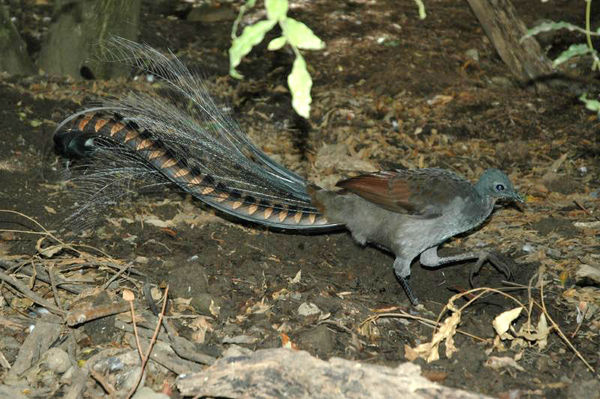
Male Superb Lyrebird
Alright, today's animal was a little less specific on type. We've had Partridges, which are contained in one family. We've had Turtledoves, a term that relates to only a few species. But now we have "Calling Birds," which I've taken to mean some sort of songbirds (though this one source claims it refers to Blackbirds, which is an interesting read.)

Anyway, my choice to go with a songbird puts me in a pickle, as songbirds aren't found in just one genus, or family. Nope, that's an entire order. So you know what? Let's go big. And awesome. Or dare I say... Superb?

Meet the Superb Lyrebird, one of the largest, longest, and heaviest songbirds on the planet. Not the petite little guy that typically comes to mind when you think of the song, huh? These birds live in the forests of Australia, and are sexually dimorphic. Females are brownish-gray, and have short tail feathers. Males, on the other hand, have spectacular tails with lacy feathers and two large plumes that form the shape of a Lyre.

Superb Lyrebirds aren't just large and flashy... they have some serious pipes. They have the ability to mimic the calls of other birds, and can even duplicate other random noises as well (watch the video clip below, it's pretty amazing). Both the males and hte females sing, but the males are louder and do it more frequently.

Singing is done more often during the breeding season, when males work to attract females into their territories. Superb Lyrebirds are not monogamous; females will enter male territories and scope out potential mates. The males built mounds, where they stand and do their displays. Upon mating, she will build a nest in her own range, and incubate and care for the single chick alone.


IUCN Status : Least Concern
Location : Australia
Size : Length (with feathers) 3.2ft (1m)
Classification : Phylum : Chordata -- Class : Aves -- Order : Passeriformes
Family : Menuridae -- Genus : Menura -- Species : M. novaehollandiae

Thứ Năm, 15 tháng 12, 2011

Rooster and Hen
On the third day of Christmas my true love gave to me... three French Hens...

Faverolles are one of the many breeds of Chicken out there that originated in France. They are named after one of the cities in which they were developed, back in the 1850s. The breed is a great all purpose chicken, good for both meat and eggs, and they are excellent egg layers even in the winter months.

I chose Faverolles as the "French Hen" today because I think they look delightfully awesome. They have feathered feet, muffs, and beards. That's a lot of fluff on a Chicken! They come in three recognized color varieties, white, salmon, and mahogany.

One really neat thing about Faverolles roosters is that they aren't as aggressive as roosters of other breeds. Both males and females are calm and good natured, and they do well in colder weather.

Status : Domesticated, listed as Threatened by the ALBC
Location : France
Size : Weight up to 8lbs (3.6kg)
Classification : Phylum : Chordata -- Class : Aves --   Order : Galliformes
Family : Phasianidae -- Genus : Gallus -- Species : Gallus gallus
On the second day of Christmas my true love gave to me, two Turtledoves...


Streptopelia turtur
Day two introduces us to the European Turtledove, a mostly-migratory member of the Pigeon family that lives in Europe during the spring and summer, and Africa during the autumn and winter. They can also be found as far east as China, and some populations that live in warmer areas (North Africa for example) remain there year round.

Do you know where Turtledoves get their name? It has nothing to do with a reptilian connection! It actually comes from their Latin species name turtur, which describes the purring sounds that they make.

It's a good thing there are two Turtledoves gifted in the song, because these birds live in pairs throughout the breeding season. Both sexes help to incubate the eggs, and the young Doves are off and on their own after only 20 days!

Outside of the breeding season the Turtledoves tend to live in large flocks. Groups that number into the thousands can be found at wintering sites in Africa! They forage for food in groups, and feed on nuts, seeds, fruits, and the occasional invertebrate.

European Turtledoves are listed as being of least concern because they have an incredibly massive range and a humongous worldwide population. In 2004 it was estimated that there were between 10 and 20 million birds just in Europe, and Europe only constitutes a fragment of the overall group. Numbers could be as high as 100 million! They are the most common native Dove on the entire European continent.

IUCN Status : Least Concern
Location : Europe, Africa
Size : Length up to 11in (29cm), Wingspan up to 22in (58cm)
Classification : Phylum : Chordata -- Class : Aves -- Order : Columbiformes
Family : Columbidae -- Genus : Streptopelia -- Species : S. turtur

Thứ Tư, 14 tháng 12, 2011

Male Rollulus rouloul
Surprise! It's a theme week! (Or... two weeks-ish). I realized I haven't done one of these in ages and ages, and I was inspired by this years Cost of 12 Days of Christmas. So we're doing the song!

On the first day of Christmas my true love gave to me, a Partridge in a pear tree.


Well, we don't really cover plants here, so sorry Pear Tree. Partridge gets all the spotlight today!

Meet the Crested Partridge, a stunning little fellow found in Southeast Asia. The species is sexually dimorphic; males are black with brilliant red crests, while females are green with brown wings.
Female

Crested Partridges can be found in dense, lowland, forested areas. They need lots of cover to survive, as they both feed and nest on the ground. These birds are omnivores that consume fruits, nuts, insects, and snails, and there are even reports of them working with wild pigs, picking up the food bits that the hogs leave behind. They typically forage in pairs or groups, and are monogamous breeders (the fact that they live very social lives makes me sad that only one gets to go in the Pear Tree!). Both of the parents help to care for and feed the chicks, which are precocial.

Crested partridges are listed as Near Threatened by the IUCN. Habitat loss from the logging industry has decreased the numbers in some countries, though many of the birds do live within protected areas.

IUCN Status : Near Threatened
Location : Southeast Asia
Size : Length up to 10in (25cm)
Classification : Phylum : Chordata -- Class : Aves -- Order : Galliformes
Family : Phasianidae -- Genus : Rollulus -- Species : R. rouloul