Hiển thị các bài đăng có nhãn Lagomorph. Hiển thị tất cả bài đăng

Thứ Ba, 11 tháng 3, 2014

Nesolagus netscheri
Today we'll be learning about another animal that is found in only a very tiny range-- the Sumatran Striped Rabbit. These Lagomorphs are endemic to the mountain rainforests of Sumatras Barisan Range.

Sumatran Striped Rabbits are actually one of the few Rabbit species to live in rainforest environments, and they also have the distinction of being one of the rarest Rabbits in the world.

Because of their remote, dense habitat and their nocturnal behavior they are rarely ever seen, and haven't been well studied. In fact, they were not seen at all between 1972 and 2000, and have only been reported 3 times since!

There are about half a dozen museum specimens around the world, but most were collected over 100 years ago, before many of the current conservation threats ramped up. Their rarity makes their "Vulnerable" listing unsurprising, and they continue to be in trouble due to habitat loss.

IUCN Status : Vulnerable
Location : Sumatra, Indonesia
Size : Length up to 16in (40cm)
Classification : Phylum : Chordata -- Class : Mammalia -- Order : Lagomorpha
Family : Leporidae -- Genus : Nesolagus-- Species : N. netscheri  
Image : Tios

Thứ Năm, 9 tháng 1, 2014

Sylvilagus audubonii
Also known as the Audubon's Cottontail, the Desert Cottontail is a rabbit that lives in the dry, desert-like habitats of western North American (though they can also be found in some pine forests as well!)

Desert Cottontails typically live in small groups, foraging together for grasses, vegetables, and even cacti. They drink very little water, if any, as they can get all they need from the plants that they eat.

Interestingly, the Desert Cottontail is one of those unusual mammals where the females are larger than the males... if only just barely. Like most rabbits, these guys breed several times a year, though have fewer litters, and fewer offspring per litter, than many of their cousins. A female will normally breed 5 times a year, each time having a gestation period of about 4 weeks. 3 young are usually born at once, and they grow quickly, leaving the nest at 2 weeks and being fully independent at 5 (leaving mom to breed again!)

IUCN Status : Least Concern
Location : Western North America
Size : Length up to 17in (43cm), Weight up to 3.3lbs (1.5kg)
Classification : Phylum : Chordata -- Class : Mammalia -- Order : Lagomorpha
Family : Leporidae -- Genus : Sylvilagus -- Species : S. audubonii
Image :  Howcheng

Thứ Tư, 20 tháng 11, 2013

Prolagus sardus
The Sardinian Pika was one of a kind-- the only member of its genus to survive till modern times. These cousins to the modern Pikas (themselves relatives to Rabbits and Hares, not rodents) lived on the islands of Sardinia and Corsica before they went extinct in the late 1700s.

Written accounts and fossil remains show that the Sardinian Pikas were once abundant on their home islands. They were hunted by the peoples that arrived there around 6,000 years ago, and may have been considered a delicacy.

Unfortunately, these Lagomorphs are no more. Many factors contributed to their decline-- the introduction of dogs and foxes and increase human populations among them. The exact date of extinction is unknown, but it was some time at the end of the 18th or the beginning of the 19th century.

IUCN Status : Extinct
Location : Sardinia, Corsica
Size : Length up to 10in (25cm)
Classification : Phylum : Chordata -- Class : Mammalia -- Order : Lagomorpha
Family : Prolagidae -- Genus : Prolagus-- Species : P. sardus
Image : Animal Photo Album

Thứ Ba, 14 tháng 5, 2013

Pentalagus furnessi
Today's animal is one of those creatures that is sometimes referred to as a "Living Fossil." You see, these Rabbits have evolved in complete isolation over thousands of years, and now have traits that make them a bit unusual.

Amami Rabbits are found on only two small islands-- Amami and Tokunoshima. They are located between the large Japanese island of Kyushu, and Okinawa. That isolation has led them to maintain primitive rabbit traits-- short ears, thick dark fur, and stocky bodies.

These Rabbits are nocturnal, which is also an unusual rabbit trait. They spend the daytime in underground dens. They also give birth to only a single baby at a time, though a female may have more that one child during a single year.

Sadly, because these Rabbits live on only two islands, they are very susceptible to habitat loss and the trouble caused by introduced species. Mongooses have been especially problematic to these rabbit, and have caused a significant population drop since they were first introduced 30 years ago. Mongoose (and feral cat and dog) eradication programs have been proposed to save the Rabbits, along with the restoration of habitat.

IUCN Status : Endangered
Location : Japan
Size : Body length up to 20in (50cm)
Classification : Phylum : Chordata -- Class : Mammalia -- Order : Lagomorpha
Family : Leporidae -- Genus : Pentalagus-- Species : P. furnessi
Image : Animal Photos

Thứ Bảy, 4 tháng 8, 2012

Netherland Dwarf
I'm heading over to the Wisconsin State Fair today, and for those of you who have not had the pleasure, the fair is known for three things: Every type of food imaginable.... on a stick. Pig races. Animals. Lots and lots of animals. While the horses, cows, and other large livestock usually get all the glory, I've always been a fan of the Rabbits and Poultry building. You get to see all kinds of different breeds, from the common to the completely unusual. Today we'll be learning all about one of the more popular Rabbits- the Netherland Dwarf.

Netherland Dwarf
The Netherland Dwarf originated in its namesake country during the early 20th century. They were the result of crosses between small wild rabbits and smaller polish breeds. The first Dwarfs were aggressive, and took after their wild relatives more than their domesticated ones. It wasn't until the past few decades that selective breeding was able to produce more gentile traits. However, there are still some skittish Rabbits out there, a carryover of their early days.

Netherlands Dwarfs are popular due to their small size, and the easier ownership requirements that go along with it. They need much smaller cages, less food, and do not need to live in pairs or groups like some small mammals do. They can be littler box trained, but success will vary on the individual.

Another reason why this breed is so popular? They retain infant-like looks as adults! They also come in just about every color imaginable. Because they are so small, they are kept as pets almost exclusively, as they aren't large enough for fur or meat usage.

Netherland Dwarfs are often crossed with other Rabbit Breeds to create smaller pets, and they have actually help to found several other breeds as well. The Jersey Woolly, Mini-Rex, and Holland Lop are all results of Dwarf crosses with other breeds.

Status : Domesticated
Location : Netherlands
Size : Weigtha round 3.5lbs (1.6kg)
Classification : Phylum : Chordata -- Class : Mammalia -- Order : Lagomorpha
Family : Leporidae -- Genus : Oryctolagus -- Species : O. cuniculus

Thứ Sáu, 23 tháng 3, 2012

Flemish Giant
It was pointed out to me that this week has been a bit of an unofficial theme week- the last couple days have featured animals that are popular within the pet industry! Well, why not keep this inadvertent theme going? Let's talk about the Flemish Giant, one of my favorite breeds of Domestic Rabbit, which can grow to weights of over 20lbs! That is larger than some dog breeds!

As the name suggests, Flemish Giants were developed in the region of Flanders. They are a very old breed, as far as modern rabbits are concerned, and were developed as far back as the early 16th century. There is some debate over the origins of the breed before that time, and some think they may have descended from large South American breeds brought back to Europe by Dutch traders.

The first confirmed records of the modern Flemish Giant breed date to the 1860s, and by the turn of the century breed clubs and standards were forming. These Rabbits were initially bred for their meat- a larger sized animal produces more food- but they are now popular as pets and for showing. The standard calls for 7 different recognized colors - black, blue, fawn, light gray, steel gray, sandy, and white - and are shown in 6 different age and sex based classes.

Flemish Giants are very docile Rabbits, and are less energetic and feisty than many of the smaller breeds, though improper socialization can make them fearful and violent. If properly handled, cared for, and interacted with, they become very tolerant, laid back, and healthy pets.

Keep in mind, however, that these guys are huge. Not only can they weigh over 20lbs, but they grow very, very quickly. A Flemish Giant can reach its full weight at only 9 months of age. They need a large habitat to move around in, and need a great deal of feeding (though don't give them too much, they are prone to obesity!)

Status : Domesticated
Location : Originated in Flanders
Size : Weight up to 22lbs (10kg)
Classification : Phylum : Chordata -- Class : Mammalia -- Order : Lagomorpha
Family : Leporidae -- Genus : Oryctolagus-- Species : O. cuniculus

Thứ Hai, 13 tháng 2, 2012

Romerolagus diazi
The Volcano Rabbit is the second smallest Rabbit in the entire world (after the very appropriately named Pygmy Rabbit). They have short ears, short legs, and a coat that allows them to easily blend in with the soil in their home range. They live in a very, very small range in Mexico and are currently listed as Endangered.

Surprise surprise, Volcano Rabbits live on the slopes of Volcanos! The Pelado, Iztaccíhuatl, Tlaloc, and Popocatepetl volcano slopes are where they make their homes (all of these volcanoes are now extinct). They live in burrows that can stretch up to 16ft long, and live in small social groups led by a dominant breeding pair.

Volcano Rabbits have the interesting distinction of being the only member of their family to make vocalizations. They make quiet squeaks and high pitched barks that are similar to those made by Pikas.

The species is listed as endangered because habitat loss and hunting have drastically reduced their population and their home range. An action plan is currently in place by the IUCN, and captive breeding colonies have been set up in a number of zoos.

IUCN Status : Endangered
Location : Mexico
Size : Body Length up to 10in (25cm)
Classification : Phylum : Chordata -- Class : Mammalia -- Order : Lagomorpha
Family : Leporidae -- Genus : Romerolagus-- Species : R. diazi

Thứ Ba, 18 tháng 10, 2011

Caprolagus hispidus
Today's animal is one of the rarest mammals in the entire world, but many people have never even heard of it! The Hispid Hare (which is actually technically a Rabbit) is an endangered species that had a population of only around 110 individuals as of 2001.

Hispid Hares were thought to be extinct in the early 1960s, but then an individual surfaced in 1966. They have a very small range that covers parts of India and Nepal, and their numbers are on the decline due to habitat loss within that range. They are also mistakenly hunted due to their resemblance to another, more common, Hare species. Hispid Hares have not done well in captivity.

Unfortunately, because they are so rare we know very little about the behavior of these Hares. They live in grassland areas, are herbivores, and they do not appear to dig burrows. They have been described as "slow moving."

As a final side note, let's quickly discuss the difference between Rabbits and Hares. For one, Hares are found within the genus Lepus. Secondly, young Hares are born more developed than young Rabbits are, because they are born above ground, not in burrows (meaning they have to fend for themselves more quickly). And thirdly, Rabbits tend to hide from predators, while Hares attempt to outrun them. Rabbits have also been domesticated. Hares have not.

IUCN Status : Endangered
Location : India and Nepal
Size : Length up to 21in (53cm), Weight up to 5.5lbs (2.5kg) 
Classification : Phylum : Chordata -- Class : Mammalia -- Order : Lagomorpha
Family : Leporidae -- Genus : Caprolagus-- Species : C. hispidus

Chủ Nhật, 24 tháng 4, 2011

Sylvilagus floridanus
The Eastern Cottontail Rabbit is one of the most common rabbit species in North America, though they can also be found in parts of Central and South America as well. They are a crepuscular species, meaning they are most active at dusk and dawn, and they prefer to live in habitats that are not quite fully forested, but that aren't completely open either.

Eastern Cottontails are very, very territorial and don't like being around each other much outside of the mating season, which involves males both fighting each other, and performing displays for females. These Rabbits reach sexual maturity when they are only 2-3 months old, and females can have as many as 3-4 litters a year, sometimes more! The high reproduction rate is necessary though, since Cottontails have what seems like an endless number of predators, and nearly 80% of adult rabbits are killed each year.

The Rabbits have a few ways to escape from those who hunt them. They can jump distances of 10-15ft (3-4.5m) and when they run, they do so in a zig-zag pattern to try and break the trail. They can reach speeds of up to 18mph (29kph).

Eastern Cottontails are herbivores that both graze and browse. They are not very picky about the vegetation that they eat, which can cause problem when they go after crops and gardens.

IUCN Status :  Least Concern
Location : North America, parts of Central and South America
Size : Body length 17in (43cm), Weight 3lbs (1.3kg)
Classification : Phylum : Chordata -- Class : Mammalia -- Order : Lagomorpha
Family : Leporidae -- Genus : Sylvilagus-- Species : S. floridanus

Chủ Nhật, 30 tháng 1, 2011

(Image Source)
Phylum : Chordata
Class : Mammalia
Order : Lagomorpha
Family : Ochotonidae
Genus : Ochotona
Species : princeps

Length : 6-8in (15-20cm)
Weight : 6oz (170g)

IUCN Status : Least Concern

Pikas are small, round little members of the Lagomorph order. There are around two dozen different species of Pika which can be found in mountainous habitats around the world. The American Pika, and its name might suggest, is found in the mountains of Western Canada, the United States, and Mexico. In the northern part of their range they can sometimes be found at sea level, but the species is not very tolerant of warm weather. In the south they are rarely found at elevations lower than 2,500m.

(Image Source)
American Pikas are extremely vocal little guys. In fact, Pikas are sometimes referred to as whistling hares. They make calls to warn each other about potential predators and intruders, to establish territories, and also as a part of their mating behavior. Pikas live in colonies, with individuals having their own territory within the colony.

They are a diurnal, herbivorous species that forages for a variety of plant materials. They store excess materials in piles that they dry out and move to their dens. American Pikas do not hibernate in winter, and depend on these stocks for a bulk of their food during that season.

American Pikas are listed as being of Least Concern, but overall their population is declining. Fragmented habitats have caused low population densities, and feral cats have had an impact as well well.

Thứ Tư, 5 tháng 1, 2011

(Image Source)
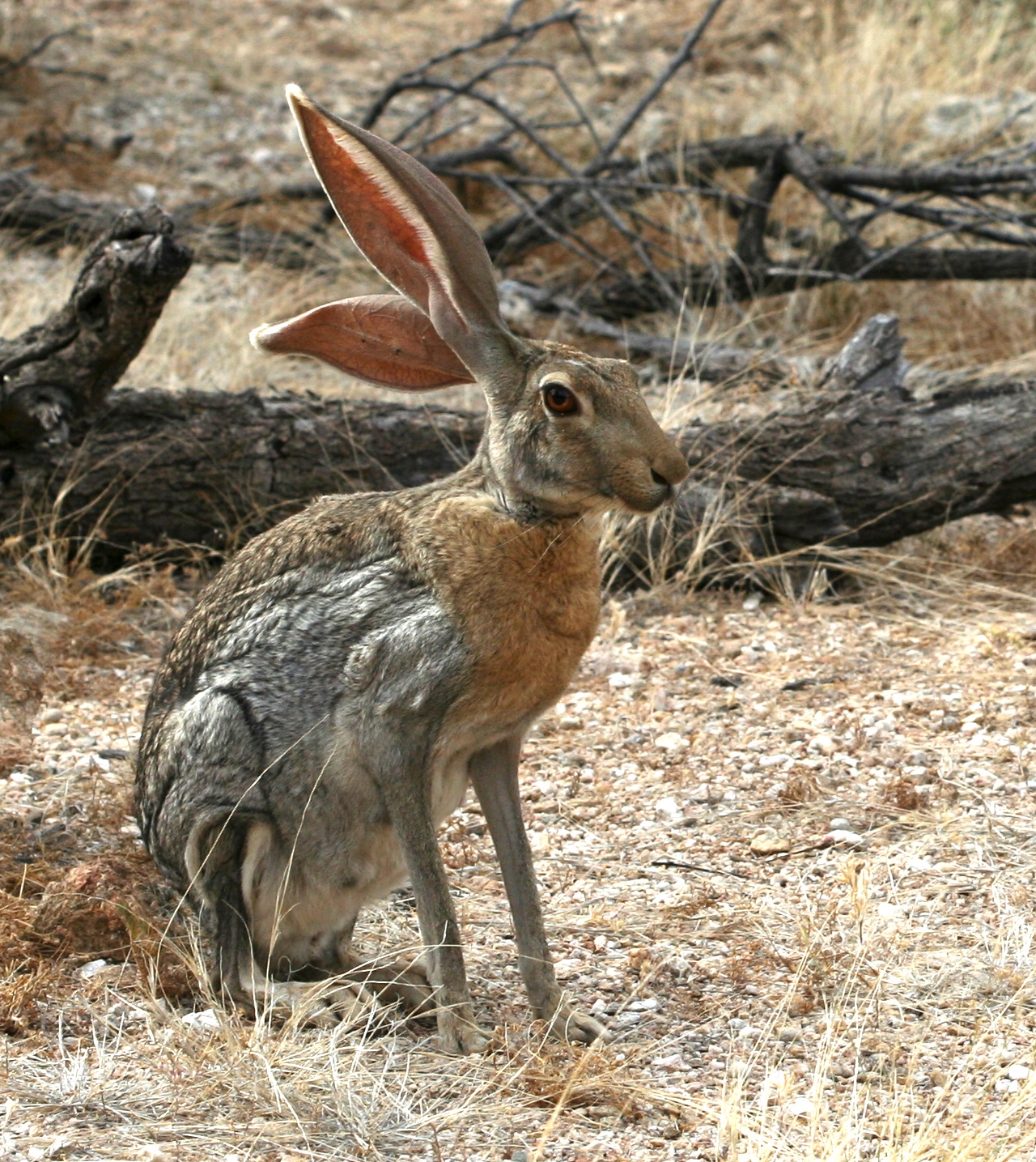
Despite the name, the Antelope Jackrabbit (Lepus alleni) is actually a hare, though rabbits and hare all members of the family Leporidae, which shares the order Lagomorpha with the Pikas. Antelope Jackrabbits are found in Western Mexico and in Southern Arizona. They are nocturnal creatures that feed during dusk and down (making them crepuscular). Antelope Jackrabbits can be found in open grassland areas, both at low and hilly elevations. They have long legs for running and jumping, and long ears, which help to  reduce heat. They also have fur that works well to insulate and reflect.

Antelope Jackrabbits are so named because of their speed (up to 35mph/56kph) and because of an interesting behavior that they exhibit while running from danger. When being chased by a predator, the Jackrabbit will flash a white patch of hair on the rump and run in a zigzag pattern. This is done with hopes to confuse their pursuer. Antelope Jackrabbits have several predators in the wild, including coyotes, hawks, and snakes.

Antelope Jackrabbits are herbivores, and feed off of grasses, leaves, and even cacti. They do not actively drink, and instead get all of their water from their diet. Breeding season is actually year round, and males will "box" for potential mates. Females may give birth to up to four litters a year, and the young are precocial not long after birth. Males do not take care of the young.

Thứ Sáu, 28 tháng 5, 2010

Angora is not simply one breed of domestic rabbit, it is many. French, English, Giant and Satin are all recognized by the American Rabbit Breeder's Association and are bred for the fine hair that they produce. A 5th breed, the German Angora, is recognized in other places, and was bred specifically to create a high yield, high density wool that could be harvested commercially. 

The English Angora is the one most commonly kept as a pet, and is the smallest of the breeds. It is characterized by large tufts of fur on the entire face save the nose, which is a trait that is more of less unique to that breed. Facial trimmings, as they are called, are found in other breeds, but not to the extent as in the English.

The history of the Angora Rabbit dates back to the 18th century, when it was believed to be imported to France from Turkey. (Ankara, the capital of Turkey, was called Angora from 1073 until 1930. This also the origin of Angora Cats and Goats) The rabbits appeared in the encyclopedia in France for the first time in 1765, and the French were the first to really capitalize on the rabbits commercially. Angoras soon became prized for their lovely hairs which can be easily harvested either with scissors, or by simply plucking out strands during their natural molting. Despite their long history in Europe, they didn't appear in the United States till the early 1900s.

All images from PlusPets
Unsurprisingly, Angora Rabbits require a lot of care and grooming to keep their coats in top condition. If you're up to that challenge, they do make very sweet and mellow pets, and are apparently pretty low cost to keep. (once you take out all of the grooming requirements) There are several sites out there about the care of these rabbits, as well as all kinds of information on their fibers and what you can do with it.

Thanks Austin for the suggestion!