Hiển thị các bài đăng có nhãn Mollusk. Hiển thị tất cả bài đăng

Thứ Sáu, 21 tháng 3, 2014

Indrella ampulla
Today we meet yet another creature endemic to the Western Ghats-- Indrella ampulla.

It is the only species within its genus, but it comes in all sorts of different colors and varieties. Yellow is a very common body color, but it can be bright red, black and white as well. The shell is dark in color, normally contains three whorls, and typically meaures no more than 2in in diameter.

Indrella ampulla lives in mountainous rainforests. There, they feed on different Fungi varieties, using their radula that contain more than 100 rows of tiny teeth!

IUCN Status : Not Listed
Location : India
Size : Shell width up to 2in (6cm)
Classification : Phylum : Mollusca -- Class : Gastropoda
Family : Ariophantidae -- Genus : Indrella -- Species : I. ampulla
Image :  NHM

Thứ Ba, 28 tháng 1, 2014

Limax maximus
Meet Limax maximus, also known as the Leopard Slug. These Gastropods are some of the largets Slugs int he world, and can grow up to 8in long.

It is pretty easy to see where these Slugs got their feline-inspired common name. They have brown bodies that are covered with darker, leopard-like spots. There are actually several different color types, ranging from very pale, to red, to dark, but all have the spots.

Limax maximus originally hailed from Europe and possibly western Africa. However, they have spread very far from home and are now common in North America, South America, and even New Zealand.

You'll find these slugs near humans-- they like to eat trash and other decaying matter, and they normally feed at night. Unfortunately, they also like to feast on young living plants as well, which is why they are considered an invasive pest in the United States, where they feed on crops.

Like all slugs, Limax maximus individuals are hermaphrodites. When they mate, two slugs will circle each other (sometimes for hours and hours) and then eventually climb a tree. The pair will then dangle from the tree by a thick strand a mucus, and it is then that they trade sperm with each other. Each slug will then go on to lay its own eggs.

IUCN Status : Not Listed
Location : Europe
Size : Body Length up to 8in (20cm)
Classification : Phylum : Mollusca -- Class : Gastropoda -- Superfamily : Limacoidea
Family : Limacidae -- Genus : Limax-- Species : L. maximus
Image : max0rz

Thứ Ba, 17 tháng 12, 2013

Haliphron atlanticus
The Seven-arm Octopus has a misleading name. They do actually have eight arms, like all Octopuses do, it's just that one of the arms (the hectocotylus, used for egg fertilization) is often curled up on the males' bodies, making it difficult to see. Females of the species do that have that issue.

Seven-arm Octopuses live in both the Atlantic and the Pacific oceans. It was believed to live only in the former until about fifteen years ago, when one was caught off the coast of New Zealand. Interestingly, these creatures have also been found at both the sea floor AND near the surface, which is unusual for Octopuses.

The species is also notable because they are quite large. In fact, they are the largest Octopuses in the world, and can measure over 11ft in length!

IUCN Status : Not Listed
Location : Atlantic and Pacific Oceans
Size : Length up to 11ft (3.5m)
Classification : Phylum : Mollusca -- Class : Cephalopoda -- Order : Octopoda
Family : Alloposidae -- Genus : Haliphron -- Species : H. atlanticus
Images : RL Hudson

Thứ Sáu, 4 tháng 10, 2013

Ammonite Model
Ammonite Fossil
Today we are going to talk about an entire Subclass of animals known as Ammonites. These shelled sea creatures lived for millions of years before going extinct along with the Dinosaurs during the late Cretaceous.

Between 240 and 65 million years ago, Ammonites could be found throughout the Oceans of the World. They ranged in size, depending on species, with the largest having shells that could grow as large as 1m in diameter. Ammonite fossils are more abundant than those of just about any other creature, since they lived for so many years and in so many places.

Ammonites lived in schools and hunted smaller sea creatures. They consumed their prey through a beak-like mouth hidden among its tentacles.

Ammonites most likely moved around by shooting water from spouts in their bodies. Their actual lifestyle is pretty speculative though, because unlike other prehistoric invertebrates (like Nautelids), the Ammonites have no living relatives.

A final fun fact to start the weekend? The name Ammonite comes from "Amun," an Egyptian god who was frequently depicted wearing spiraled horns (similar to the shell pattern).

Status : Extinct for 65 million years
Location : Oceans worldwide
Size : Varies, up to 1m in shell diameter
Classification : Phylum : Mollusca -- Class : Cephalopoda -- Subclass : †Ammonoidea
Images : Lmbuga Commons , Rept0n1x

Thứ Năm, 11 tháng 4, 2013

Arion ater
So you'd probably think that a creature called the Black Slug would always be black, right? Well... not exactly  These European Gastropods actually have white and brown color morphs as well, and tend to be darker the farther north they live.

Black Slugs are nocturnal omnivores, coming out at night to feed on fungi, plants, and carrion. They live in wet areas, and actually produce a slime to keep their skin extra moist. Not only does that moisture help them to breathe better, but the slime itself tastes very bad and helps to deter predators. The mucus also helps them to move easier across the ground.

Like many slug species, the Black Slug is hermaphroditic-- they do not require a partner to reproduce. However, sexual reproduction is the preferred method. After mating, the slugs lay their eggs in dark, moist areas, like under rotting logs or in compost heaps.

Though Black Slugs originated in Europe, they have made their way over to Canada and the United States, and are now considered to be pests. They are very useful in their natural ecosystems-- they consume decaying matter and break up debris-- but in non-native areas they can upset the ecosystem. Gardeners in their native lands are also not fond of the slugs, and poison traps are used to control them. It is not advisable to eat Black Slugs, due to those toxins.

IUCN Status : Not Listed
Location : Europe
Size : Body length up to 6in (15cm)
Classification : Phylum : Mollusca -- Class : Gastropoda
Family : Arionidae -- Genus : Arion -- Species : A. ater
Image : Emoke Denes

Thứ Ba, 12 tháng 2, 2013

Enteroctopus dofleini
The Giant Pacific Octopus is regarded as being the largest of all the Octopus species. Some specimens have weighed in at 150lbs! They have arms that can reach six feet in length, and the females are generally larger than the males. As with many Octopus species, they have special pigment cells in their skin that allow them to change color to match their surroundings.

As the name denotes, this Cephalopod lives in the Pacific Ocean-- specifically in the North Pacific. You'll find these Octopuses at a wide range of depths, from the shallow coasts to waters as deep as 1,500ft. They feed on Mollusks and Crustaceans, breaking shells with their strong beaks. For the extra tough prey, they have a organ called the Salivary Papilla. They can use this to bore into shells, and secrete saliva that can corrode the tough layers.

Giant Pacific Octopuses have a surprisingly short life-span. Five years tends to be their maximum life expectancy, and most live even fewer years than that. Females pass on while guarding their young, starving themselves so that their eggs stay safe. She may lay as many as 100,000 eggs, and will spend seven months in a den, tending to her offspring until they hatch. Though males do not take part in this obsessive brooding ritual, they too die not long after mating.

IUCN Status : Not Listed
Location : Pacific Ocean
Size : Weight up to 150lbs (68kg)
Classification : Phylum : Mollusca -- Class : Cephalopoda -- Order : Octopoda
Family : Octopodidae -- Genus : Enteroctopus -- Species : E. dofleini

Thứ Sáu, 28 tháng 12, 2012

Amphioctopus marginatus
The Coconut Octopus is a rather unusual Cephalopod, in fact, they are one of only two different Octopus species that has been observed walked in a bipedal nature. Furthermore, depending on how you look at it, they actually use tools!

The tropical waters of the western Pacific Ocean is where there creatures call home, dwelling in areas where there is a sandy bottomed floor. They aren't especially large-- their heads are about 3in long, while the tentacles measure an additional 6. They feed on small Crustaceans and Clams.

Coconut Octopuses get their name from the fact that they use coconut shells for protection and shelter. They pick up discarded half shells and carry them around their soft bodies. When threatened, they can cover themselves with the shells, creating a permanent hiding place. There are many scientists who argue that this constitutes tool usage, while there are a handful that dispute the claim.

IUCN Status : Not Listed
Location : Pacific Ocean
Size : Arm length around 6in (15cm)
Classification : Phylum : Mollusca -- Class : Cephalopoda -- Order : Octopoda
Family : Octopodidae -- Genus : Amphioctopus -- Species : A. marginatus

Thứ Bảy, 24 tháng 11, 2012

Achatina fulica
Meet a member of the invasive species club-- the Giant Afican Snail is considered one of the top 100 worst Invasive Species on the planet. Ant not only are they on the top 100 list, they actually sit at #2!

African Giant Snails are naturally found in East Africa, but they have spread to warm locations around the world in the last few decades. They are large snails (hence the name), sporting shells that can grow to nearly 8in in length. They reach maturity after about 6 months, and can live as long as ten years. During that time they never really stop growing.

They are a hermaphroditic species, possessing both male and female reproductive organs. They do not reproduce asexually-- they need another snail. But their interesting reproductive system makes it easier to multiply, since they do not need to track down a member of the opposite sex.

They feed on over 500 different species of plant, so you can see why they are considered to be such a nuisance! However, the African Giant Snail isn't just considered troublesome because it eats native plants. They also carry parasites that can cause Meningitis in humans, as well as other diseases that can severely damage the crops that they don't consume. In order to keep the invasive Snails in check, quarantines, pesticides, and even flame throwers have been used.

IUCN Status : Not Listed
Location : East Africa
Size : Length around 8in (22cm)
Classification : Phylum : Mollusca -- Class : Gastropoda -- Family: Achatinidae
Genus : Achatina -- Species : A. fulica

Chủ Nhật, 11 tháng 11, 2012

Yochelcionella
Today's animal is one of the older ones that we've talked about. Older than Dinosaurs, older even than the existence of land animals. Yochelcionella is the name from a genus of now-extinct  Molluscs that lived during the Cambrian over 520 million years ago.

About a dozen species have been identified from fossils, and they have a very wide distribution. Remember, back 500 million years ago, the world looked like a very different place! Remains have been found in places like China, Australia, Greenland, Canada, Spain, and Antarctica!

Members of the genus can all be identified by their interesting shells. They are very high cones, with little spouts sticking out of them. Scientists tend to agree that these spouts were used for respiration. Because only the shells are found, they are usually reconstructed to look similar to a Snail. Like just almost all animals during this time period, the Yochelcionella species lived underwater.

Perhaps my favorite little fact about these guys is that one species, Y. daleki, is named after the murderous Daleks from the long running British Sci-Fi  series, Doctor Who. The little spout on the Mollusc does kind of bear a resemblance to the Dalek arms...

Status : Extinct for around 525 million years
Location : All over the world
Classification : Phylum : Mollusca -- Class : †Helcionelloida -- Order : †Helcionelliformes
Family : †Yochelcionellidae -- Genus : †Yochelcionella

Thứ Bảy, 20 tháng 10, 2012

Nautilus pompilius
The Nautilida Order contains six extant species and a handful of extinct ones, some of which date all the way back around 550 million years. They are primitive Cephalopods that often are given the "living fossil" moniker-- they have changed very little over the past several million years.

The Chambered Nautilus is perhaps the best known of the bunch. They are large in size (one subspecies reaches just under a foot in shell diameter) and have a very widespread distribution across the Pacific.

The shell of the Chambered Nautilus is covered in dark and light stripes-- a coloration pattern that camouflages them. The shell serves as protection, and also helps with buoyancy  as the Nautilus can fill and empty out different pockets with gas. As they grow, the shell gains new chambers, and full grown adults will have around 30 different compartments.

Aside from the shell, the Chambered Nautilus displays several other interesting traits. For one, they have no lenses or corneas in their eyes. Secondly, they have around 90 tentacles, none of which have suckers (something most other Cephalopods have).

The Chambered Nautilus is a very slow growing creatures. They are between 15 and 20 years old before they reach sexual maturity. Reproduction takes place internally, with four of the males' tentacles forming a part called the spandix. They use this to transfer a spermatophore mass to the female. The mass attaches to the female's mantle and releases the sperm. Newly hatched babies have shells that measure about 1in in diameter.

Back during the Renaissance, Chambered Nautilus shells were very popular with artists and collectors. They would attach the shells to metal stems, forming decorative cups. Some got exceptionally elaborate-- like this piece using guilt silver that looks like an Ostrich!

IUCN Status : Not Listed
Location : Pacific Ocean
Size : Shell Diameter up to 10in (25cm)
Classification : Phylum : Mollusca -- Class : Cephalopoda -- Order : Nautilida
Family : Nautilidae -- Genus : Nautilus -- Species : N. pompilius

Thứ Năm, 30 tháng 8, 2012

Hapalochlaena lunulata
The Greater Blue-ringed Octopus is, interestingly, not even the largest of the Blue-ringed Octopuses. That honor goes to the confusingly named Lesser (or Southern) Blue-ringed Octopus, which is only a hair larger. In fact, all members of the Blue-ring groups are quite small-- most are only a few centimeters in body length, with tentacles only a tad longer.

 The Greater Blue-ringed Octopus is distinctive among its family members in that it has a relatively large range. Most others live in a very specific watery area, but the Great Blue-ringed can be found in tropical waters throughout the Pacific Ocean, and in parts of the Indian Ocean as well.

These Octopuses get their names from the bright blue circles that appear when they feel threatened. I should note that these rings are visible during calm periods as well, but they are much less noticeable. Those vibrant patches serve as warnings to predators because these guys are venomous! Greater Blue-ringed Octopuses actually have two types of venom-- one that they use to deter would-be attackers, and one that they themselves use to attack prey (small little invertebrates and fish).

Great Blue-ringed Octopus venom can be incredibly dangerous to humans. They don't usually attack unprovoked, but if you do something to make them feel threatened, watch out! The toxin paralyzes and can kill in a matter of minutes!

IUCN Status : Not Listed
Location : Tropical Pacific Ocean
Size :  Body length up to 5cm
Classification : Phylum : Mollusca -- Class : Cephalopoda -- Order : Octopoda
Family : Octopodidae -- Genus : Hapalochlaena -- Species : H. lunulata

Thứ Hai, 21 tháng 5, 2012

Berghia coerulescens
I always love writing about Nudibranchs. They are such colorful little Gastropods! Today's Nudibranch is Berghia coerulescens, a species with that can be found in the Atlantic Ocean, as well as in the Mediterranean and Caribbean Seas. (I was unable to find any common name for the species, but if anyone knows of one, let me know!)

B. coerulescens are quite small, typically between 4 and 7cm. You can identify them by all the weird blue and yellow fringes that grow out from their bodies. These growths are called Cerata, and they aide in respiration and defense. This species consumes Anemones (as do most members of their family). Anemone venom passes through the Nudibranch and actually collects at the tip of the Cerata, making the Nudibranch venomous as well!

Berghia coerulescens is a common species in the temperate waters of its range. They are also sometimes kept in captivity, though they have a relatively short life expectancy (only a few months).

IUCN Status : Not Listed
Location : Atlantic, Caribbean, Mediterranean 
Size : Body Length up to 2.5in (7cm)
Classification : Phylum : Mollusca -- Class : Gastropoda -- Superfamily : Aeolidioidea
Family : Aeolidiidae -- Genus : Berghia -- Species : B. coerulescens

Thứ Năm, 26 tháng 4, 2012

Tritonia diomedea
My daily inspiration for animals comes from all kinds of sources.. and today it comes from a big cute pink slug monster that I saw hanging up at a graphic design exhibit. Convenient muse, huh?

So let's talk about a real-life pink Slug, one that doesn't have anthropomorphic eyes! This is Tritonia diomedea, and it is a Nudibranch. Nudibranches are soft-bodies marine slugs all found within the clade Nudibranchia. There are around 3,000 species, many are stunningly beautiful, and they can be found in oceans worldwide.

T. diomedea lives off of the Northern Pacific Coast of North America. They inhabit relatively shallow waters, ranging at depths between 5 and 750m where there is a sandy or silty sea floor.

Though the image I present is pink, the species can also be found in various shades of red and orange. The Sea Slugs feed on tiny little Cnidarians like Sea Pens and Corals, and they hunt them out using their tentacles to smell!

After looking at so many beautiful Nudibranches, I strongly suggest that you take a long at some of the other fantastic species out there. They are one of the most colorful animal groups out there!

IUCN Status : Not Listed
Location : Pacific Coast of North America
Size : Length around 8in (20cm)
Classification : Phylum : Mollusca -- Class : Gastropoda -- clade Nudibranchia
Superfamily : Tritonioidea -- Family : Tritoniidae -- Genus : Tritonia -- Species : T. diomedea

Chủ Nhật, 9 tháng 10, 2011

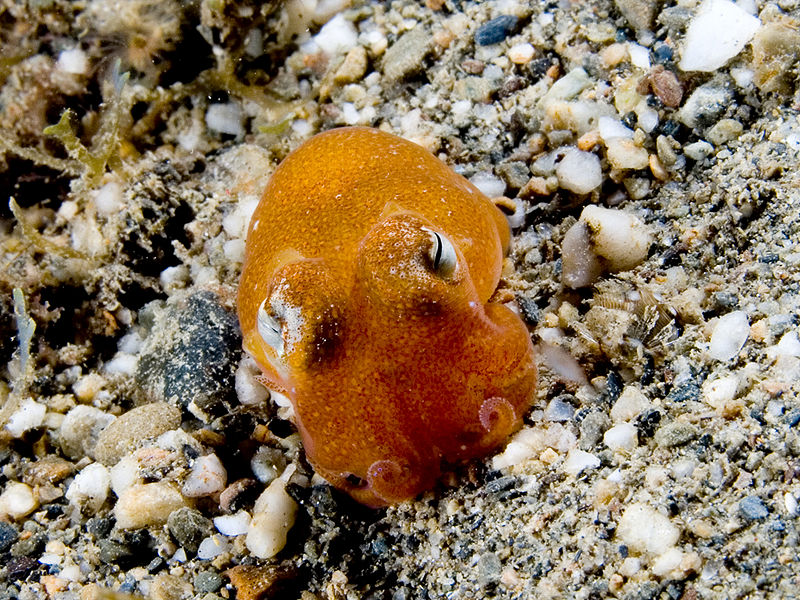
Euprymna scolopes
The Hawaiian Bobtail Squid is an itty bitty little thing that has a mantle length of only around one inch! As the name suggests, they can be found off of Hawaiian waters, though they also live in other shallow coastal areas of the central Pacific as well.

The most important thing that you need to know about the Hawaiian Bobtail Squid is has a symbiotic relationship with a bacteria known as Vibrio fischeri.

The bacteria inhabit an organ in the Squid's mantle. The Squid feeds the Bacteria a solution of amino acids and sugar, and in return for the meal the Bacteria gives the Squid a defensive advantage. You see, the organ that the Bacteria lives in deals with light, and the Bacteria itself is bioluminescent. The Bacteria are able to determine the amount of light hitting the top of the Squid's mantle, and then emulate that on the underside. This makes it very difficult to see the Bobtail Squid when looking upwards.

The Squids are not born with the Bacteria ready to go, they must acquire the little helpers by using an attractive mucus. At the end of the Squid's day, most of the Bacteria is expelled in order to conserve body energy.

Hawaiian Bobtail Squid feed on tiny crustaceans, and they themselves are preyed upon primarily by Monk Seals. Even if they are able to avoid the hungry Pinnipeds, the Bobtail Squids have very short lifespans, typically living only 3-10 months.

IUCN Status : Not Listed
Location : Pacific Ocean
Size : mantle length 1.2in (3cm)
Classification : Phylum : Mollusca -- Class : Cephalopoda -- Order : Sepiolida
Family : Sepiolidae -- Genus : Euprymna -- Species : E. scolopes

Thứ Hai, 26 tháng 9, 2011

Geomalacus maculosus
The Kerry Slug is a rare Slug that was first discovered in County Kerry, Ireland back in 1842. Since then they have also been found in parts of northern Spain and Portugal. They are medium sized slugs that are easy to identify by their spotted pattern.

The one thing that makes them stand out from other slugs is the fact that they aren't at all considered to be a pest. They are found only in wild areas, rather than in gardens. Their need for wild habitats in one of the reasons the slug has become so rare.

They are also distinctive because of their defensive behavior. When they feel threatened they roll up into a tight ball and unstick themselves from whatever they were holding on to. Other Slugs remain attached.

Kerry Slugs are protected in all of the locations that they are found in. Habitat loss and loss of some of their favorite foods (lichens and mosses) have been hurting the populations of the unique little slug. Protection, monitoring, and captive breeding of the species have helped to keep them going.

IUCN Status : Least Concern
Location : Ireland, Spain, Portugal
Size : Length up to 3.2in (8cm)
Classification : Phylum : Mollusca -- Class : Gastropoda -- Superfamily : Arionoidea
Family : Arionidae -- Genus : Geomalacus-- Species : G. maculosus

Thứ Hai, 8 tháng 8, 2011

Selonochlamys ysbryda
The Ghost Slug is a relatively new species to science, having only been discovered in 2006. Similar slugs had been previously found in Turkey and Georgia, so the discovery of this little guy in Wales was quite interesting! It's species name, S. ysbryda, means "ghost" in Welsh.

Ghost Slugs are interesting because unlike most other slugs, they are carnivores. These guys feed off worms, cutting them up with their teeth and sucking them down. They hunt at night and live underground, sporting pale white skin and no external eyes.

Ghost Slugs may have arrived in Wales via potted plants, as they have only been found in gardens and similar areas. It is still unknown if they are actually an alien species. Biologists are collecting information from residents to help them learn more about Ghost Slugs. An identification guide can even be found on their website.

IUCN Status : Not Listed
Location : Europe
Size : Length 2.5in (6.5cm)
Classification : Phylum : Mollusca -- Class : Gastropoda -- Superfamily : Parmacelloidea
Family : Trigonochlamydidae -- Genus : Selenochlamys -- Species : S. ysbryda

Thứ Sáu, 8 tháng 7, 2011

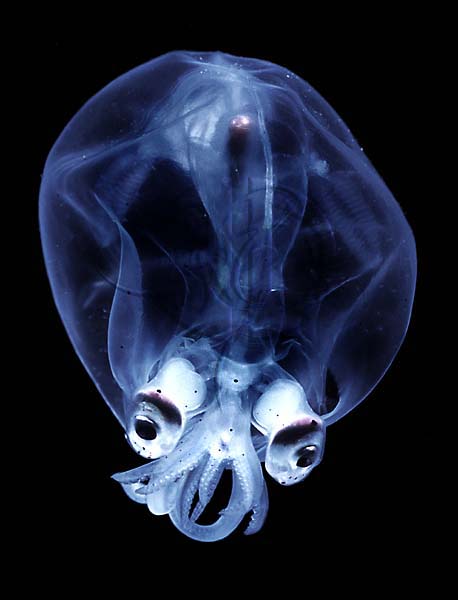
Teuthowenia pellucida
Sometimes, when I don't have any suggestions lined up, I start doing Google searches for weird animal names, just to see if they exist. Apparently there is no such thing as a  "Pumpkin Squid," but that near-futile effort did lead me to todays animal, the awesomely named Googly-Eyed Glass Squid.

There are about 60 different species of Glass Squid, all found within the Cranchiidae family. They can be found in oceans worldwide, and most share the common characteristic of having transparent bodies.

The Googly-Eyed Glass Squid is no exception to this. Their small bodies (females are slightly larger than males) are transparent, and they posses very large eyes which give them their common name. They live in the deep oceans, around 7,500ft (2300m) down.

Googly-Eyed Glass Squids have photophores on their tentacles and eyes that allow them to be bioluminescent. They also have the interesting ability to puff themselves up, making them seem much larger to predators.

IUCN Status :  Not Listed
Location : Southern Oceans
Size : Body length up to 8in (~200mm)
Classification : Phylum : Mollusca -- Class : Cephalopod -- Order : Teuthida
Family : Cranchiidae -- Genus : Teuthowenia -- Species : T. pellucida

Thứ Bảy, 28 tháng 5, 2011

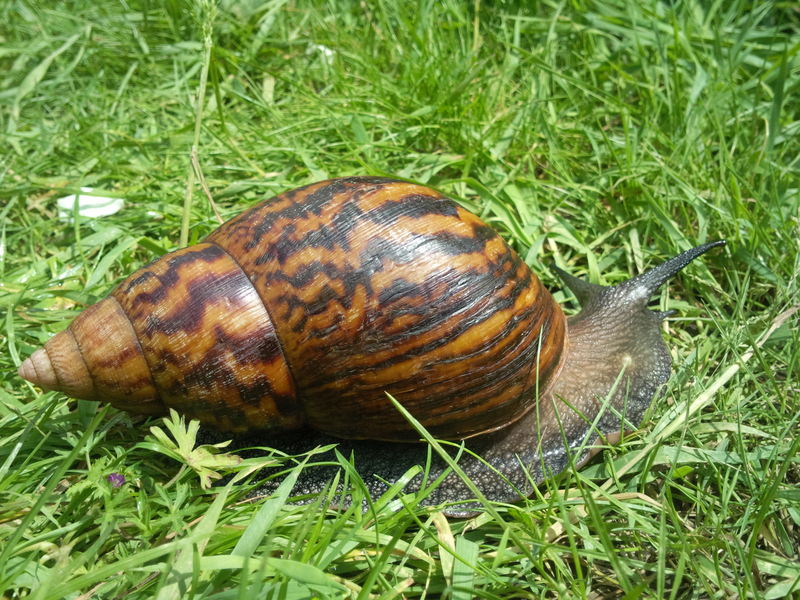
Achatina achatina
The Tiger Snail, also known as the African Giant Snail, is the largest land dwelling snail in the entire world. Some of the largest shells ever measured were a foot long! They are found in West Africa, and are kept as pets in some places of world. In their native Africa they are often harvested for food, due to their gigantic size.

Like many snails, the Tiger is hermaphroditic, though two snails are still required for breeding to take place. They can lay over a thousand eggs a year and live as long as ten years!

Tiger Snails are illegal to own or import in the United States. Why? Because of Achatina fulica. That species of snail, which is very similar to the Tiger Snail, is a horrible invasive species that feeds on and damages over 500 different plant types. Authorities have found and confiscated Tiger Snails at importation points, in an effort to keep a second huge invasive snail out of the country.

IUCN Status :  Not listed
Location : West Africa
Size : Shell length up to 1ft (30cm)
Classification : Phylum : Mollusca -- Class : Gastropoda -- Family: Achatinidae
Genus : Achatina -- Species : A. achatina

Thứ Bảy, 21 tháng 5, 2011

Spirula spirula
Today we have another reader suggestion, Spirula spirula, also known as the Ram's Horn Squid. As the suggester points out, the shell of this creature may look very familiar, but most people probably don't know that it belongs to a tiny, deep sea cephalopod!

The Ram's Head Squid can be found in tropical waters at depths as far as 3,300ft (1,000m). They are little things, with body lengths measuring only around 1.6in (40mm). The Ram's Head Squid has eight arms and two longer tentacles, all of which have suckers. Adults are able to partially draw them in to their mantle.
Internal Shell

The shell that we spoke up earlier is actually found completely within the squid, and it helps to control buoyancy.  Because of that mechanism the Squids swim in a head-down motion.

Ram's Head Squids only live about a year and a half, and a lot of their behavior is not well known due to their small size and deep sea living. We do know that they are carnivores, that they reproduce in a way similar to many other squids. Males use a a tentacle to implant a sperm sac on to the female.

IUCN Status :  Not listed
Location : Tropical Oceans
Size : Body Length up to 1.6in (40mm)
Classification : Phylum : Mollusca -- Class : Cephalopoda -- Order : Spirulida
Family : Spirulidae -- Genus : Spirula -- Species : S. spirula

Thứ Ba, 3 tháng 5, 2011

Hexabranchus sanguineus
When you think of Sea Slugs, you probably don't think about beautiful creatures, but the Spanish Dancer might just be an exception. These members of the Nudibranch order are named for their flowing shape that resembles the moving skirt of a Flamenco dancer!

Spanish Dancers are even beautiful in the way that they lay their eggs. They lay them in a ribbon shaped pattern that, when all assembled, looks like a red rose!

Strange beauty aside, Spanish Dancers are notable because they are one of the few Sea Slugs that can actually swim, albeit only for short distances. They do so by unfolding their wide mantles and undulating through the water. Spanish Dancers are also the largest of all Nudibranches.

Spanish Dancers are carnivores that often eat toxic prey that they are immune to like Sea Sponges and Portuguese Man-O-Wars. Consuming the toxic meals makes the Dancer itself toxic, creating a defense mechanism to keep them safe from their own predators. The "egg-roses" that the Spanish Dancers lay are also incredibly toxic, which keeps predators from eating the developing slugs.

IUCN Status : Not Listed
Location : Indian Ocean and Red Sea
Size : Length 16in (40cm)
Classification : Phylum : Mollusca -- Class : Gastropoda -- Order : Nudibranchia
Family : Hexabranchidae -- Genus : Hexabranchus -- Species : H. sanguineus