Hiển thị các bài đăng có nhãn Snail. Hiển thị tất cả bài đăng

Thứ Bảy, 24 tháng 11, 2012

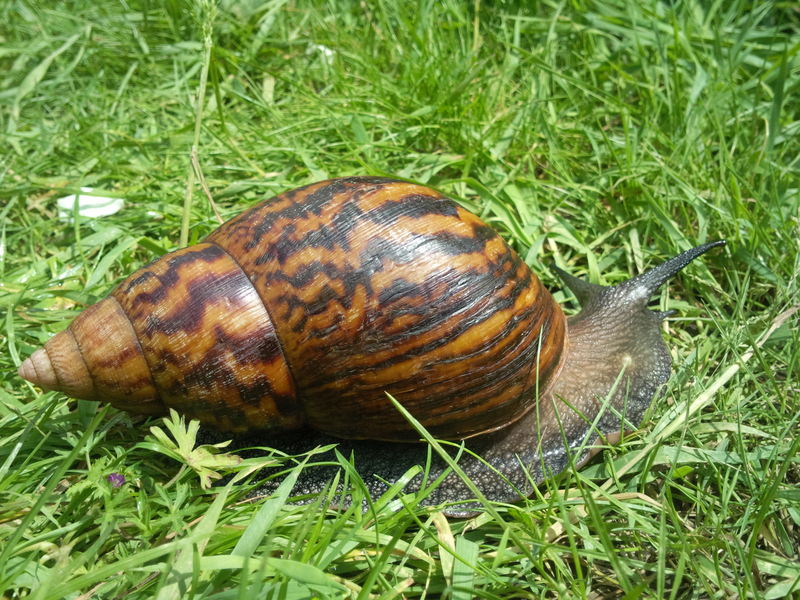
Achatina fulica
Meet a member of the invasive species club-- the Giant Afican Snail is considered one of the top 100 worst Invasive Species on the planet. Ant not only are they on the top 100 list, they actually sit at #2!

African Giant Snails are naturally found in East Africa, but they have spread to warm locations around the world in the last few decades. They are large snails (hence the name), sporting shells that can grow to nearly 8in in length. They reach maturity after about 6 months, and can live as long as ten years. During that time they never really stop growing.

They are a hermaphroditic species, possessing both male and female reproductive organs. They do not reproduce asexually-- they need another snail. But their interesting reproductive system makes it easier to multiply, since they do not need to track down a member of the opposite sex.

They feed on over 500 different species of plant, so you can see why they are considered to be such a nuisance! However, the African Giant Snail isn't just considered troublesome because it eats native plants. They also carry parasites that can cause Meningitis in humans, as well as other diseases that can severely damage the crops that they don't consume. In order to keep the invasive Snails in check, quarantines, pesticides, and even flame throwers have been used.

IUCN Status : Not Listed
Location : East Africa
Size : Length around 8in (22cm)
Classification : Phylum : Mollusca -- Class : Gastropoda -- Family: Achatinidae
Genus : Achatina -- Species : A. fulica
Thứ Bảy, 28 tháng 5, 2011

Achatina achatina
The Tiger Snail, also known as the African Giant Snail, is the largest land dwelling snail in the entire world. Some of the largest shells ever measured were a foot long! They are found in West Africa, and are kept as pets in some places of world. In their native Africa they are often harvested for food, due to their gigantic size.

Like many snails, the Tiger is hermaphroditic, though two snails are still required for breeding to take place. They can lay over a thousand eggs a year and live as long as ten years!

Tiger Snails are illegal to own or import in the United States. Why? Because of Achatina fulica. That species of snail, which is very similar to the Tiger Snail, is a horrible invasive species that feeds on and damages over 500 different plant types. Authorities have found and confiscated Tiger Snails at importation points, in an effort to keep a second huge invasive snail out of the country.

IUCN Status :  Not listed
Location : West Africa
Size : Shell length up to 1ft (30cm)
Classification : Phylum : Mollusca -- Class : Gastropoda -- Family: Achatinidae
Genus : Achatina -- Species : A. achatina

Thứ Tư, 20 tháng 4, 2011

Cypraea tigris
Tiger Cowries are one of the most abundant Molluscs in the Ocean, and their shells have been used by people all over the world, despite the fact that they are found only in the Indian and Pacific Oceans. But more on that later.

Underneath the shiny white, brown, and grey spotted shell lives a nocturnal snail that feeds off of algae. What makes Cowries especially interesting is that they have a mantle that they can spread over the surface of their shell. It keeps other, smaller creatures from sticking to them, and also keeps the shell clean, smooth, and shiny. They can draw the mantle into the shell if threatened.

Cowries and their shells have been used for a wide variety of human purposes. They have served as food, as currency, as decoration, as fishing lures, and as religious objects. Tiger Cowry shells, and other Indo-Pacific Cowries, were even found in Pompeii, far from their natural distribution. This just goes to show how far these objects were moved and traded.

IUCN Status :  Not Listed
Location : Pacific and Indian Oceans
Size : Length up to 6in (15cm)
Classification : Phylum : Mollusca -- Class : Gastropoda -- Order : Mesogastropoda
Family : Cypraeidae -- Genus : Cypraea -- Species : C. tigris

Thứ Năm, 17 tháng 6, 2010

Also known as the Burgundy Snail and the Edible Snail, Helix pomatia is probably most commonly known by its culinary moniker... Escargot. Now, these snails are not the only species that can become Escargot, but they are certainly one of the most traditional. Roman Snails have been picked up and eaten since well, Roman times, if not earlier. While they are found in all of continental Europe, it was the Romans who first brought the snails with them to England, were they can still be found, albeit rarely. These snails now have legal protection in the U.K.

Courtship image from The Living World of Molluscs
They are quite large, with body lengths of 4 inches and shells up to 2 inches in diameter. They are the largest land snails found in Europe. Roman Snails are hermaphroditic, meaning they are both male and female at the same time, and their courtship rituals are quite extensive. The process can last for hours as the snails circle around each other before touching their soles against one another. The young that hatch from the eggs look like miniature versions of their parents, but only a few will actually live to reach maturity at about two years. Roman Snails have the ability to hibernate, which allows them to live 10-15 years.

Roman Snails also have a substantial impact on decomposition within an ecosystem. They are able to assimilate high percentages of their food, and consume it very quickly, which assists in the aforementioned decomposition and break down.

Image from Wikimedia Commons
As previously mentioned, Roman Snails are rare and have legal protection in the United Kingdom. They are also scarce and protected in other areas as well, including France. Ever since snail consumption became fashionable in the 19th century the population has reached endangered levels. The culinary tradition is only able to continue due to established Snail farms and importation from countries where the numbers are higher.