Hiển thị các bài đăng có nhãn Turtle. Hiển thị tất cả bài đăng

Thứ Năm, 24 tháng 4, 2014

Geochelone elegans
It doesn't require a huge imagination to figure out where the name "Star Tortoise" comes from. These reptiles have carapaces that are predominantly dark with a lighter, starburst-type pattern.

You'll find these fancy Turtles in the drier regions of India, including scrub forests, semi-deserts, and arid grasslands. They are most active during the early morning and late afternoon hours, when they spend time foraging for flowers, grasses, and leaves.

During mating season, which coincides with the rainy season, males will fight one another for mates. During these matches they will shove back and forth and attempt to flip their rival over on to his back. The last one literally standing wins. After mating, the females will dig a hole and lay her eggs-- each season she can produce up to 10 clutches of up to a dozen eggs each. Those eggs can take anywhere from 1.5 to 6 months to hatch (depends on the weather conditions) and the young Tortoises are totally on their own from the start.

IUCN Status : Least Concern
Location : India
Size : Length around 10in (25cm)
Classification : Phylum : Chordata -- Class : Sauropsida -- Order : Testudines
Family : Testudinidae -- Genus : Geochelone -- Species : G. elegans
Image :  CBurnett

Thứ Ba, 25 tháng 2, 2014

Chelydra rossignonii
Until recently (about 1996), everyone thought that the Central American Snapping Turtle, and its cousin the South American Snapping Turtle were just subspecies of the more widespread and well-known Common Snapping Turtle. But they are different species entirely! (Albeit of the same genus).

As you can probably guess, this particular Turtle lives in the countries of Central America, inhabiting slow moving bodies of water.

These Snappers are solitary animals, and they are nocturnal, which means much is still unknown about their specific behaviors and biology. They are omnivores though, and they feed on different fish, insects, and plant matter. They actually have little barbels around their mouth that they use to lure in prey... and then quickly snap it up.

Central American Snapping Turtles are listed as Vulnerable due to hunting and habitat loss. Theya re now protected in parts of their range, but enforcement is spotty.

IUCN Status : Vulnerable
Location : Central America
Size : Carapace length around 14in (36cm), Weight around 26lbs (12kg)
Classification : Phylum : Chordata -- Class : Reptilia -- Order : Testudines
Family : Chelydridae -- Genus : Chelydra -- Species : C. rossignonii
Image : Leo7

Chủ Nhật, 21 tháng 4, 2013


Heosemys spinosa
The Spiny Turtle, also known as the Sunburst Turtle, is a land-dwelling Turtle named for the pointed spikes that extend outward from the rim of their carapace. These spines are much more pronounced in juveniles, and as adults they are most noticeable on the rear of the shell.

Spiny Turtles live in the hilly rainforests of Southeast Asia. They live relatively close to bodies of water, and feed mainly on plants and fruits. Interestingly, we know next to nothing about their wild breeding habits. In captivity it appears that breeding is triggered by the rainy season, and that the females will lay only two or three eggs per clutch. But we don't know the exact nuances of their reproductive process when left in a wild habitat.

Sadly, the Spiny Turtles are listed as endangered. They have been hunted extensively for their meat, and currently their populations are very small and are typically isolated from one another. Very little is being done to conserve the species. Unfortunately, they are also very difficult to breed in captivity.

IUCN Status : Endangered
Location : Southeast Asia
Size : Body length around 10in (24cm)
Classification : Phylum : Chordata -- Class : Sauropsida -- Order : Testudines
Family : Geoemydidae -- Genus : Heosemys -- Species : H. spinosa
Image : Ecology Asia

Chủ Nhật, 14 tháng 4, 2013

Natator depressus
The Flatback Sea Turtle is the only member of its genus, Natator, which means "swimmer." Combine that with the species name, depressus, which is derived from "flat," and you get a pretty accurate description of the creature! They are close to a meter in length, with very flat, smooth, grey carapaces.

Flatback Sea Turtles live only in the waters between New Guinea and the northern coast of Australia, where they hunt for squid, mollusks, and other invertebrates. However, they exclusively breed in Australia, nesting on beaches on the continent and on coastal islands.

Speaking of nesting, the Flatback Sea Turtles are distinct among their kind because they lay larger eggs than their cousins, though they also lay a much lower number. For example, the Green Sea Turtle can lay up to 200 eggs at a time. The Flatback lays only 50.

These Turtles are listed as vulnerable by local governments, but the IUCn lists them as data Deficient because the species is so difficult to accurately survey. As with other Sea Turtles, the Flatbacks are affected by habitat loss, climate change, and pollution.

IUCN Status : Data Deficient
Location : Australia, New Guinea
Size : Carapace length up to 35in (.9m)
Classification : Phylum : Chordata -- Class : Reptilia -- Order : Testudines
Family : Cheloniidae -- Genus : Natator -- Species : N. depressus
Image : Marine Bio

Thứ Tư, 9 tháng 1, 2013

Gopherus agassizii
Today's animal gets its name from 19th century Swiss-American naturalist Jean Louis Rodolphe Agassiz, and it can be found in the desert areas of the Southwest United States (they are even the state reptiles of both California and Nevada). They can actually live in incredibly hot areas that reach over 140 degrees F, due to their ability to burrow underground to escape the extreme heat.

Agassiz's Desert Tortoises measure about 14in long, and males are slightly larger than females. Interestingly,t he two sexes also have slightly different shell shapes. Males have inward curved at the rear of the carapace, while females have outward curves. This is so that the males can stand upright against the female in order to successfully mate. Males will also fight each other during each breeding season in order to establish reproductive rights, and the Tortoises will have numerous different mates over their 30 to 50 years of life.

Sadly, these Tortoises are listed as Vulnerable (partially) because of decline caused by human activities. Military, agricultural, and urban development have all caused a loss in habitat. Development has not just taken up their habitat, but it has introduced excess predators. Ravens are major predators of Desert Tortoise eggs and hatchlings, and there are more of these birds around due to human land development.

There area number of illnesses that have also affected these Tortoises. Upper respiratory tract disease has been plaguing the population since the 1970s, and  is a chronic, infectious condition. Furthermore, a shell disease called Cutaneous dyskeratosis is also found in the population.

IUCN Status : Vulnerable
Location : Southwest United States
Size : Length up to 14in (36cm)
Classification : Phylum : Chordata -- Class : Sauropsida -- Order : Testudines
Family : Testudinidae -- Genus : Gopherus -- Species : G. agassizii

Thứ Bảy, 5 tháng 1, 2013

Platysternon megacephalum
You may be surprised to find out that the Big-headed Turtle actually isn't that large when compared to other Turtles. Their heads are just proportionally larger than the rest of their bodies (their carapaces measure only about 8in across). In fact, their heads are so large that they cannot retract them into their shells! The translation of their species name, megacephalum, or "big head," is quite appropriate.

This unusual looking Turtle is found in the fast-flowing mountain streams of China and Southeast Asia. They are actually very poor swimmers, but are excellent at climbing and grasping on to rocks. They feed during the nighttime on various underwater animals, clinging to the stream bed to move and hunt.

Sadly, the Big-headed turtle is listed as Endangered. This is because illegal hunting and collection for the pet trade have dropped their numbers significantly. Though they are legally protected in some parts of their range, the illegal capture continues, making the Turtles even more rare and thus more valuable on the black market. If the trend continues in this way they could quickly become extinct in the wild.

IUCN Status : Endangered
Location : Southeast Asia
Size : Carapace length up to 8in (20cm)
Classification : Phylum : Chordata -- Class : Reptilia -- Order : Testudines
Family : Platysternidae -- Genus : Platysternon-- Species : P. megacephalum

Thứ Tư, 3 tháng 10, 2012

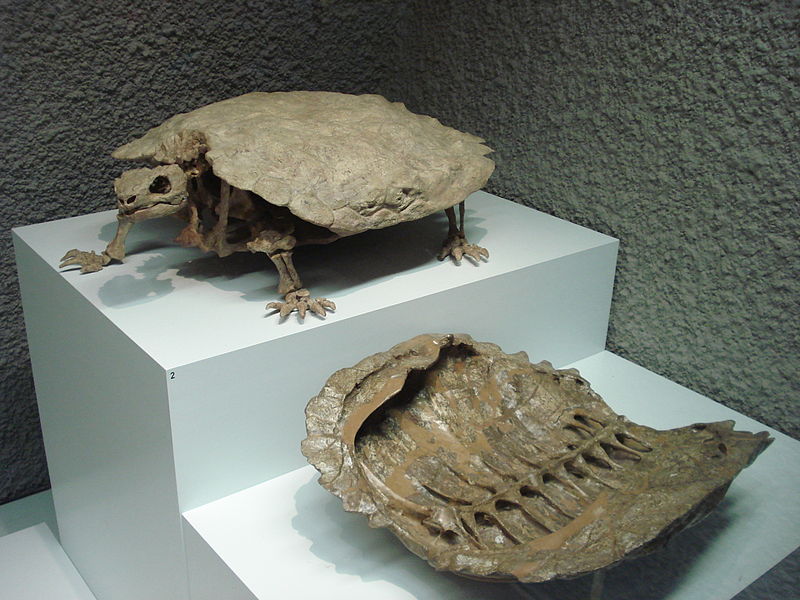
Colossochelys atlas
In the past we have learned all about the massive prehistoric Sea Turtles that once swam the world's oceans, but we have yet to talk about what is possibly the largest land Turtle ever discovered. This creature is even larger than the Galapagos and Aldabara Tortoises-- it had a shell that could grow nearly 7ft long!

The appropriately named Atlas Tortoise lived during the Miocene and Pleistocene periods, and its fossils have been found in India, Pakistan, and Thailand. There is also speculation that they lived as far west as southern Europe. Like their closest modern relatives, they were slow moving, plant eating herbivores.

The Atlas Tortoise probably looked very similar to the Galapagos Tortoise, just longer, taller (nearly 6ft!), and heavier. Their massive, 1,000kg+ bodies were supported by thick, sturdy legs that could, along with the head, retract into the shell when threatened.

There is some controversy about the classification of this species, and it has gone by many names. When first discovered and named back in 1837, they were called Megalochelys sivalensis. Their current name was bestowed in 1844, but was flip flopped around to both Geochelone atlas and Testudo atlas, before coming back to the Colossochelys genus again. It is still sometimes referred to by all four of those genus names, confusing!

Status : Extinct since the Pleistocene (around 1 million years)
Location : South Asia
Size : Shell Length up to 7ft (2.5m)
Classification : Phylum : Chordata -- Class : Reptilia -- Order : Testudines
Family : Testudinidae -- Genus : †Colossochelys -- Species : † C. atlas

Thứ Tư, 22 tháng 8, 2012

The Archelon type specimen
I love covering extinct Turtles because they have such an interesting evolutionary history. Turtles have been around since the Triassic, dating back 220 million years. They've even had roughly the same body shape for the last 200 million of those years, with modifications being made to their teeth (losing them), their shells (going from soft to hard) and their size (varies completely!)

Today's Turtle, Archelon, definitely had a unique size. These giant Sea Turtles grew to be 12 feet long! Archelon lived during the late Cretaceous Period, and its fossils have been found primarily in South Dakota and Wyoming, which were once covered by shallow seas.

Once you get past its car-like size, you'll notice that Archelon did look quite a bit like our modern Sea Turtles. In fact, its closest living relative is the large (but not that large) Leatherback Sea Turtle. In fact, like the Leatherbacks of today, Archelon probably ate jellyfish and other soft-bodied sea creatures like squid.

Archelon did have two major differences though. The first was that its shell wasn't hard-- it was actually soft and leathery and supported by an internal bone structure. Secondly, they had remarkably broad, paddle-like flippers (modern Sea Turtles also have long flippers, but they are not nearly as broad proportionally).

They died out at the end of the Cretaceous Period, around 65 million years ago, and no Turtle since has come close to rivaling it in size!

Status : Extinct for 65 million years
Location : North America
Size : Length around 12ft (3.6m), Weight up to 2tons
Classification : Phylum : Chordata -- Class : Reptilia -- Order : Testudines
Family : †Protostegidae -- Genus : †Archelon -- Species : A. ischyros

Thứ Sáu, 27 tháng 7, 2012

Palea steindachneri
Wow, this week is becoming an unofficial Mascarene Islands theme week, and sort of by accident too! I came across today's animal while browsing around a site that listed the reptiles and amphibians of Hawaii. I zeroed in on a Softshell Turtle, as they are very interesting looking creatures... and what do you know, they've been introduced to Mauritius!

And though I found the animal in a Hawaiian context, they aren't native Hawaiians. The Wattle-necked Softshell Turtles are actually native to Vietnam and southern China, and were introduced to islands elsewhere. Interestingly, most of what we know of their biology and behavior comes from those Hawaiian individuals.

Wattle-necked Softshell Turtles belong to an entire family of Softshell Turtles, Trionychidae, but they are the only species in their genus. Like their cousins, they have flat shells covered with leathery skin rather than bony scutes. They also have long, retractable necks that have wattle clusters around the base (hence the name).

Unfortunately, like many other Softshell Turtles, the Wattle-necked Softshell Turtle is Endangered. This is due in part to their desirability in the food trade in Asia. Captive breeding farms have been set up to keep the wild Turtles from being hunted. But those farms may actually be hurting the Turtles, as they make the food more popular. The introduced populations in Hawaii and Mauritius may some day be the only populations left.

IUCN Status : Endangered
Location : Southeast Asia, Hawaii, Mauritius
Size : Length up to 10in (25cm)
Classification : Phylum : Chordata -- Class : Reptilia -- Order : Testudines
Family : Trionychidae -- Genus : Palea -- Species : P. steindachneri

Thứ Ba, 24 tháng 7, 2012

Cylindraspis peltastes
There were five different Tortoise species within the Cylindraspis genus:
  • Cylindraspis indica - Réunion giant tortoise
  • Cylindraspis inepta - Saddle-backed Mauritius giant tortoise
  • Cylindraspis peltastes - Domed Rodrigues giant tortoise
  • Cylindraspis triserrata - Domed Mauritius giant tortoise
  • Cylindraspis vosmaeri - Saddle-backed Rodrigues giant tortoise
All five have been extinct for around 200 years.

The Cylindraspis Tortoises were once found on the Mascarene Islands of Rodrigues, Réunion, and Mauritius (home of the Dodo). This small group of islands is located in the Indian Ocean, off the coast of Madagascar. They were first discovered by Europeans in 1507, and were colonized around a century later. When humans arrived, the Tortoises were abundant across the island chain, but within 100 years they were almost completely wiped out. A few decades after that they were gone entirely.

How and why did this fast extinction happen? Well, it is a story very similar to that of one of their more famous island neighbors-- the Dodo. These Tortoises were very large, and very slow moving. This made them easy targets for hunting, much like the Dodo. The Tortoises also required very little food and maintenance, which made them ideal creatures to take on boats as a food supply.

Some of the species saw a decline faster than others (the Réunion Giant Tortoise was nearly gone by 1730, for example). Most were eliminated by 1800, with the last individuals dying out by 1840.

Sadly, the Cylindraspis Tortoises are not the only island turtles to be negatively affected by humans, and even the popular Galapagos Tortoises have faced extinction (some subspecies are gone entirely). Hopefully modern conservation measures and learning from the past can prevent more Tortoises from going the way of the today's animals.

IUCN Status : Extinct by 1840
Location : Mascarene Islands
Size : Varies
Classification : Phylum : Chordata -- Class : Reptilia -- Order : Testudines
Family : Testudinidae -- Genus : †Cylindraspis

Thứ Tư, 11 tháng 7, 2012

Chelodina longicollis
It's easy to see where this animal gets its name-- the Eastern Long-necked Turtle has a neck that can be nearly as long as their carapace! These necks are so long that they aren't pulled directly back into the carapace. They bend in sideways.

These Australian natives have flat carapaces that grow to around 8in in length and are colored in shades that range from black to brown to green. Their undersides (plastrons) are cream colored with very distinctive black lines.

You can find these Turtles living in slow moving freshwater streams and ponds. They have powerful webbed feet that allow them to dig and swim with ease, and they spend a good deal of time basking on rocks and logs. In the wild Long-necked Turtles are 100% carnivorous, feeding on insects, mollusks, tadpoles, fish, and other small creatures. When the Turtles themselves feel threatened, they secrete a stinky fluid from their musk glands. This gives them one of their other common names-- "Stinker."

Eastern Long-necked Turtles can be kept as pets, but they require a good deal of space, as well as a long commitment. These guys can live for decades!

IUCN Status : Least Concern
Location : Australia
Size : Carapace length around 8in (20cm)
Classification : Phylum : Chordata -- Class : Sauropsida -- Order : Testudines
Family : Chelidae -- Genus : Chelodina -- Species : C. longicollis

Thứ Bảy, 19 tháng 5, 2012

Proganochelys quenstedti
Poor Proganochelys. For over 100 years it was the oldest turtle species ever discovered. its fossils dated back 210 million years! ...And then Odontochelys was found in 2008 with fossils 10 millions years older... and ruined that "oldest" distinction. Ah well, such is science! I'm sure even Odontochelys will be dethroned at some point; we still have such much to learn about the Earth's past.

Proganochelys fossils have been found in Germany and Thailand, and they show that this was a creature around 1m long. They look remarkably like the turtles that we have today, and even shed some light on how turtle got to be how they are.

Since it already has its shell, Proganochelys doesn't teach us much about shell evolution (Odontochelys helped a bit with that though!). It does, however, demonstrate how turtles lost their teeth very on in their evolutionary development. and it also has the large ear opening that is also found in modern turtles.

One big difference between Proganochelys and modern turtles is the retractability of the head. Our ancient friend simply could not do such a thing. But! They did have small spines on the neck to protect themselves with. Another cool difference? A spiny, clubbed tail!

Status : Extinct, lived around 210 million years ago.
Location : Germany, Thailand
Size : Length up to 3.3ft (1m)
Classification : Phylum : Chordata -- Class : Sauropsida -- Order:  Testudines
Family : Proganochelidae -- Genus : Proganochelys -- Species : P. quenstedti

Thứ Sáu, 13 tháng 4, 2012

Stigmochelys pardalis
The Leopard Tortoise, sometimes also referred to as the African Leopard Tortoise is a large, colorful species of reptile that can be found throughout the grassland and semi-arid regions of the African continent. They also happen to be popular in the pet industry.

What blows my mind about keeping these guys as pets is that they can grow to be over 2ft long! One typically thinks of pet reptiles as living in small little terrariums, but not these Tortoises! They are actually best kept in large outdoor pens in very warm, dry areas. And have I mentioned that they can live more than 50 years? That is a lifetime pet commitment right there!

While we're discussing size, I should also note that these are the fourth largest Tortoises in the entire world, and can weigh more than 50lbs. Surprisingly, even with all that weight, Leopard Tortoises are pretty good at getting around. They have small claws on their front feet that give them good maneuverability over bumpy terrain, and young Tortoises have even been observed making vertical climbs!

Leopard Tortoises are not listed by the IUCN, but pet industry demands have affected their wild numbers in some areas. It has been illegal to import them into the United States since 2000, which is definitely a good thing. Wild-caught Leopard Tortoises do not adjust well in captivity, carry several different parasites, and those that live often need a substantial amount of rehabilitation. Thankfully there are now captive breeders to supply those who feel that a giant long-lived Tortoise is the right pet for them.

IUCN Status : Not Listed
Location : Africa
Size : Body length around 18in (45cm)
Classification : Phylum : Chordata -- Class : Sauropsida -- Order : Testudines
Family : Testudinidae -- Genus : Stigmochelys-- Species : S. pardalis

Thứ Sáu, 2 tháng 3, 2012

Odontochelys semitestacea
Odontochelys is an extinct animal that was only just recently discovered (2008). It is pretty darn remarkable find, and represents the earliest Turtle that we know about.. it dates back to the Early Triassic over 220 million years ago!

Odontochelys is a transitional reptile. It shares many characteristics with modern turtles, but also demonstrates traits found in earlier reptiles. It has a plastron, which is the under part of a turtle's shell, but it has no carapace! It also has a turtle-like beak, but there are teeth inside it!

The find is helping scientists figure out how turtles evolved. The previous-oldest-fossil already had a carapace, so discovering a species without one gives clues as to where the shell actually came from. One theory is that shells came from the fusion of osteoderms, which are bony plates of armor in the skin. But Odontochelys has no osteoderms, yet it still has a plastron.

The other theory, which is now looking better, is that the plastron grew first (presumably to protect the aquatic turtles from underside attacks). Once the plastron was in place the turtles eventually evolved extensions from their ribs and backbone that fused together to form a full shell. However, it will be difficult to determine for sure until more transitional fossils are uncovered.

Status : Extinct for around 220 Millions Years
Location : China
Size : Length up to 9.5in (24cm), Weight up to 4.5lbs (2kg)
Classification : Phylum : Chordata -- Class : Sauropsida -- Order : Testudines
Family : †Odontochelyidae -- Genus : †Odontochelys-- Species : †O. semitestacea

Thứ Hai, 6 tháng 2, 2012

The Olive Ridley Sea Turtle is one of the smaller Sea Turtles; they have a carapace length of around 2ft. They also have the distinction of being the most abundant Sea Turtle on the planet, with about 800,000 females coming ashore to nest annually.

Lepidochelys olivacea
Olive Ridleys, named for their olive coloration, have a very large distribution and can be found in tropical waters around the world. They are a migratory pelagic Turtle, but they also can be spotted in coastal regions as well.

Olive Ridley Sea Turtles exhibit one of the most interesting nesting habits in the world. Once or twice a year, in waves triggered by some unknown event (Lunar Cycles? Wind? No one knows for sure), thousands of female Turtles come ashore in events called Arribadas. Each turtle lays around 100 eggs, and sometimes there are so many Turtles that they actually dig up previously laid nests in order to deposit their offpspring! One beach in India saw 200,000 females at a single event!

Despite the large population number, Olive Ridley Sea Turtles are considered to be Vulnerable by the IUCN. This is because the selected survey sites have shown a population decline over the last 2-3 generations. The Marine Turtle Specialist Group actually reports a 50% decline since the 1960s. The Olive Ridleys are at risk due to hunting, egg harvesting, bycatch, and habitat degradation. So while they are the most abundant of the Sea Turtles, they are also one of the most exploited. The Turtles are currently protected by numerous agreements and treaties, including CITES I.

IUCN Status : Vulnerable
Location : Tropical waters worldwide
Size : Carapace Length up to 28in (70cm)
Classification : Phylum : Chordata -- Class : Reptilia -- Order : Testudines
Family : Cheloniidae -- Genus : Lepidochelys -- Species : L. olivacea

Thứ Hai, 29 tháng 8, 2011

Geochelone sulcata
After the Galapagos and Aldabra Tortoises, the African Spurred Tortoise takes the title as third largest in the world. These land giants dwell in drier regions of central and northern Africa where they subsist on a diet of fruits and vegetables. During the driest times of the year, the Tortoises build burrows and enter states similar to hibernation in order to keep from dehydration.

Breeding occurs during rainier parts of the year, and males will fight for the right to breed with females. During the copulation itself, females will be unable to move due to the weight of the male Tortoises. About two months after mating the female will dig a large nest and deposit 15-30 eggs into. They will incubate for an additional 8 months before the 2" hatchlings emerge. It will take the Tortoises fifteen years to reach sexual maturity. But, like their large Tortoise cousins, they can live over 100 years.

African Spurred Tortoises have experienced some drastic population drops. They've been losing their habitats due to urbanization and the spread of livestock, and have also been hunted for meat. African Spurred Tortoises are also collected for the pet trade when they are in their younger years. This makes re-population difficult, as they take so long to mature.

IUCN Status : Vulnerable
Location : Africa
Size : Length up to 36in (90cm), Weight up to 200lbs (91kg)
Classification : Phylum : Chordata -- Class : Sauropsida -- Order : Testudines
Family : Testudinidae -- Genus : Geochelone -- Species : G. sulcata

Thứ Tư, 6 tháng 7, 2011

Terrapene carolina
The Eastern Box Turtle is quite common throughout its range in the eastern United States. In fact, they are the most abundant species of terrestrial turtle in that part of the Country.

Box Turtles are named for their hinged plastrons, (the bottom part of the shell) which allows them to draw in their arms and head and close up completely to stay safe from predators.

Eastern Box Turtles are most active at dawn and dusk, and spend their days cooling off in logs and mud. They also will enter pools of water during the warmest weather, despite the fact that they are a terrestrial species. In the northern parts of their range, the Eastern Box Turtle hibernates during the winter.

Mating for Eastern Box Turtles can take place at any time between April and October. What is quite remarkable about their mating process is that a female can store up the sperm and lay the eggs up to four years later!

IUCN Status :  Vulnerable
Location : Eastern United States
Size : Body length up to 6.5in (16.5cm)
Classification : Phylum : Chordata -- Class : Reptilia -- Order : Testudines
Family : Emydidae -- Genus : Terrapene -- Species : T. carolina

Thứ Hai, 23 tháng 5, 2011

Dermochelys coriacea
Did you know that today is World Turtle Day, an event created in 2000 to bring attention to Turtles and Tortoises? In honor of today I'll be doing my own part to inform and educate about one of the world's most endangered Turtle species, the Leatherback Sea Turtle.

Leatherback Sea Turtles are the largest of all the turtle species, one individual was weighed to 2,020lbs (915kg)! They are a pelagic species that can be found in waters around the world, and they make extensive migrations between their feeding and breeding grounds. These incredible turtles have the distinction of having the largest distribution of any reptile, and belong to a family that dates back over 100 million years!

Hatchlings crawl towards the sea
Leatherbacks are also distinctive because unlike most other Turtles, they do not have a hard, bony shell. Their back is actually quite flexible and rubbery feeling, and covered in ridges that make them more hydrodynamic. Leatherbacks can dive down as far as 4,200ft (1,280m), which is also a record for Turtle species. As adults, they feed almost entirely on Jellyfish.

Unfortunately, the Leatherback Sea Turtle is at risk. Egg collection for food and medicine damages their breeding numbers, and the Turtles also find themselves victims of boats and oceanic pollution. They are protected by several different acts, but their large distribution is troubling, as there are so many countries that must make an effort to save the species. Leatherbacks are doing better in the Atlantic ocean due to extensive nest protection, but the Pacific population is still struggling from hunting and habitat loss.

IUCN Status :  Critically Endangered
Location : All oceans worldwide, except Arctic and Antarctic waters
Size : Body Length up to 7ft (2.1m), Weight up to 2,000lbs (907kg)
Classification : Phylum : Chordata -- Class : Sauropsida -- Order : Testudines
Family : Dermochelyidae -- Genus : Dermochelys-- Species : D. coriacea

Thứ Tư, 30 tháng 3, 2011

Black Softshell Turtle
Phylum : Chordata
Class : Reptilia
Order : Testudines
Family : Trionychidae
Genus : Aspideretes?
Species : A. nigricans

IUCN Status : Extinct in the wild

Like the Yangtze Soft-shell Turtle, the Black Softshell Turtle is also extremely rare, so rare that they are listed as being extinct in the wild. There are between 150-300 living in a man-made pond at the Hazrat Sultan Bayazid Bastami Shrine in Chittagong, Bangladesh, and it is believed that there is one other small population in Assam, India.

The Turtles at the shrine are protected, and cannot be killed or harvested. It is believed that the Turtles are actually connected to the saint. Pilgrims offer food to the turtles, and females nest in protected, walled off areas. They lay up to 40 eggs at a time which take around 100 days to hatch.

Not much else is known about these turtles and their historical habitats or wild behaviors. They were already living near exclusively in the shrine when they were first described in 1875.

Chủ Nhật, 27 tháng 3, 2011

Kleinmann's Tortoise
Phylum : Chordata
Class : Sauropsida
Order : Testudines
Family : Testudinidae
Genus : Testudo
Species : T. kleinmanni

Length : 4.5in (11.5cm)

IUCN Status : Critically Endangered

Kleinmann's Tortoises are also referred to as Egyptian Tortoises, though sadly they are completely extinct in Egypt. Small populations still live in desert and semi-arid areas of Libya and a few other nearby areas.

When we last visited the world of the Tortoises, we looked at the Speckled Padloper Tortoise, the smallest tortoise in the world. Kleinmann's Tortoises are the smallest Tortoises in the Northern Hemisphere, and the second smallest overall in the world.. They are easy to identify due to their small size, high carapaces, and dull yellow shells. They also have two very distinct dark triangular marks on their plastrons.

Kleinmann's Tortoises have seen their populations fragmented due to habitat loss. Their small size has also made them incredibly popular in the pet trade, and thousands of them were taken in the past few decades. It is estimated that there are only 7,500 left. The species is protected in Egypt, but not in Libya, where most of the wild individuals still live.