Hiển thị các bài đăng có nhãn Pinniped. Hiển thị tất cả bài đăng

Thứ Tư, 2 tháng 4, 2014

Omnatophoca rossii
The Ross Seal is one of the least studied Seal species native to the pack ice of Antarctica. They are less common overall than the Weddell and Leopard Seals, and because they tend to live alone they have a very low population density.

Ross Seals are also smaller in size than many other their cousins. They rarely grow larger than 2m in length, which is as much as 5ft shorter than the Leopard Seals. They do, however, have incredibly large eyes. In fact, their genus name, Omnatophoca roughly translates to "Eye Seal," because they can grow up to 7cm in diameter!

Another interesting anatomical feature of the Ross Seal is its voice. They can create some really interesting siren-type noises, both on land and underwater. Because these noises carry for long distances, scientists believe that the Seals use them to either locate other Seals, or to warm them away from their territory.

Ross Seals are listed as being of Least Concern, but because they are uncommon and not well studied we don't really know much about their population size or its trends. Estimates suggest anywhere from 100,000-250,000 individuals.

IUCN Status : Least Concern
Location : Antarctica
Size : Length up to 6.6ft (2m), Weight up to 450lbs (204kg)
Classification : Phylum : Chordata -- Class : Mammalia -- Order : Carnivora
Family : Phocidae -- Genus : Ommatophoca -- Species : O. rossii
Image :  Dave Buller

Thứ Ba, 25 tháng 3, 2014

Leptonychotes weddellii
For the last week or so we've been learning about animals that live in mountain rainforests. This week let's totally mix it up and move to a completely different ecosystem and location entirely-- Antarctica.Our southernmost continent doesn't harbor a ton of year-round terrestrial life, but it is the migratory home of several different birds, and it is surrounded by waters that are teeming with life of all types.

The Weddell Seal is one of those marine animals that makes Antarctica its home. These large, docile mammals live further south than any other Seal, and they tend to stick close to home-- most never move more than a few miles from where they were born.

Weddell Seals take advantage of the rich waters surrounding Antarctica. They hunt Cod, Silverfish, Octopus, Crab, and many other sea creatures. While searching for food they can dive as far as 2,000ft, and stay under for 45 minutes. An adult Weddell Seals eats anywhere from 20-110lbs of food every day!

You'd think a 10ft, 1,000lb mammal would be near the top of the food chain-- but Weddell Seals have predators of their own! Orcas and Leopard Seals love to track them down, so they have to be careful while fishing and especially while raising their young. Little Weddell Seals grow fast-- they can swim at 2 weeks -- but they aren't weaned or able to hunt on their own for another month after that.

IUCN Status : Least Concern
Location : Antarctica
Size : Length up to 10ft (3m), Weight around 1,100 lbs (500kg)
Classification : Phylum : Chordata -- Class : Mammalia -- Order : Carnivora
Family : Phocidae -- Genus : Leptonychotes -- Species : L. weddellii
Image :  NOAA

Thứ Tư, 5 tháng 2, 2014

Though it may not look like it, the animal in that picture-reconstruction is an ancestral Seal! Yes, Seal! The finned, sleek bodied ocean mammals! In fact, it is the most ancient Seal ever found.

Puijila darwini was only discovered in 2007, so it is a pretty recent find. Amazingly, only one fossil has been uncovered so far-- but the skeleton was almost totally complete! It was found in Nunavut, Canada.

Puijila lived a semi-aquatic carnivorous lifestyle. It had webbing on all four feet, and swam by paddling through the water. It is an interesting fossils not just because it is the most primitive Seal known, but also because it is an example of a transitional species. All land animals evolved from sea-dwelling creatures, and Seals and Whales are examples of mammals that returned to the sea. Puijila was a step between fully land-dwelling Carnivore and the eventual ocean-dwelling Pinnepeds.

Status : Extinct, lived 21-24 million years ago
Location : Canada
Size : Length up to 3.3ft (1m)
Classification : Phylum : Chordata -- Class : Mammalia -- Order : Carnivora
Suborder : Pinnipedimorpha -- Genus : Puijila -- Species : P. darwini
Image : Smokeybjb

Thứ Sáu, 25 tháng 10, 2013

New Zealand Sea Lions, also sometimes called Hooker's Sea Lions, are the rarest and most vulnerable Sea Lions in the world. It is estimated that only 10,000 still remain, no thanks to decades of human hunting, being scooped up as bycatch for the commercial fishing industry, and bad-luck natural disasters.

Phocarctos hookeri
As the name states, these Sea Lions are found in New Zealand, specifically near the southern, aubantarctic islands. In fact, nearly the entire populations breeds at three colony sites on the Aukland Islands.

Breeding takes place from November to February. The males come ashore first to stake out spots, with the largest, strongest males claiming the most territory and the most number of mates. (Males can grow twice as large as females, if not bigger) Females (who are usually pregnant) arrive soon after. They give birth to a pup, and then breed again 1-2 weeks after.

One standout fact is that during this entire breeding season, the males do not feed. Females return to the water to bring food back for themselves and their growing pups, but the males risk losing their territory if they leave. This is another reason why the largest males tend to be more successful-- they have greater fat stores to sustain them during the summer.

New Zealand Sea Lions are listed as Vulnerable, and their are a handful of actions being taken to keep them safe. Their breeding grounds are now protected, hunting has been banned, and work is being done to prevent them from being captured in fishing nets. Unfortunately, disease has also stricken the Sea Lions-- several different bacterial diseases have spent through the colonies in the past 20 years. The worst, in 1998, killed 53% of all newborns and 20% of breeding females. There is a bright side though-- births in 2013 were the highest they had been in 5 years, and Sea Lions are starting to breed again on islands that had long been absent of colonies.

IUCN Status : Vulnerable
Location : New Zealand
Size : Male body length up to 11ft (3.3m), female up to  6.6ft (2m)
Classification : Phylum : Chordata -- Class : Mammalia -- Order : Carnivora
Family : Otariidae -- Genus : Phocarctos -- Species : P. hookeri
Image : Tomas Sobek  Brocken Inaglory

Thứ Bảy, 6 tháng 10, 2012

Arctocephalus tropicalis
The Subantarctic Fur Seal is one of the smaller Fur Seals, and it is also one of the most "tropically" located. They live closer to the Equator than than other Southern Hemisphere relatives do, though they don't quite make it up to the literal tropics... which makes their species name a little misleading.

As with most seals, there is some difference in size between the males and females. Males tend to grow about 2ft longer than the other sex, and can weight three items as much (300lbs vs. around 100lbs). Both sexes do share a similar look, sporting creamy colored faces and chests. However, males are a dark brown over the rest of their bodies, while females are more grey.

Subantarctic Fur Seal
During the breeding season (which begins around September/October), the males haul ashore and stake out territories that they defend. The females eventually follow, choosing a male's territory to reside in. There, she will give birth to her pup that she got pregnant with the previous year, and will with the resident male about a week or two after. Subantarctic Fur Seals have delayed implantation, so though she may have mated in December, the female will not actually be pregnant until April or May. Pups live with their mothers until the next one is born, and though the males may leave after breeding season ends, the mother/pups groups will always stick close to the rookery in order to nurse. Fun fact: the milk that the mothers give to their pups contains 39% fat, which is a lot compared to the 5ish% in human milk!

Subantarctic Fur Seals were in trouble back in the early 19th century-- they were hunted pretty extensively for their pelts. Luckily, the hunted died down and enough Seals remained to allow the population to rebound. There are now around 300,000 individuals, and they are listed as being of Least Concern.

IUCN Status : Least Concern
Location : Southern Indian, Atlantic, and Pacific Oceans
Size : Male body length up to 6.6ft (2m), female up to  4.5ft (1.4m)
Classification : Phylum : Chordata -- Class : Mammalia -- Order : Carnivora
Family : Otariidae -- Genus : Arctocephalus -- Species : A. tropicalis

Thứ Hai, 19 tháng 3, 2012

Lobodon carcinophagus
The Crabeater Seal is an incredibly abundant species that can be found throughout the Antarctic waters. It is estimated that there are literally millions, if not tens of millions of these guys swimming around, which is a huge contrast to some of the other Seals we've talked about that are on the brink of extinction.

What makes Crabeater Seals so successful? Well, they have incredibly specialized teeth that allow them to strain out Krill and other small critters. (Interestingly, they don't eat crabs!) Those tiny crustaceans are very abundant in the Antarctic waters, giving the Seals a huge food source. They are able to dive down several hundred meters in search of prey, and can hold their breath for over 10 minutes. (Though dives are typically much shorter and more shallow)

Crabeater Seals also have a pretty unique family group. Most seals mate, and then the male leaves and has nothing to do with the pup and female. Crabeater males hang around and defend the female and her pup until the pup is completely weaned. Another interesting tidbit about these guys is that the males and females are very similar in size, unlike the extreme sexual dimorphism found in some other Seal and Sea Lion species.

IUCN Status : Least Concern
Location : Antarctica
Size : Body Length up to 7.5ft (2.5m)
Classification : Phylum : Chordata--  Class : Mammalia -- Order : Carnivora
Superfamily : Pinnipedia -- Family : Phocidae -- Genus : Lobodon-- Species : L. carcinophagus

Thứ Năm, 23 tháng 2, 2012

Neophoca cinerea
The Australian Sea Lion is a sedentary Pinniped found off of the southern and western coasts of Australia. They breed on beaches and offshore islands, and rarely stray far from the area in which they were born. Australian Sea Lions are the only species within their genus, and they are also one of the most endangered Pinnipeds in the world.

Back in the 18th century, when Australia was first colonized by Europeans, the Sea Lions were hunted extensively for their hides and oil. The population plummeted and didn't receive any national protection until the 1970s. There are now around 14,000 individuals left, but habitat interference and fishing net entanglement continue to be threats.

Luckily, many of the breeding beaches are receiving protection, and the breeding cycle for the Australian Sea Lion is a rather interesting one. The season lasts for about 5 months, but because the males are unable to continuously protect their harems, they only come ashore for 4 weeks at a time. When they are with the females, the males are incredibly aggressive toward other males, and they will sometimes kill young pups that are not their own.

Females are pregnant for almost 18 months, and will breed again almost immediately after giving birth. However, there is some debate over how long the true gestation period actually is. It is generally agreed that there is delayed implantation, but the length of the delay is unknown. Periods of 3 months, 6 months, and even 10 months have been suggested.

IUCN Status : Endangered
Location : Southern Australia
Size : Body Length up to 8ft (2.5m), Weight up to 660lbs (300kg)
Classification : Phylum : Chordata -- Class : Mammalia -- Order : Carnivora
Suborder : Pinnipedia -- Family : Otariidae -- Genus : Neophoca-- Species : N. cinerea

Thứ Bảy, 19 tháng 11, 2011

Arctocephalus townsendi
We almost lost the Guadalupe Fur Seal. They were hunted commercially during the 1700s and 1800s, and were believed to be extinct by the beginning of the 20th century. Luckily, some survived and the species has been revived. The population is now nearing 7,500. Though they have been rebounding, they still remain the rarest of the Fur Seals.

Guadalupe Fur Seals breed exclusively on Guadalupe Island, off of the Pacific Coast of Mexico. The location is a protected sanctuary. When not breeding, the seals have occasionally been found up towards California and the Channel Islands.

Guadalupe Fur Seals exhibit incredible sexual dimorphism. Males can weigh nearly 4 times more than the females! However, females tend to live longer. Their life expectancy (around 23 years) is close to double that of a males (only 13 years).

During the mating season males will protect territories and mate with all females inside of their range (usually 4-12 in total). Interestingly, many of the seals will breed in caves rather than on the beaches. One theory is that the hunting of the past drove them to hide.

Fish and Squid make up the Fur Seal's diet. And though they are not truly migratory, they will make round trips that measure hundreds of miles in order to find food. They hunt mainly at night, and will dive to depths of around 55ft (17m).

IUCN Status : Near Threatened
Location : Guadalupe Island, Mexico
Size : Length up to 7ft (2.2m) for males, 5ft (1.5m) for females. Weight up to 415lbs (188kg) for males, 110lbs (49kg) for females
Classification : Phylum : Chordata -- Class : Mammalia -- Order : Carnivora
Suborder : Pinnipedia -- Family : Otariidae -- Genus : Arctocephalus -- Species : A. townsendi

Thứ Năm, 13 tháng 10, 2011

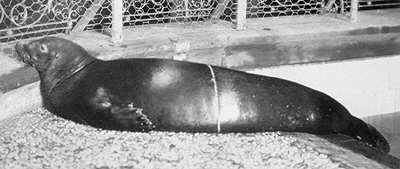
Captive Monacus tropicalis
The Caribbean Monk Seal is the only Pinniped to have ever gone extinct due to human involvement. They also have the distinction of being the only Caribbean Seals, and one of the very first animals described by Columbus in the 15th century (his crew killed and ate eight of them).

Caribbean Monk Seals once swam the waters of the Caribbean Sea and Gulf of Mexico. They were large seals, measuring nearly 3m long. Like with many Pinniped species, the males were larger than the females. They fed on fish, octopuses, and crustaceans.

Caribbean Monk Seals were hunted for their oil, and were killed my fishermen who didn't want to compete with the large predators. It didn't help that the seals were very slow on land, not very aggressive, and could be easily hunted. The last officially spotted Monk Seal was seen in 1952 at Seranilla bank between Jamaica and the Yucatan. Interestingly the species wasn't considered endangered by the US Government until 1967, when it was already way, way too late.

Spottings popped up here and there over the decades, but none could be scientifically confirmed. The IUCN listed them as extinct in 1996. In the 2000s, searches to locate any remaining Seals turned up nothing, and they were declared extinct by the US Government in 2008. Sadly, the two other Monk Seal species, found in Hawaii and the Mediterranean, are on the sharp decline towards extinction today.

IUCN Status : Extinct since the 1950s
Location : Caribbean Sea and Gulf of Mexico
Size : Length up to 8ft (2.5m)
Classification : Phylum : Chordata -- Class : Mammalia -- Order : Carnivora
Suborder : Pinnipedia -- Family : Phocidae -- Genus : Monachus -- Species : M. tropicalis

Thứ Tư, 2 tháng 2, 2011

Bull Sea Lion
Phylum : Chordata
Class : Mammalia
Order : Carnivora
Family :Otariidae
Genus : Eumetopias
Species : jubatus

Length : Males 11ft (3.25m), Females 8ft (2.5m)
Weight : Males 2,500lbs (1120kg), Females 1,000lbs (35kg)

IUCN Status : Endangered

Oh George Steller, you have so many species named after you! We've discussed his Sea Cow, his Sea Eagle, and now his Sea Lion! I had a cute little songbird planned for today, but I must admit that the massive Midwestern storm made me change up my post, so cold weather Sea Lion it is!

The Steller Sea Lion is the largest of all the "eared seals," which includes fur seals and sea lions. They can be found in the Northern waters of the Pacific, running from Hokkaido, Japan over to Alaska and sometimes even down as far as California. They are carnivores, and eat fish, squids, octopuses, crustaceans, and, on occasion, smaller seals. They are able to dive 1,300ft (400m) in search of prey.

Pup, Female, and Male
During Breeding Season, Steller Sea Lions congregate on beaches, or "rookeries," which get completely covered by the animals. Bulls fight of territories and the cows within them. Their single-mindedness also leads to the deaths of young pups, who get trampled over by the massive males.

Steller Sea Lions have seen a drastic decline in population since the 1970s. The number have dropped over75%. One likely cause of this is the increase of commercial fishing, which has reduced the Sea Lion's prey.

Thứ Hai, 6 tháng 9, 2010

Adult (Image Source)
Harp Seals are probably best known in their pup form; the white, fluffy, adorable little guys that seems highly represented in the children's plush toy market. Harp Seals are found in the Arctic Waters, where they live on park ice and migrate up to 2,500km each year between breeding grounds and summering areas. They come together for breeding and molting and form groups of several thousand seals. Adult Harp Seals measure up to 6ft in length, and weigh about 300lbs. They are carnivores, and are able to dive to 100m and hold their breath for 15min.

Pup (Image Source)
Harp Seals come together in large groups to mate. This usually happens right after weaning the previous season's pup. After mating, female Harp Seals are able to delay implantation, allowing her to give birth when pack ice is available. You seals are born a camouflaging white, and will feed off an extremely high-fat milk for about the first two weeks of their life. Once the pups have reached about 80lb, they are very abruptly weaned and left on their own. Pups will go through an extensive molting process before finally achieving their adult coats at sexual maturity at the age of 4-6. Harp Seals are so named because of a harp-shaped pattern found on the sides of the adult seals.

The fluffy white coats of newborn Harp Seals as made them very desirable. Harp Seals are one of the most commercially important of all the Seals, and though the hunts are now regulated in most areas, hundreds of thousands of Harp Seals are killed each year.

Thứ Năm, 19 tháng 8, 2010

Odobenus rosmarus are large, Arctic Pinnipeds that can grow in excess of 3,000lb and reach lengths of 10-12 feet, with the males being slightly larger than the females. They are known for their whiskered faces and enormous tusks, which are found on both sexes. These tusks can grow up to 39in, and are actually just long canine teeth.

Image from Wikimedia Commons
Walrus tusks are useful for a number of purposes. Males use them to fight for and protect mates and territory. Males and Females use their tusk to break ice, and maneuver themselves out of water. Their whiskers also serve an important purpose: detecting shellfish meals on the sea floor. Clams and mussels make up a large portion of their diet.

Walruses are very social creatures, and live in large herds year round. During non-breeding times, separate herds form for males and females. These herds also tend to migrate, moving from beaches to ice flows. As far as reproduction goes, females have 15-16 month gestation periods, and calves can weigh over 150lbs at birth!

Because Walruses are so massively large, their only non-human predators are Orcas and Polar Bears. Walruses were hunted for their tusks, hides, and oil for many, many years. Currently only a handful of native groups are allowed to hunt Walruses, and the numbers are carefully monitored.

Thứ Năm, 22 tháng 7, 2010

The genus Mirounga holds two extant species, the Northern Elephant Seal (Mirounga angustirostris) and the Southern Elephant Seal (Mirounga leonina). The two species, predictably enough, reside in their respectively named hemispheres. The Northern Elephant Seals are often found on offshore islands and along the California coast. Southern Seals live in Antarctica, splitting time (depending on the season) between the mainland and the offshore pack ice.

Arguing Males from Friends of the Elephant Seals
Southern Elephant Seals are the largest of all the seals. The heaviest males recorded were over 8,000lbs. Both the Southern and Northern seals demonstrate extreme sexual dimorphism. Females rarely weigh much over 1,000lbs, and only grow to be about half as long as the males. They also do not sport the species' naming feature: the elephant trunk-like nose that is exclusive to the males. These noses assist the males in making loud, resonating sounds during the breeding season. Both the males and females lose a large amount of their body weight during that season, as they do not feed until the pups are weaned. Females can lose 35% of their overall mass.

The breeding season is interesting for the Elephant Seal. Males come ashore and fight each other, often brutally, for mates. Elephant Seals are polygynous, with one male breeding with a large number of females. After the dominant males have established themselves, the female arrive and give birth to the pups that they have been pregnant with for the past year. While they are nursing their pups, they will mate again with one of the males. Once their pups are weaned and mating is complete, the seals return to the sea. It is possible for females to give birth to ten pups over their lifetimes, and their overall life expectancy is a few years longer than the males.

Image from ItsNature
As previously mentioned, the Northern Elephant Seals can be found along the California coast. One site in particular houses a large colony that comes in year round to perform various functions. Año Nuevo state park sees thousands of Elephant Seals each year, either breeding, birthing, or molting. I was lucky enough to visit this place a few years back during the adult male molting season, and even from a pretty far distance back you can appreciate just how massive these pinnipeds are!

Both Northern and Southern Elephant Seals were hunted to near extinction for their oil during the 19th and early 20th century. Populations are now protected, and the Northern species has been steadily growing. The Southern Elephant Seals, however, have been experiencing a population decline in recent years. The exact reason for this is unknown, but it may just be that without hunting, the population has grown faster than the prey can sustain.

Thanks to John for the suggestion!

Chủ Nhật, 6 tháng 6, 2010

Our final Alaska Week animal will be one of my favorites - the Harbor Seal. Like some of our other Alaskan friends, Harbor Seals, also known as Common Seals, can be found in other locations. In fact, they exist on the Northern Hemisphere coats of the both the Atlantic and Pacific Oceans. Harbor Seals are abundant in Alaska, numbering over 150,000. This is a substantial amount when the entire Pacific population is only around 300,000.

Taxonomically, Harbor Seals (Phoca vitulina) are considered True or Eared Seals, and are members of family Phocidae. This differentiates them from the fur seals and sea lions (Otariids or Eared Seals) with whom they share the overall Pinniped super family. True Seals have no external ears, dense, short hair, internal or retractable reproductive organs, and are better suited to ocean swimming and endurance than the Eared Seals, though they trade off is a definite awkwardness on land.

Image from Seal Sitters
Harbor Seals can dive to depths of 1640 feet and hold their breath for over 20 minutes. Males are slightly larger than females, reaching 6.5ft as opposed to 5.5. They feed on fish, squid and octopi, and they in turn are fed upon by killer whales, sharks, sea lions, and even land predators like bears and wolves. They are also huntedThey are relatively solitary animals, sometimes living completely alone and sometimes living only in small groups. The mother/pup bond is exceptionally strong due to the lack of large protective colonies. Interestingly the milk that mothers feed their pups can contain up to 45% fat.

Harbor Seals are incredibly non-vocal. While I'm sure a lot of people think of loud barking when they think of any type of seal or sea lion, the Harbor Seal doesn't bark at all. Young pups have unique cries to tie them to their mothers, but beyond that, most of the seals' vocal communication is done underwater. Above water, physical communication is far more common.