Hiển thị các bài đăng có nhãn Musteloid. Hiển thị tất cả bài đăng

Thứ Năm, 19 tháng 9, 2013

Every year on September 19th, we learn about a Badger. We've talked about the American Badger, Honey Badger, and Japanese Badger-- so now comes time for the iconic European Badger.

Meles meles
This critter lives everywhere in Europe. Its range covers nearly the entire continent, plus parts of the Middle East as well. With a span that large it's no wonder that there are eight different subspecies, the most populous of those being the creatively named "Common Badger," Meles meles meles.

European Badgers can measure up to 3ft in length and weigh between 20 and 35lbs, depending on the time of year (they bulk up in the fall.) They have those distinctive white faces with black lines running from ear to mouth.

This Badger species is one of the least carnivorous of all the members of the Carnivora Order. They will track down rabbits and other prey using their fantastic sense of smell, but they also eat a huge amount of vegetation as well, including fruits, fungi, acorns, and grasses.

European Badgers also have the distinction of being the most social Badgers. Where their relatives tend to be solitary, these guys will live in small groups that number up to ten adults. Only the dominant females will breed each year and produce cubs, and if a subordinate female also breeds, her offspring might be killed by the more senior members of the group.

These Badger groups occupy a territory, which is passed down from generation to generation. Because of their long-term residencies, the dens that European Badgers build can be very, very complex. Some have literally dozens of different entrances, and passages can be hundreds of feet long. Some Badgers (depending on location) will go into torpor during the winter, and will cover up their den entrances while they sleep. In warmer locations, the Badgers may not go inactive during winter at all.

European Badgers have a long relationship with humans. They have been hunted for sport for hundreds of years, and their hair is popular for use in shaving brushes. The Badgers are also, unfortunately, carriers of rabies and Bovine Tuberculosis (bTB). Various culls have taken place during the last few decades in order to keep bTB from spreading, including a program start started in August 2013. There is much debate on whether the culls are necessary, and some locations are trying out vaccination programs to see if they are more effective.

IUCN Status : Least Concern
Location : Europe
Size : Length up to 35in (90cm), Weight up to 35lbs (16kg)
Classification : Phylum : Chordata -- Class : Mammalia -- Order : Carnivora
Family : Mustelidae -- Genus : Meles -- Species : M. meles
Image : Mark Robinson Andy Mabbett

Thứ Tư, 8 tháng 5, 2013

Mustela sibirica
Meet the Siberian Weasel, also known as the Kolonok! These Mustelids have a huge range that spans across not just Siberia, but China, Mongolia, India, and several other east and central Asian countries as well. They have also been introduced to parts of Japan.

These long, slender mammals have impressively long tails-- they can be half their entire body length! They have fur that ranges from blonde to red, and have black masks and a white snout.

Siberian Weasels live in burrows, but the term "burrow" is very non-specific. They will hang out in tree stumps, fallen logs, and in dens that were built by other mammals but were vacated. The Weasels tend to have multiple burrowing sites-- one primary location and a number of more temporary hiding places.

Theses burrows are also were the Weasels care for their young. They line the area with feathers and other soft materials. Mating takes place in April and May, with a gestation period of about a month. A female can give birth to 10 offspring at a time, and the young ones are born blind and helpless. They grow very quickly though! By August they are off on their own!

Siberian Weasels, like many of their breathern, have pelts that are used by humans. In this case they are very popular with paint brush manufacturers. They don't do well in captivity though  so the hairs are usually only taken from wild individuals, making the brushes more expensive. At this time the range of the Siberian Weasel is quite large, and they are numerous in number, so human hunting has not massively affected their population.

IUCN Status : Least Concern
Location : Asia
Size : Body Length up to 15in (38cm)
Classification : Phylum : Chordata -- Class : Mammalia -- Order : Carnivora
Family : Mustelidae -- Genus : Mustela -- Species : M. sibirica
Image : YoPhotographer

Thứ Năm, 4 tháng 4, 2013

We've talked about a few different Hybrid animals in the past, and most of those are creatures that are completely man-made-- they would never hybridize in the wild. Today's animal is a bit different in that it can and has crossed before in wild conditions (though it is still rare to do so).

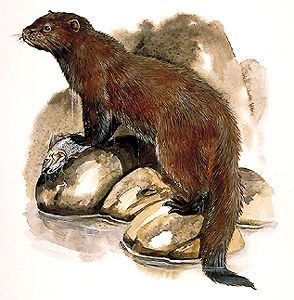
Khonoriks are crosses between European Mink and European Polecats. The only meet up in the wild in parts of Europe that have declining Mink populations. There is evidence of this happening at the turn of the 20th century, when warmer climates caused the Polecats to enter Mink ranges.

In 1978 the first captive bred Khonoriks were bred, by Dr. Dmitry Ternovsky in the Soviet Union. The fur produced by the hybrids was more valuable than that of the two parent species, but the breeding projects declined when Mink populations did, and are now more or less defunct.

Khonoriks are are roughly the same size as European Polecats, the larger of the two parent species. They have dark fur with pale ear tips, and blotchy facial masks. Additionally, they have the ability to swim (like Minks) and burrow (like Polecats), which lets them have a wide-ranging diet. As with most hybrids, the males are sterile though the females can be fertile.

Status : Hybrid
Location : Europe
Size : Length up to 18in (45cm)
Classification : Phylum : Chordata -- Class : Mammalia -- Order : Carnivora
Family : Mustelidae -- Genus : Mustela -- Species : M. putorius x M. lutreola
Image : Ferret Center

Thứ Ba, 12 tháng 3, 2013

Spilogale pygmaea
Pygmy Spotted Skunks are found only on the Pacific Coast of Mexico, where they live in wooded areas. Because of their range, they are listed as Vulnerable. Tourism and development has lead to habitat loss and fragmentation.

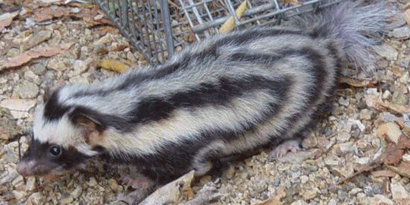
Pygmy Spotted Skunks have small, slender bodies that reach up to a foot in length. Their fur is black with 2-6 white stripes running down the length. Those stripes eventually break up into spots near the hindquarters.

As with all Skunks, this particular species has scent glands near the tail. However, when threatened their first reaction is not to spray, but rather to flee. If cornered, they will puff up and get aggressive  and will only turn to spray if that still does not work.

Pygmy Spotted Skunks are omnivores, and will feed on insects, fruits, small mammals, and reptiles, and will even climb trees in their search for prey. Baby Skunks follow their mother around during her nighttime forages.

IUCN Status : Vulnerable
Location : Mexico
Size : Body Length up to 13in (34cm)
Classification : Phylum : Chordata -- Class : Mammalia -- Order : Carnivora
Family : Mephitidae -- Genus : Spilogale -- Species : S. pygmaea
Image : elhogarnatural

Thứ Tư, 20 tháng 2, 2013

Procyon cancrivorus
The Crab-Eating Raccoon is a lesser-known relative to the popular and iconic Common Raccoon. This particular species lives in Central and South America, inhabiting marshy, forested areas.

The name is a bit misleading, as the Crab-Eating Raccoon does not exclusively eat Crabs. It is also not the only Raccoon to eat Crustaceans-- the Common variety does as well. In addition to their name-sake meals, these Raccoons also eat amphibians, fruits, eggs, fish, and insects. They are very dexterous creatures, having the ability to manipulate food and other objects with their hands.

Crab-Eating Raccoons are nocturnal and solitary. They look slimmer and sleeker than their northern cousins, but that is only because their hair is shorter due to a lack of undercoat (they don't need it since they live in tropical climates).

IUCN Status : Least Concern
Location : Central and South America
Size : Body length up to 30in (80cm)
Classification : Phylum : Chordata -- Class : Mammalia -- Order : Carnivora
Family : Procyonidae -- Genus : Procyon -- Species : P. cancrivorus
Image : Steven Johnson

Thứ Ba, 1 tháng 1, 2013

Galictis vittata
There are two species of Grison in the world, the Lesser (G. cuja), and the Greater (G. vittata). They are both found on the continent of South America, and are sometimes referred to as South American Wolverines. The Greater lives further North, reaching into Mexico and Central America, while the Lesson Grison lives only in the southern parts of the continent.

Though they have a Wolverine name  they are no where near the size. These Mustelids grow only about 1 foot and a half in length, and they actually look a little skunk-like. Both species have black legs, bellies, and faces, but have a grey backs.

Grison are diurnal, and live either alone or in small groups that burrow into the ground for both food and shelter. They are omnivores, feeding on small mammals like mice and chinchillas, as well as on fruits. They kill their prey by a fast bite to the neck.

Interestingly, the Grison can be tamed, and they are used in the hunting of Chinchillas. This is not all that surprising when you remember that they are relatives to the Ferrets, which have been used in hunting for centuries.

IUCN Status : Least Concern
Location : South America
Size : Length up to 20in (50cm), Weight up to 3kg
Classification : Phylum : Chordata -- Class : Mammalia -- Order : Carnivora
Family : Mustelidae -- Genus : Galictis

Thứ Ba, 6 tháng 11, 2012

Hydrictis maculicollis
The Spotted-necked Otter can be found in many of the rivers and lakes of Sub-Saharan Africa. They prefer to live near clear, continuous, fresh water, and will build dens near these sources.

When it comes to Otter size, this species is on the small end of the scale-- full body and tail length tops out around 1m, and females are generally smaller and lighter than the males. They can be identified by their sleek brown coats, and by the namesake white and brown spots on the neck and underside.

Spotted-necked Otters live either alone or in very small family groups and they tend to be more social during the breeding and birthing seasons. However, some father Otters will help to raise the pups, while others do not. Regardless of how many otters they live with, these guys certainly love to play, and will splash and frolic either alone or in groups.

One of the reasons that Spotted-necked Otters prefer clear water is that they hunt almost exclusively by sight. They feed on small fish, crustaceans, and amphibians.

Unfortunately, their need for such specific water conditions may lead to a decline over time. Habitat loss and pollution are two current conservation concerns.

IUCN Status : Least Concern
Location : Africa
Size : Length around 40in (1m)
Classification : Phylum : Chordata -- Class : Mammalia -- Order : Carnivora
Family : Mustelidae -- Genus : Hydrictis-- Species : H. maculicollis

Thứ Tư, 19 tháng 9, 2012

Meles anakuma
Why it's that day of the year again. Happy Badger day! (We actually could go for another eight years before running out of Badgers to talk about...)

Last year we talked about the internet-famous Honey Badger, and the year before we learned about my beloved American Badger, but this year we'll be discussing one of the lesser known Badgers, the Japanese Badger!

Japanese Badgers belong to a different subfamily from the previously featured Badgers, and are close relatives of the yet-to-be-discussed European and Asian Badgers. As you can probably guess, they are endemic to Japan, and their island dwelling lifestyle has left them slightly smaller than their continental cousins. It is hypothesized that their ancestors entered Japan from the Korean Peninsula, which would explain why the species has not been found on the northernmost island, Hokkaido.

You can identify the Japanese Badger by their grey-brown hair and chocolate colored facial stripes that are similar to those found in the European and Asian Badgers, but are a bit less pronounced. They have tiny ears, short tails, and large, powerful feet with non-retractable claws for digging expertise.

One thing I found rather interesting is that Japanese Badgers have a polygynandrous breeding system. This means that both the males and the females will mate with multiple partners throughout the year. Unlike their close European cousins, they do not even form pair bonds to rear the offspring-- females do that duty alone. They actually will mate at all times of the year, but the females are luckily able to delay implantation so that her cubs are only born during the favorable spring season. Another fun fact? Female offspring will stay with their mothers for up to 14 months, but males will hang around for more than two years! Outside of mother/offspring groups the Japanese Badgers are solitary, more so than other Badger species.

Though they are currently listed as being of Least Concern, the Japanese Badger population has been on the decline for the last 30 years or so. Habitat loss has been a big factor, as is the spread of invasive Raccoons who compete for food and breeding sites.


IUCN Status : Least Concern
Location : Japan
Size : Length up to 30in (75cm)
Classification : Phylum : Chordata -- Class : Mammalia -- Order : Carnivora
Family : Mustelidae -- Genus : Meles -- Species : M. anakuma

Thứ Hai, 20 tháng 8, 2012

Ferrets
Today's animal will probably be a familiar one, as they have become very popular pets in the last 30 or so years. But did you know that Ferret domestication goes back much, much further than a few decades? Through mitochondrial DNA testing, we know that Ferrets were domesticated from either the European Polecat or the Steppe Polecat (or a hybrid of the two) somewhere between 2,000 and 2,500 years ago!

The first domesticated Ferrets were used specifically for the hunting and capture of other small animals, and the name "Ferret" itself derives from the Latin word furonem-- "Thief". Wild Ferret relatives (like the aforementioned Polecats) are naturally good at moving their lean bodies through underground tunnels and burrows, flushing out prey like Rabbits and Moles. Domesticated Ferrets have the same skill set, and for hundreds of years were used to hunt small mammals and control rodent populations.

Ferret hunting does still exist in some areas, but it is much more controlled that it was previously (so as not to completely imbalance the rodent and rabbit populations). They are now kept as house pets, and are also common lab animals that have been used extensively in bio-medical research. Ferrets and humans share many metabolic and physiological features, which makes them ideal for studies dealing with (among others) heart disease, nutrition, and respiratory illness.

Did you know what Ferrets are one of the most popular pets in North America? However, they aren't for everyone! Ferrets are very active critters with big personalities and curious natures. They do best when allowed to roam outside of a cage, and also prefer to live in groups.

They are demanding pets that require attention and a large degree of maintenance to keep happy and healthy. For example, they have very quick metabolisms and have to eat roughly every four hours. They also require yearly medical checkups and vaccinations, and should be spayed or neutered. De-scenting is also a common medical procedure, as Ferrets naturally have anal musk glands that are used for mating and defensive purposes. If you can handle the Ferret lifestyle, they make for very interesting and engagement pets that can live as long as ten years.

Status : Domesticated
Location : Originated in Europe
Size : Length up to 20in (51cm)
Classification : Phylum : Chordata -- Class : Mammalia -- Order : Carnivora
Family : Mustelidae -- Genus : Mustela -- Species : M. putorius -- Subspecies : M. p. furo

Thứ Hai, 27 tháng 2, 2012

Mustela nivalis
The Least Weasel has a very appropriate name- they are the smallest member of the entire Carnivora order! Though their size is small, their home range is not. These little Mustelids live in Europe, North America, North Africa, and Asia. They have also been introduced to several other locations as well.

Least Weasels feed on other small mammals, and on rare occasion also hunt birds and amphibians. While their prey is usually smaller, like a mouse or gerbil, they have been known to take down much larger animals like adult rabbits.

Like a handful of other Mustelids, the Least Weasels change color depending on the time of year. In winter their coats are dense and white, while in summer the hair is more coarse and brown.

The breeding season of the Least Weasel is completely dependent on their prey. If the rodent populations are high they might breed a few times a year. But if the populations are low, there may only be one litter. The young  Weasels can be born in litters of up to ten, and they grow very fast. A Least Weasel reaches sexual maturity when they are 3-4 months old.

IUCN Status : Least Concern
Location : Europe, Asia, North Africa, North America
Size : Length up to 10in (25cm)
Classification : Phylum : Chordata -- Class : Mammalia -- Order : Carnivora
Family : Mustelidae --  Genus : Mustela -- Species : M. nivalis

Chủ Nhật, 16 tháng 10, 2011

Nasua nasua
Meet the South American Coati, a curious looking member of the Raccoon Family that is native to the forests of it's namesake continent.

Coatis are gray or brown in color, and have the ringed tails that can also be found in their Raccoon cousins. They are diurnal, and live in groups that can number up to 30 individuals. They feed off of a huge variety of fruits, eggs, and invertebrates, and they use their long noses to help them overturn rocks and plants to find meals.

South American Coatis are both arboreal and terrestrial. They do most of their hunting on the ground, but interestingly they mate and give birth in trees!

Right now, South American Coatis are listed at the Least Concern level, due to their very wide range. However, populations are on the decline as threats of hunting and deforestation continue to affect them.

IUCN Status : Least Concern
Location : South America
Size : Length up to 3.3ft (1m)
Classification : Phylum : Chordata -- Class : Mammalia -- Order : Carnivora
Family : Procyonidae -- Genus : Nasua -- Species : N. nasua

Thứ Hai, 19 tháng 9, 2011

Last year for my birthday I wrote about one of my favorite animals, the intensely awesome and unforgettable American Badger. I figured this year (wow, it's been a year?) I'd write about another Badger, the ferocious and epic Honey Badger.

Mellivora capensis
Do not let this name fool you! Honey Badgers are anything but sweet. Also known as Ratels, these large Mustelids can be found in Africa, the Middle East, and parts of Asia. They are known for their incredible courage, fearlessness, and tenacity. Just Google Honey badger, seriously. The entire first page of results is essentially websites and videos about how much butt they kick (the video in that link includes profanity, but is nonetheless hilarious).

Honey Badgers get their name because they enjoy eating Bee larve. They have an interesting relationship with a bird known as the Honey Guide. The bird leads the Badger to the hive, then waits to get an easy meal once the Badger has gotten its fill. The Badgers have amazing claws and powerful arms that let them climb to and rip apart bee hives. Their think skin allows them to get stung without much bother! That skin also helps when they go after other, larger prey... like Cobras. And small Crocodiles. Actually, Honey Badgers will eat just about anything. Over sixty species are consumed by Kalahari populations, ranging from larvae to antelope, to pythons, to jackals!

But back to that skin. Honey Badger skin is loose and thick. They are not actually immune to venom and bee stings, but the thickness of their hide keeps them relatively safe. As seen in the video below, the snake venom typically causes the Badger to drift off to sleep for a short spell. The looseness of their skin also serves a purpose in that is makes the Badger very difficult to grab on to and do damage to, which is great for those times when the Badger feels the need to fight larger predators for food. Like Lions.

Honey Badgers live a solitary lifestyle, unless they happen to be a female with a baby. Young Badgers will live with their mother for up to 16 months, learning the ways of hunting and awesomeness. Male Honey Badgers live in large ranges that overlap the smaller ranges of females. This suggests a polygynous breeding structure.


IUCN Status : Least Concern
Location : Africa, Middle East, South Asia
Size : Length up to 22in (56cm), Wingspan 50in (127cm)
Classification : Phylum : Chordata -- Class : Mammalia -- Order : Carnivora
Family : Mustelidae -- Genus : Mellivora-- Species : M. capensis

Chủ Nhật, 11 tháng 9, 2011

The Eastern Spotted Skunk is perhaps not what you would think of when the word "Skunk" comes to mind. After all, they don't have stripes!

Spilogale putorius
All Skunks are members of the Musteloid superfamily, which makes them relatives to Weasels, Badgers, and Racoons. Eastern Spotted Skunks are actually pretty Weasel-looking, moreso than some other Skunks, due to their slender bodies. This allows them to be more agile and active.

Not only is this species more agile and more slender than other Skunks, but it is also more social. During the winter as many as eight Skunks may share a common den. They also happen to be the only Skunk that climbs trees!

Eastern Spotted Skunks are omnivores, and they are excellent rodent catchers. Their diet changes based on the seasons, but they also eat insects, fruit, eggs, and even honey. They themselves are preyed upon by owls, coyotes, foxes, bobcats, and a handful of other predators. When threatened, they do a series of handstands to warn their attackers, and if that doesn't work they shoot out their amazingly accurate musk. They can aim well to hit things as far as 16ft (5m) away!

IUCN Status : Least Concern
Location : Eastern United States
Size : Body length up to 13in (33cm)
Classification : Phylum : Chordata -- Class : Mammalia -- Order : Carnivora
Family : Mephitidae -- Genus : Spilogale -- Species : S. putorius

Thứ Hai, 6 tháng 6, 2011

Lutra lutra
The Eurasian Otter is also frequently referred to as the Common Otter. They have a pretty large range that spans across Europe and Asia, and they can be found near all sorts of waterways, including areas of both salt and fresh water.

Eurasian Otters do almost all of their feeding in the water. They have webbed paws to help them swim, as well as the ability to dive for up to two minutes at a time. While in the water their whiskers serve as sensory devices, alerting them to the movement of fish and other animals. They eat a huge variety of creatures, including birds, crustaceans, fish, clams, and insects. A single Eurasian Otter can eat 15% of its body weight each day!
Adult Otter

Juvenile Otters are incredibly social and love to play, slipping and sliding down river banks and chasing and wrestling. Their playtime also serves the purpose to teaching them how to hone their hunting techniques. Mother Otters also help their offspring to hunt by catching and releasing fish for their young to go after.

As adults the Eurasian Otters are less social; most live alone and live in groups only when mating or when a  mother is raising their young.

As a whole, the species has a very large range. However, water pollution has caused local extinctions in some areas of Western Europe. Bycatching from fishing and hunting have also hurt the Eurasian Otter populations.

IUCN Status :  Near Threatened
Location : Europe, Asia, parts of the United Kingdom
Size : Body length up to 27in (70cm)
Classification : Phylum : Chordata -- Class : Mammalia -- Order : Carnivora
Family : Mustelidae -- Subfamily : Lutrinae -- Genus : Lutra -- Species : L. lutra

Thứ Bảy, 4 tháng 6, 2011

Neovison macrodon
Sea Minks are another species that have gone extinct in more recent times. These close relatives to the American Mink lived on the Atlantic coast, and were for a while considered to be a subspecies of the American Mink, but recent research has shown that the two are distinct species.

In their time, the Sea Minks lived off of the ocean, consuming fish and mollusks. Unfortunately, they were hunted to extinction by around 1894.

The primary reason for the loss of this species is the think reddish fur that they possessed. At the time, the European fur trade was in high demand for Mink pelts, and the Sea Mink was the largest Mink out there. While they had assuredly been hunted for hundreds, if not thousands of years by native peoples, the European demand was the final blow.

IUCN Status :  Extinct since the 1890s
Location : North Atlantic Coast of United states and Canada
Size : Length up to 30in (76cm)
Classification : Phylum : Chordata -- Class : Mammalia -- Order : Carnivora
Family : Mustelidae -- Genus : Neovison -- Species : †N. macrodon

Thứ Hai, 28 tháng 3, 2011

Winter Coat Ermine
Phylum : Chordata
Class : Mammalia
Order : Carnivora
Family : Mustelidae
Genus : Mustela
Species : M. erminea

Length : 13in (33cm)

IUCN Status : Least Concern

Ermines (also known as Stoats) can be found natively throughout the Northern Hemisphere. They are one of those curious creatures that possesses the ability to change color with the season. In summer, they are brown with lighter undersides, but in the winter they are almost completely white! Ermines are skilled predators that consume mostly birds and small mammals.

Ermine's don't live particularly long, in fact, their average life expectancy in the wild is only a year or two! Because of this, females are sexually mature at the age of only two months, which is remarkable since young are born blind and helpless. Interestingly, males take a year or two to sexually mature, meaning they often only live through one mating season.

Summer Coat Ermine
The winter fur of an ermine has been highly sought after, and has been used as a symbol of royalty and nobility. Ermine fur is also mimicked in heraldry.

Ermines have unfortunately become quite problematic in several island areas. For example, in the 1880s they were brought to New Zealand to control of the rabbit populations. The Ermines bred and flourished, which proved disastrous to many of the country's flightless bird species. The New Zealand Department of Conservation is constantly working on ways to eliminate what they refer to as "public enemy number one for New Zealand birds."

Thứ Sáu, 31 tháng 12, 2010

(Image Source)
The Asian Small-Clawed Otter, (Aonyx cinerea) also known as the Oriental Small-Clawed Otter, can be found in freshwater wetlands and swamps of South and Southeast Asia, as well as in Indonesia and the Philippines. They have slender, short furred bodies, with very small, blunt claws (hence the name). Their feet are not fully webbed, which gives them increased dexterity with their hands. This allows them to catch prey- which includes Crustaceans, Mollusks, small Mammals, and Fish- with their hands rather than just with their mouths like other Otters do.

Asian Small-Clawed Otters have a couple more cool features. They are the smallest of all the Otters, weighing in at a maximum of 10lb (4.5kg) and measuring up to 24in (61cm). They are also the most vocal. They make about a dozen different sounds, each with its own specific meaning. They also have excellent vision both above and below water.

(Image Source)
These Otters live in small, female-dominated groups of up to a dozen individuals. Partners mate for life, and they both take part in the raising of their children. This social behavior makes them different from many other Otter species, which are either more solitary in general, or the father takes little part in the raising of offspring. Couples produce up to two litters a year, each with 2-3 pups. The pups are born quite helpless, and wont even open their eyes for six weeks. They will then be swimming after nine. Many young Otters remain with their parents and help raise subsequent litters.

Asian Small-Clawed Otters are listed as Vulnerable with a decreasing population trend. They are threatened by the loss of their wetland habitats, and by a loss of food supply from over-fishing and pollution.

Thứ Tư, 17 tháng 11, 2010

They may look like abnormally cute ferrets, and while Vormela peregusna are Mustelids, and members of the same subfamily as Weasels, Martens, and Badgers, but they belong to a genus all their own. They are one of the rarer Mustelids of the world, though their range covers large parts of Eastern Europe, the Middle East, and Asia. Marbled Polecats can be found in open habitats like grasslands, and steppes.


(Image Source)
The Marbled Polecat gets its name from the interesting pattern that shows up on its back. Their face is black and white, but their body is a rich marbled combination of yellows, browns, whites, and reds. They have short muzzles, long tails, and powerful front claws that help them to dig and burrow. When threatened, Marbled Polecats hiss and fluff up their hair, making their bodies appear much larger. They also have some exceptionally stinky glands under their tail that release foul odors.


Normally solitary creatures, Marbled Polecats come together to breed during spring and early summer. At this time the coloration on males is more vivid. Marbled Polecats are one of the species that practices delayed implantation (embryonic dispause). They typically do not give birth for 8-11 months after mating, despite only have a 40ish day gestation period. Up to eight young are born at once, and they grow fast! Females are already at sexual maturity when they are three months old (males take long at about a year.)


Marbled Polecats feed on various rodents, insects, reptiles, and birds. Unfortunately their numbers have been on the decline due to the reduction of their prey, and due to habitat loss.

Thứ Sáu, 5 tháng 11, 2010

We all know about Mustelids; otters, weasels, badgers. But have you heard about the Tayra? Tayras are the only species within the genus Eira and are found in tropical forests of Central and South America. They look quite weasel-life, with dark brown body hair, a lighter colored head, a body length of around 60cm, and a bushy tail. Tayras weigh up to 11lbs.
(Image Source)

Tayras (Eira barbara) are diurnal and solitary, and are both arboreal and terrestrial, often making their homes in hollow trees. Tayras are excellent swimmers and climbers. They are also omnivorous, and prefer to eat rodents, though reptiles, insects, and fruits are also consumed.

Tayras are different from some other mustelids in that they do not have delayed implantation during reproduction. After mating the females have a a 63-70 day gestation period before giving birth to 2-3 offspring. These young are weaned after 2-3 months.

Many wild Tayra populations are on the decline, due to habitat loss. The northernmost subspecies, found in Mexico, is listed as vulnerable.

Chủ Nhật, 19 tháng 9, 2010

What A Lovely Creature!
(Source)
It's my birthday today, and Wisconsin won yesterday, so heck, I'm doing the Badger! Badgers are awesome! Now, we're talking about the American Badger in this instance, not the European or Honey Badger, though both are just as awesome but will be discussed at a later date. American Badgers (Taxidea taxus) can be found throughout plains habitats in the western United States, Canada, and parts of Mexico. Since 1957 the Badger has been the state animal of Wisconsin, and the Badger moniker itself comes from the "Badger den" holes that miners lived in during the early 1800s. Fun Wisconsin Facts!

American Badgers are relatively large Mustelids. They can grow as large as 3ft in length and weight over 25lbs. They have flat bodies, and short, stocky legs that are used for some serious digging. They vary in overall color, but all Badgers have a very distinctive face with a white chin, black patches, and a white stripe that extends all the way down the back. They have excellent senses of sight, smell, and hearing, which are all used to search for prey. Badgers do most of their digging in order to locate and pursue prey, which includes various rodent species and ground nesting birds. In some areas, Badgers and Coyotes have a strange working relationship. Coyotes cannot dig and Badgers cannot chase, and by hanging out near each other both can benefit. It has been found that Coyotes are capable of catching a third more prey when working with a Badger.

So Majestic!
(Source)
American Badgers are solitary and primarily nocturnal. They do not actually hibernate in the winter, but instead will go into short inactive states where they may not leave their burrow for days at a time. Badgers actually mate in fall, but females are capable of delaying implantation so that their young are born in spring rather than during the cold winter months. An average of three young are born at a time, and will stay with their mother for 5-6 months.

Badgers are tough little guys and have few natural predators. While they will rarely pick a fight, if a Badger is provoked it can be a formidable fighter and can also emit a harsh musk to ward off attackers. There are anecdotes of Badgers fighting off pairs of Coyotes and being able to outdig men with shovels.

And not only are they awesomely fearsome... but they have an adorable side as well! Oh, and Teddy Roosevelt kept one as a pet, named Josiah. Not recommended, but awesome.


Methinks I might just visit the Badger at the Zoo today. Awesome.