Hiển thị các bài đăng có nhãn Fish. Hiển thị tất cả bài đăng

Thứ Năm, 17 tháng 4, 2014

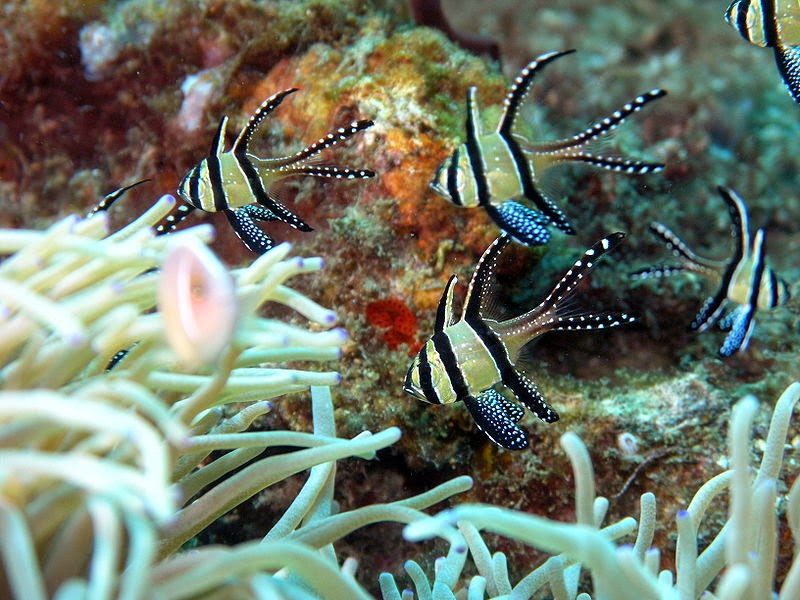
Pterapogon kauderni
The Banggai Cardinalfish is a small tropical fish that is becoming very rare in the wild, even though it has been successfully bred in captivity.

You will only find these small, 3in long fish around the Banggai Islands of Indonesia. They are the only members of their genus, and you can tell them apart from other Cardinalfish by their three-striped bodies, tasseled first dorsal fin, long second dorsal, and their deep-forked tail fins.

Banggai Cardinalfish are diurnal and live in small groups of about a dozen members. They are opportunistic feeders who dine on whatever smaller plants and animals they can find.

Courtship and mating is pretty interesting for these guys-- females are the ones who initiate. They isolate a male and the pair will perform various courtship rituals before spawning. The Cardinalfish are mouthbrooders, which means that the males take the fertilized eggs (up to 90 of them) into their mouths and incubate them for up to 30 days. During that time they do not feed. The female will stay near the male and defend the territory for the first few days, but she eventually leaves.

Banggai Cardinalfish are very popular in the aquarium industry. They breed in captivity, but more than half a million fish are still captured from the wild each year. The small range and high rate of collection has led the species to an "Endangered" listing.

IUCN Status : Endangered
Location : Indonesia
Size : Length around3in (8cm)
Classification : Phylum : Chordata -- Class : Actinopterygii -- Order : Perciformes
Family : Apogonidae -- Genus : Pterapogon-- Species : P. kauderni
Image : Jens Petersen

Thứ Hai, 14 tháng 4, 2014

Plectropomus leopardus
Meet the Coral Trout, also known as the Leopard Coral Grouper. These colorful fish make the western Pacific Ocean their home, and they can be found near the coral reefs that give them their name.

Coral Trout can be identified by their red and yellow bodies and their blue spots that have darker rings around them. They grow to a maximum of 2ft in length.

One amazing fact about these fish is that they are all born as females. No one really knows what triggers a female to male change, but they are usually well over a year old when it happens. The average length at change is around 1.5ft!

The spawning rituals of these fish are also pretty interesting. Males establish territories and they do dancing displays to attract females-- fanning out their fins and shaking from side to side. If a female likes what she sees, the two will spawn around sunset. This practice involves the pair swimming very quickly towards the surface and releasing the eggs and sperm into the water. The fertilized eggs float near the surface, and the larval fish will emerge after only a few days.

IUCN Status : Near Threatened
Location : Pacific Ocean
Size : Length up to 2ft (60cm)
Classification : Phylum : Chordata -- Class : Actinopterygii -- Order : Perciformes
Family : Serranidae -- Genus : Plectropomus -- Species : P. leopardus
Image :  Leonard Low

Thứ Hai, 7 tháng 4, 2014

Oncorhynchus clarki stomias
We are bouncing all over the world now-- from India, to Antarctica, and now to the Rocky Mountains of the United States!

Today's animal is a subspecies of fish that is found only in those particular mountains-- the Greenback Cutthroat Trout. These freshwater fish once had a massive range that extended over the Rockies and the American West. Today they are limited to only 1% of that, and are found only in the state of Colorado (where it is the state fish).

The Greenback Cuttroat Trout grows to lengths of around 1.5ft, and weighs up to 10lbs. They have brilliant green and red coloration, complete with spots, and become even more vibrant during spawning.

The reason for the decline of this fish is threefold-- they were over-fished, they dealt with industrialization and toxic runoff from mining, and they had to compete with introduced fish species. The U.S. Fish and Wildlife Service has been undertaking recovery efforts for the past few decades. Unfortunately, inter-breeding and the persistence of threats have kept these fish to just a 4 mile stretch of the Bear River.

IUCN Status : Not listed, but Endangered by USA Endangered Species Act
Location : North America
Size : Length up to 18in (45cm)
Classification : Phylum : Chordata -- Class : Actinopterygii -- Order : Salmoniformes
Family : Salmonidae -- Genus : Oncorhynchus-- Species : O. clarki -- Subspecies : O. c. stomias
Image :  Joel Sartore

Thứ Hai, 31 tháng 3, 2014

Lampanyctus macdonaldi
Previoulsy we learned about a very large fish found in the Antartic Waters. Today, we'll learn what we can about a very small one -- Lampanyctus macdonaldi, also known as the Rakery Beaconlamp.

This deep sea fish can actually be found in the Arctic as well-- it's a creature that really enjoys polar seas. Like most fish in cold waters, these guys are small, maxing out around 6in in length. They feed on creatures that are even smaller still, like tiny shrimp and other crustaceans.

Rakery Beaconlamps undergo small migrations every single day, moving up and down to different depths depending on the time. During the day they travel as far as 1,000m down. During the night they move upwards, hunting between 150 and 250m.

IUCN Status : Not Evaluated
Location : Antarctica
Size : Length up to 6in (16cm)
Classification : Phylum : Chordata -- Class : Actinopterygii -- Order : Myctophiformes
Family : Myctophidae -- Genus : Lampanyctus -- Species : L. macdonaldi
Image :  SFSA

Thứ Sáu, 28 tháng 3, 2014

Dissostichus mawsoni
Today's animal is a pretty cool creature-- it is one of the top predators in Antarctica's Ross Sea, dominating over other species of fish that barely reach 1/3 its size!

The Antarctic Toothfish can grow up to 2m long, making it a giant in cold waters where the fish tend to stay half a meter or less. They are also important because they serve as prey to the large Mammals that feed in those waters-- one group of Orcas actually feeds almost exclusively on them!

The life habits of the Antartic Toothfish haven't been extensively studied, but we do know that they can live as long as 50 years, and don't reach maturity until 16 or 17. Scientists believe that they migrate in order to breed, but that hypothesis hasn't been confirmed because no eggs have ever been found!

Another weird fact is that these fish are able to produce proteins in their body that act like anti-freeze. Those proteins are incredibly efficient at keeping the Toothfish's blood from crystallizing!

IUCN Status : Not Evaluated
Location : Antarctica
Size : Length up to 6.6ft (2m)
Classification : Phylum : Chordata -- Class : Actinopterygii -- Order : Perciformes
Family : Nototheniidae -- Genus : Dissostichus -- Species : D. mawsoni
Image :  Last Ocean

Thứ Hai, 24 tháng 3, 2014


Horabagrus brachysoma
Finally we get to our last animal of the Western Ghats series (for now...), the Sun Catfish. It goes by a whole mess of other names-- Guther's Catfish, Yellow Catfish, Bullseye Catfish, etc. Thankfully we have scientific names to sort out the confusion!

Sun Catfish make their homes in the high-vegetation-filled, slow-moving rivers and streams pf western India. Because they live in waters of varying depths and salinity levels, they aren't especially picky when it comes to diet. These adaptable fish will eat anything and everything they can swallow, and since they can grow up to 18in in length that gives them lots of options!

Sun Catfish have been captured for the pet trade, and for food. They are currently listed as "Vulnerable" due to over-exploitation and because of habitat degradation in the nearby areas.

IUCN Status : Vulnerable
Location : India
Size : Length up to 18in (45cm)
Classification : Phylum : Chordata -- Class : Actinopterygii -- Order : Siluriformes
Family : Horabagridae -- Genus : Horabagrus-- Species : H. brachysoma
Image :  N. Hepworth

Thứ Năm, 20 tháng 3, 2014

Sahyadria denisonii
Finally we move to a cold-blooded inhabitant of the Western Ghats-- the Denison's Barb. This small fish makes it home in the fast moving rivers and streams of that particular range.

Like the other creatures this week, the Denison's Bard is Endangered. Unlike those animals, it's number one threat isn't habitat loss. Primary issue for the Barb? Overfishing for the Aquarium Trade. While these animals are becoming rare in the wild, they are growing in popularity in captivity. Which is really unfortunately, because they don't breed well in captivity, which means even more are taken from the wild as a result.

Denison's Barbs grow to around 6in in length, are can be identified by the lateral black and red lines on their bodies. They live in small schools, and forage for just about anything they can find. Algae, Crustaceans, Insects, and plant detritus are all commonly consumed.

IUCN Status : Endangered
Location : India
Size : Body Length around 6in (15cm)
Classification : Phylum : Chordata -- Class : Actinopterygii -- Order : Cypriniformes
Family : Cyprinidae -- Genus : Sahyadria-- Species : S. denisonii
Image :  Stan Shebs

Thứ Tư, 26 tháng 2, 2014

Synodontis nigriventis
Meet a curious little fish that hails from the Congo River in Africa-- the Blotched Upside-down Catfish.

As the name and picture illustrate, these Catfish actually do spend most of their time swimming upside down. Crazy, huh? Their coloration actually reflects their preferred bodily orientation. Unlike other fish who are dark on the top and paler on the bottom (to beldn with predators who would be looking up or down at them), these guys have pales backs and dark bellies!

Why do they swim like this? For hunting reasons. By looking up at prey they can surprise it easier, catching it quickly from below. They feed on small insects and crustaceans.

Interestingly, the Catfish aren't born swimming upside down-- they don't really invert until they are around 2 months old. Overall they don't get particularly large as they age. 3-4 inches is their maximum size.

Blotched Upside-down Catfish can be kept as pets, and do best in small groups of 3 or 4.

IUCN Status : Least Concern
Location : Congo River Basin
Size : Length up to 4in (12cm)
Classification : Phylum : Chordata -- Class : Actinopterygii -- Order : Siluriformes
Family : Mochokidae -- Genus : Synodontis-- Species : S. nigriventis
Image : SeriouslyFish

Thứ Tư, 19 tháng 2, 2014

Salmo marmoratus
Meet the Marble Trout, a freshwater fish that has distinct coloration pattern and a very limited range.

The name "Marble Trout" comes (obviously) from its scales, which have a marbled pattern to them. Their specific habitat affects the darkness and the exact coloring. Aside from color, the Marble Trout can be identified by their skinny, cylindrical bodies and their 1-2ft size at maturity.

Marble Trout are found only in a handful of rivers and basins in the world. Italy, Slovenia, Croatia, Bosnia and Herzegovina, and Montenegro are the only nations that they are currently found in. They live only in freshwater, and feed on smaller fish and aquatic invertebrates.

Despite their small range, the Marble Trout are considered to be of Least Concern. Though damming and habitat loss have made them rare (and possibly extinct) in some localized areas, there are enough of them, and they breed fast enough, that they aren't in major imminent danger as a species.

IUCN Status : Least Concern
Location : Europe
Size : Length up to 2ft (65cm)
Classification : Phylum : Chordata -- Class : Actinopterygii -- Order : Salmoniformes
Family : Salmonidae -- Genus : Salmo-- Species : S. marmoratus
Image : Jaz pa Pojdem

Thứ Hai, 3 tháng 2, 2014

The Ocellated Dragonet is also called the Scooter Blenny, even though it is not actually a member of the Blenny family. Weird huh?

In the wild, these fish are found in the western Pacific Ocean, where they live on the seafloor of shallow coral reef areas. You will often see several of them living in a loosely-affiliated group, though they don't form actual schools. They feed on very tiny Zooplankton.

Speaking of size, Ocellated Dragonets are small, only about 3in long, and have brown bodies that are covered with stripe and spot patterns. You can tell the difference between males and females based on the dorsal fin. The fin is larger for males, and it has bright orange coloration at the base.

IUCN Status : Not Listed
Location : Southwest Pacific Ocean
Size : Length up to 3in (9cm)
Classification : Phylum : Chordata -- Class : Actinopterygii -- Order : Perciformes
Family : Callionymidae -- Genus : Synchiropus-- Species : S. ocellatus
Image : GraouQuarium

Thứ Sáu, 31 tháng 1, 2014

Meet the Common Seahorse, a fish that has a range extending throughout the Indian and Pacific Oceans. However, even with a range that size these Seahorses are in trouble. Their population is on the decline due to habitat degradation and high levels of overfishing. They are one of the most popular Seahorses used for traditional medicines, and are captured in high amounts. As a result, the Common Seahorse is becoming rather uncommon, and they are listed as Vulnerable by the IUCN.

In the wild, the Common Seahorse lives at relatively shallow depths, often attaching their tails to coral or seaweed in order to keep to one place. They are also popular in aquariums, and many are now being captive bred to keep the wild populations sustainable.

Common Seahorses have a really interesting reproductive process. After courting, the mail and female move very close together so that the female can lay her eggs in the male's brood pouch. After all the eggs have been deposited the female leaves and it is all up to dad to incubate their offspring. After about a month it is time for the young Seahorses to hatch, and the father wiggles back and forth to get his young children out into the world. What an interesting process!

IUCN Status : Vulnerable
Location : Indian and Pacific Oceans
Size : Length up to 14cm
Classification : Phylum : Chordata -- Class : Actinopterygii -- Order : Syngnathiformes
Family : Syngnathidae -- Genus : Hippocampus-- Species : H. kuda
Image : Nhobgood

Thứ Hai, 27 tháng 1, 2014

Oxynotus caribbaeus
The Caribbean Roughshark is a small species of shark that grows to a maximum length of about 1.5ft. Proof that not all sharks are gigantic terrifying man-eaters for
sure!

Caribbean Roughsharks hail from the Caribbean Sea and Gulf of Mexico, and they tend to live at depths of between 1400 and 1600 feet-- so no where near the surface! They have blunt noses, two dorsal fins, and no anal fin. They also have really unusual coloration-- darker grey or brown over most of their body, but light grey on the fins and head, with dark blotches.

Because they live at those depths, they aren't studied a whole lot. We do know that they are slow moving predators, and they feed on small invertebrates and fish.

These Sharks are most commonly seen when they get caught up in fighting nets. They show up occasionally as bycatch for bottom trawls.

IUCN Status : Data Deficient
Location : Caribbean
Size : Body Length up to 20in (50cm)
Classification : Phylum : Chordata -- Class : Chondrichthyes -- Order : Squaliformes
Family : Oxynotidae -- Genus : Oxynotus -- Species : O. caribbaeus
Image : http://perso.wanadoo.es/escualostk/clas_escuali.htm

Thứ Hai, 13 tháng 1, 2014

The Bigeye Tuna is a commercially captured fish that also happens to be the most threatened of all the Tuna species. They are listed as Vulnerable by the IUCN and appear on several "do not eat" red lists, including the one put out by Greenpeace.

Bigeye Tuna are found in the tropical and temperate oceans of the world. They are large fish, able to grow as long as 6ft and weighing several hundred pounds.

These particular fish are named for their unusually large eyes (compared to other Tuna). They also have deeper bodies than their closest relative, the Yellowtail. Interestingly, but the Bigeye and Yellowtail are referred to as "Ahi."

Overfishing is the biggest threat to the Bigeye Tuna. And lower Tuna numbers affect more than just the fishermen hunting them. Because these fish are so large, they serve as powerful predators in the food chain, and without them the natural balance is thrown off.


IUCN Status : Vulnerable
Location : Tropical and Temperate Oceans
Size : Length up to 6.6ft (2m), Weight up to 400lbs (180kg)
Classification : Phylum : Chordata -- Class : Actinopterygii -- Order : Perciformes
Family : Scombridae -- Genus : Thunnus -- Species : T. obesus
Image :  Robbie Cada

Thứ Tư, 11 tháng 12, 2013

Coryphaenoides armatus
Today's animal is one of those deep sea fish that we so uncommonly see alive. Even though they live in all of the world's oceans, the Abyssal Grenadiers normally hang out between 1,000 and 15,000 feet down!

These fish are abundant in the dark depths of the oceans. As adults they can grow nearly a meter in length, though smaller sizes are more common. They feed on other fish, sea urchins, crustaceans, and cephalopods.

Abyssal Grenadiers have a very distinct look to them. They have large heads (featuring large eyes) but bodies that taper out into a tail that completely lacks a caudal fin, along with spined fins that run down both their dorsal and central sides. These fish are known to be very slow-growing, and live as long as 60 years.

Amazingly, while many fish species are suffering, the Abyssal Grenadier populations are booming! They live so far down that they aren't affected by the fishing industry, and between 1989 and 2004 they doubled in number. Scientists don't know much else about them though. Their reproductive habits are unknown, and they have never been kept in captivity.

IUCN Status : Not Listed
Location : Worldwide
Size : Length up to 1m
Classification : Phylum : Chordata -- Class : Actinopterygii -- Order : Gadiformes
Family : Macrouridae -- Genus : Coryphaenoides -- Species : C. armatus
Images : Fishbase

Thứ Năm, 5 tháng 12, 2013

The Florida Gar is a large freshwater fish found in the waters of the southern United States, especially in Florida and Georgia. They can grow to lengths of 3-4ft, and can be identified by their blotchy dark spots that cover the body and fins.

Florida Gars are able to live in shallow waters that have very little oxygen. They have a special organ, called an air bladder, that allows them to breathe air.

You'll find these fish living in small groups that number between 2 and 10 individuals. They breed in the early spring during a large spawning events where the females lay sticky eggs in the aquatic vegetation and males swim over them and release sperm to fertilize. The parents have no more involvement with the eggs after the spawning event.

As juveniles, Florida Gars feed on insect larvae, plankton, and very small fish. As they grow up they move to larger fish and invertebrates. The Gars hunt by stalking prey very slowly, and then lunging with inedible speed and catching the victims in their jaws.

Florida Gar don't taste very good, so they are not commonly captured by human fishermen. They are abundant through their range and the population is currently stable.

IUCN Status : Not Listed
Location : Southern United States
Size : Length up to 4ft (1.3m)
Classification : Phylum : Chordata -- Class : Actinopterygii -- Order : Lepisosteiformes
Family : Lepisosteidae -- Genus : Lepisosteus-- Species : L. platyrhincus
Image : Kihn Quyen

Thứ Ba, 26 tháng 11, 2013

Sargocentron xantherythrum
Meet the Hawaiian Squirrelfish, a species that is found only around the Hawaiian Islands. They, and all other Squirrelfish, get their name from the defensive sounds that they make-- they sounds like chattering Squirrels!

Hawaiian Squirrelfish are bright red with bold white stripes running horizontally down their bodies. Their scales and gill spines are rough, which sometimes causes the fish to get caught up in netting material. They
also have very large eyes, which make seeing in dark water easier. These fish are nocturnal and are normally only active at night.

During the daytime hours the Squirrelfish hide out in various nooks and crannies of the coral reefs that they live around. You will usually find them in small schools, and they feed on small invertebrates like starfish and crustaceans.

Hawaiian Squirrelfish are sometimes found in the aquarium trade. They are said to be hardy, and are generally peaceful. Keeping several at a time requires a large tank, because they will fight over daytime hiding spaces otherwise.

IUCN Status : Not Listed
Location : Hawaii
Size : Length up to 17cm
Classification : Phylum : Chordata -- Class : Actinopterygii -- Order : Beryciformes
Family : Holocentridae -- Genus : Sargocentron -- Species : S. xantherythrum
Image : Aquarium Domain

Thứ Tư, 16 tháng 10, 2013

Today's animal goes by two different names, depending on who you ask. Either it is the Hawaiian Butterflyfish (named for its location), or it is Tinker's Butterflyfish (named for the man who discovered it). So choose which one you like!

Speaking of likeable things, these colorful fish are very sought after in captive aquariums. They are said to be hardy and adapt well to new environments, but they usually sell for extremely high prices. As with all captive fish, they should only be purchased from responsible providers!

In the wild, Hawaiian Butterfly fish like to live near steep slopes and the coral reefs that are found on them. They can be found as far down as 450ft. And though 'Hawaii' is in their name, they are also found in the nearby Marshall Islands as well. The Butteflyfish feed on a variety of of different planktons, and when it comes to breeding they will actually pair off, and can be seen swimming together.

IUCN Status : Not Listed
Location : Pacific Ocean
Size : Length up to 6in (15cm)
Classification : Phylum : Chordata -- Class : Actinopterygii -- Order : Perciformes
Family : Chaetodontidae -- Genus : Chaetodon-- Species : C. tinkeri
Image : Klaus Stiefel

Thứ Năm, 3 tháng 10, 2013

Bajaichthys elegans
Bajaichthys elegans is known only from a single juvenile fossil that was discovered back in 1987. But the fossil is enough to tell us that this interesting looking creature is a relative to the modern-day Oarfish.

Monte Bolca, near Venice Italy, is the site where the fossil was found. This site is an important trove of fossils from the Eocene, especially the Lutetian Epoch. That time period lasted between roughly 47 and 41 million ago, and it was the same timet hat our buddy Bajaichthys lived.

This creature has quite an interesting look to it-- it has an anal fin that runs the entire length of the tail, a vary tall dorsal fin, and two little wing-like pelvic fins. Because of its anatomy, it could belong to one of two different Lamprid families, which is why is currently does not belong to a family at all! We won't know more until additional, adult forms are uncovered-- which may not happen for a very long time, if at all!

Status : Extinct 41 million years
Location : Fossils found in Italy
Size : Length of 4cm
Classification : Phylum : Chordata -- Class : Actinopterygii -- Order : Lampriformes
Family: incertae sedis -- Genus : Bajaichthys -- Species : B. elegans
Image : Stanton F Fink

Thứ Hai, 9 tháng 9, 2013

Lophius piscatorius
So today's animal goes by many names -- the Angler, the Sea-devil, the Frog-fish. All of these monikers refer to Lophius piscatorius, a deep sea fish native to the north Atlantic and Mediterranean.

The Angler has a very large head, but a flat body that is absent of scales. As with most Anglerfish species, the females are much much larger than the males-- they can grow over 6ft long, while the males will only grow to a few inches.

These fish live on the sea floor, hiding out near the very bottom and attracting smaller fish to them using a lure. When the prey gets close they suck them in whole. Amazingly, the Angler has a very expandable stomach-- they can consume fish that are nearly as large as they are!

Despite their ugly appearance, Anglers are commercially fished. However, they are listed on the Greenpeace Red List. This is because the trawling method used to fish them up is very damaging to the sea floor. Additionally, these fish have very long lives and mature slowly. Taking large numbers of them is detrimental, as it cane take a very long time for the population to naturally rebound.

IUCN Status : Not Listed
Location : Atlantic and Mediterranean
Size : Females up to 6.6ft (2m)
Classification : Phylum : Chordata -- Class : Actinopterygii  -- Order : Lophiiformes
Family : Lophiidae -- Genus : Lophius-- Species : L. piscatorius
Image : Meocrisis

Thứ Năm, 29 tháng 8, 2013

Channa argus
The Northern Snakehead is a fish that is originally found in China, Russia, North Korea, and South Korea. However, in the past decade or so they have also made their way over to the United States and Canada, where they are considered to be an invasive
species.

You can identify a Northern Snakehead by its large mouth, very long dorsal fin, and a rounded tail fin. They come in shades of brown, with both lighter and darker blotches.

Northern Snakeheads are excellent hunters, with no natural predators of their own. Which is why their introduction to non-native areas has been so damaging. They disrupt the normal food chain and threaten the livelihood of other species. In North America, the fish have been both intentionally and unintentionally introduced, and have been found from Florida all the way to British Columbia.

One reason they are so hard to contain is the fact that they can breathe air, and can survive out of water for long stretches of time. This means that they have the ability to move between nearby bodies of water by wiggling their bodies.

IUCN Status : Not Listed
Location : East Asia
Size : Length up to 40in (1m)
Classification : Phylum : Chordata -- Class : Actinopterygii  -- Order : Perciformes
Family : Channidae -- Genus : Channa -- Species : C. argus
Image : Cornell