Hiển thị các bài đăng có nhãn Marsupial. Hiển thị tất cả bài đăng

Thứ Tư, 15 tháng 1, 2014

Macropus bernardus
The Black Wallaroo is the smallest of the Wallaroo species, and one of the smallest Kangaroo family members overal. They grow to a maximum height of only 1m, and weigh less than 50lbs.

They are also the Wallaroo with the most limited range-- these Marsupials are found only in a tiny part of Australia's Northern Territory. In that small range though, they live in an assortment of habitats. These include both dense forests and open grasslands.

The name of the species is a little misleading. You see, only male Black Wallaroos are actually black. The females are a brownish-grey. Males and females live solitary lives most of the time, and only come together to breed. Breeding season does run year round, and females can actually support two joeys of different ages at a single time. Her actual gestation period is only about a month, and the newborns are just a few centimeters long. It will take six months for them to emerge from mom's pouch.

Black Wallaroos are listed as Near Threatened because of their tiny range. It is important to protect their small habitat, or else they could be in some serious trouble.

IUCN Status : Near Threatened
Location : Australia
Size : Height up to 3.3ft (1m) ,Weight up to 50lbs (22kg)
Classification : Phylum : Chordata -- Class : Mammalia -- Infraclass : Marsupialia
Order : Diprotodontia -- Family : Macropodidae -- Genus : Macropus -- Species : M. bernardus
Image : TrekNature

Thứ Năm, 7 tháng 2, 2013

Dendrolagus scottae
The Tenlike, also known as Scott's Tree Kangaroo, is an extremely rare Macropod found only in the Torricelli Mountain Range of Papua New Guinea. They have dark fur, long tails,feed on a diet of vines and leaves, and are one of the most endangered Mammals on the planet.

The Tenlike was described by science for the first time in 1989, and even then they were very, very rare. In 2000 it was believed that less than 100 remained. Not long after that the Tenlike Conservation Alliance was formed in order to protect the Tree Kangaroos from extinction.

It is believed that the total range of these Marsupials is less than  125 square kilometers. Hunting is a major threat, and the TCA is working with villages to both stop the practice, and to create a safe, protected zone in the mountains where the Tenlike live. There are still many surveys that need to be done, as well as a lot of footwork. The group has been successful though, as it is believed that numbers are now around 200.

IUCN Status : Critically Endangered
Location : Papua New Guinea
Size : Weight up to 24lbs (11kg)
Classification : Phylum : Chordata -- Class : Mammalia -- Order : Diprotodontia
Family : Macropodidae -- Genus : Dendrolagus -- Species : D. scottae

Thứ Tư, 26 tháng 12, 2012

Macropus antilopinus
The Antilopine Kangaroo, also referred to as the Antilopine Wallaroo, is one of the lesser known Kangaroo species. They aren't as popular as the Grey and Red Kangaroos, though they are common and abundant, and decently large in size. (The name confusion stems from the species being very large and slender compared to other Wallaroos, but smaller than the other Kangaroos).

"Antilopine" means "antelope-like," a reference to their long legs and speed. Males and females differ in both size and color, with males being larger and more red, while females are small and grey. They live only in northern Australia, inhabiting the forests and tropical woodlands there. The Kangaroos often live in groups of three or more, and they move about their territory grazing on various grasses and plants.

Typically only one offspring is born per year, and the young kangaroos emerge from the pouch each year during the wet season. Males will try and breed with many females each year, and do not take part in the care of their offspring.

Though they are listed as Least Concern, increased global temperatures could spell disaster for the Antilopine Kangaroos. One prediction is that a 2 degree Celsius increase could reduce their range by 90%!

IUCN Status : Least Concern
Location : Australia
Size : Weight up to 70kg
Classification : Phylum : Chordata -- Class : Mammalia -- Infraclass : Marsupialia
Order : Diprotodontia -- Family : Macropodidae -- Genus : Macropus -- Species : M. antilopinus

Thứ Sáu, 17 tháng 8, 2012

Phalanger gymnotis
After a week of cold-blooded, carnivorous Sharks, I think we're due for something warm, fluffy, and fruit eating. Meet the Ground Cuscus, a furry Marsupial native to New Guinea and its surrounding islands.

The Ground Cuscus has short grey hair with a white belly, along with a prehensile tail and opposable digits on their back feet to assist in climbing. They are nocturnal, solitary creatures, and feed during the night on fruits and leaves. The Cuscuses really only come together to breed, and like all Marsupials they have very, very short gestational periods. A mother Cuscus will be pregnant for only 13 days, though it will be another 100 days before their young actually leave the pouch.

Cuscuses are relatives to the Possums, and like the Possums, most of them are found living up in the trees almost exclusively. Not so with today's Cuscus! While they do feed in trees (and have the aforementioned adaptataions to help with climbing) they actually burrow in the ground (hence the name). They are the only Cuscus species to do this, but unfortunately those burrows make them easy to find by predators as well as human hunters.

Ground Cuscuses are taken by humans for use in traditional medicine, as food, and for the pet trade. Though they are listed as being of Least Concern (due to their large range and number of individuals), the population is on the decline overall and has actually been eliminated from some areas. Currently the species can be found in a handful of protected locations, but more measures will need to be taken if the downward trend continues.

IUCN Status : Least Concern
Location : New Guinea
Size : Body Length up to 17in (44cm), Weight up to 6.5lbs (3kg)
Classification : Phylum : Chordata -- Class : Mammalia -- Order : Diprotodontia
Family : Phalangeridae -- Genus : Phalanger -- Species : P. gymnotis

Thứ Năm, 19 tháng 7, 2012

Burramys parvus
The Mountain Pygmy Possum is a tiny little Marsupial whose prehensile tail is actually longer than the rest of its body! They are only about the size of a mouse, measuring only a few inches in length, and weighing just 45g. They have dense dark fur on the top, with lighter undersides.

Mountain Pygmy Possums are rare and critically endangered. They were actually considered extinct until 1966, when the first live one was found (before then they only known from fossil forms).

Only three populations of these little guys are known to science, and it is believed that there are less than 2,000 individuals left. All three of these populations are found in southern Australia, in either New South Wales or Victoria. The Possums live in rock screes and boulder fields of high elevation areas. They are the only Alpine Marsupials in Australia.

Mountain Pygmy Possums also have the distinction of being more terrestrial than their other Possum cousins. While they are still excellent climbers, they spend most of their time on the ground. They are a nocturnal species, and hunt moths during the evening hours. During the winter months they hibernate, surviving off of stored up fat reserves.

IUCN Status : Critically Endangered
Location : Southern Australia
Size : Length up to 11cm
Classification : Phylum : Chordata -- Class : Mammalia -- Infraclass : Marsupialia
Order : Diprotodontia -- Family : Burramyidae -- Genus : Burramys -- Species : B. parvus

Chủ Nhật, 11 tháng 3, 2012

Trichosurus vulpecula
The Common Brushtail Possum is a species of Marsupial found in Australia. As the name probably suggests, they are a common animal, and have the largest range and most abundant population of any Australian Marsupial.

The Brushtails do in fact have very bushy tails, though the underside had a naked patch. This is because the Possum's tail is prehensile, and that patch allows them to grip things better. They feed on a variety of plants, including fruits and Eucalyptus, and have also been known to eat the occasional animal. The species is also nocturnal, meaning that they need to find dark places to sleep in during the daytime- possibly even inside a house roof!

Common Brushtail Possums are arboreal creatures, and are excellent climbers. The females even have front-facing pouches for their offspring, in part so that they don't lose them. Some other marsupials, especially those that dig, have backwards facing pouches to keep dirt and debris away from their developing infants.

A baby Possum is only 1.5cm at birth, and will need to grow in the pouch for 5 months. Once they leave the pouch they will ride around on mother's back for an additional couple of months.

IUCN Status : Least Concern
Location : Australia
Size : Body Length around 23in (58cm)
Classification : Phylum : Chordata -- Class : Mammalia -- Infraclass : Marsupialia
Order : Diprotodontia -- Family : Phalangeridae -- Genus : Trichosurus -- Species : T. vulpecula

Thứ Bảy, 10 tháng 12, 2011

Giant Koala Model
Thousands and a millions of years ago, Australia went through a boom of Megafauna. Cow-sized Wombats! Huge Kangaroos! Massive Snakes! There was even a Giant Koala!

Unfortunately... the Giant Koala wasn't really all that giant. Fossils demonstrate that the species was about 1.3 larger, but much heavier and more robust.

What makes the species really interesting is that they happened to live side by side with modern Koalas. They were not their ancestors, but rather their genus sharing cousins. This brings up questions regarding where Koalas actually came from, as for a long time they were considered to be descendants of the Giant Koalas. So far the fossil record hasn't provided the full picture (which is common, as there are very exact conditions that must be met for something to fossilize).

Unfortunately, we do not know what caused the extinction of the Giant Koala. But with modern Koalas facing a similar fate, we may see history tragically  repeat itself.

Status : Extinct for 50,000 years
Location : Australia
Size : Weight around 30lbs (13kg)
Classification : Phylum : Chordata -- Class : Mammalia -- Infraclass : Marsupialia
Order : Diprotodontia -- Family : Phascolarctidae -- Genus : Phascolarctos -- Species : P. stirtoni

Thứ Hai, 24 tháng 10, 2011

Spilocuscus maculatus
The Spotted Cuscus is a very shy, nocturnal, arboreal marsupial that can be found in parts of Australia and New Guinea. They are very difficult to spot, but that is due to their elusive shyness, and not to the fact that they are rare or uncommon. These Cuscuses are hunted in their range, but their population is stable.

The Spotted Cuscus lives in lowland tropical rainforests, and they feed primarily on leaves and fruits, though they have been observed consuming small animals and eggs as well.

Mating happens year round, and like most of their other actions, takes place in trees. The female will be pregnant for about a week, before giving birth to offspring that weigh only a gram! Though she is capable of raising three babies at a time in her forward opening pouch, there is usually only one. The offspring will stay in the pouch for 6-7 months, and will reach sexual maturity after a year.

IUCN Status : Least Concern
Location : Northern Australia, New Guinea
Size : Body Length up to 26in (65cm), Weight up to 13lbs (6kg)
Classification : Phylum : Chordata -- Class : Mammalia -- Subclass : Marsupialia
Order : Diprotodontia -- Family : Phalangeridae -- Genus : Spilocuscus -- Species : S. maculatus

Thứ Hai, 22 tháng 8, 2011

Though the name might suggest that they are denizens of the swaps, Swap Wallabies also live in forests and upland areas of Eastern Australia. They are the only members of their genus, Wallabia.

Wallabia bicolor
Swamp Wallabies are nocturnal, solitary marsupials. They are mostly-browsing herbivores that eat a huge variety of plants, including grasses, shrubs, and bark.

They can live up to 15 years, and reach sexual maturity after only 15 months. Like all Marsupials, they give birth to very tiny, underdeveloped young. Swamp Wallabies have only one Joey at a time, which is born after a gestation period of about five weeks.  They remain in the pouch for eight or nine months, and will often remain with the mother until they themselves reach sexual maturity. Swamp Wallabies are unique in that their gestation period is longer than their estrus cycle.

Some farmers consider Swamp Wallabies to be threats, because they feed on crops. Hunting and habitat loss have have been issues for these Wallabies, but overall they remain very common.

IUCN Status : Least Concern
Location : Australia
Size : Length 30in (76cm)
Classification : Phylum : Chordata -- Class : Mammalia -- Infraclass : Marsupialia
Order : Diprotodontia -- Family : Macropodidae -- Genus : Wallabia -- Species : W. bicolor

Chủ Nhật, 15 tháng 5, 2011

Alas, we come now to the end of Marsupial Week. Our final feature is the Thylacine, sometimes known as the Tasmanian Tiger or Tasmanian Wolf. This extinct carnivore is another great example of convergent evolution; because it lived in a place devoid of placental mammalian predators, if was able to fill that niche and closely resemble a dog despite being completely unrelated.

Benjamin, the last captive Thylacine
Unfortunately, Thylacines are now extinct, most likely due to competition with introduced predators and human hunting. They disappeared from the Australian mainland around 200 years ago, and the last examples of the species died in captivity during the 1930s. There have been several sightings in the wild ever since, but none of these claims were official and confirmed.

When they lived, Thylacines were the largest carnivorous Marsupials. They fed off of smaller animals, typically other marsupials, and hunted alone or in pairs during the nighttime. After Europeans arrived in Australia, Thylacines were said to cause the deaths of countless livestock. It is now believed that many of these claims were exaggerated and that the species was made an unfortunate scapegoat. The resulting hunting contributed to their extinction.

Captive Thylacines
Thylacines, like all marsupials, had pouches. But did you know that both the females and males had them? Females used their back facing pouches to conceal and care for their young. Males used theirs as a cover for their external genitalia.

One thing I found especially interesting about this extinct creature is that scientists have actually tried to resurrect the species from the DNA left behind in museum specimens. While the original project was scrapped in 2006, it was announced in 2008 that some gene sequences were replicated in mice. The success of that project can help us to learn much more about this, and possibly other, extinct species.

Status :  Extinct since the 1930s
Location : Australia, Tasmania, and New Guinea
Size : Shoulder height 24in (60cm)
Classification : Phylum : Chordata -- Class : Mammalia -- Infraclass : Marsupialia
Order : Dasyuromorphia - Family : †Thylacinidae -- Genus : †Thylacinus -- Species : †T. cynocephalus

Thứ Bảy, 14 tháng 5, 2011

Yesterday we learned about one of the Western Hemisphere's most unique marsupials, and now we'll move on to one of its most common. The Virginia or North American Opossum is the only marsupial on the continent to live north of Mexico. They can be found throughout the eastern United States, parts of the West, and down into Mexico and Central America, living in habitats that range from forests, the farmland, to urban areas.

Didelphis virginiana
So what came first, the Possum, or the Opossum? Well, if it's the word we're talking about, Opossum came first. It is derived from an Algonquin word that means "White Animal." The term was eventually adapted to refer to Australia's similar looking marsupials. Opossums also came first in the line of marsupial evolution. They are one of the oldest marsupial families.

Opossums are nocturnal scavengers that live off of an omnivorous diet. They consume plant matter, insects, and even carrion. Virginia Opossums can be quite aggressive when threatened, though if their foe is substantially larger they will "play possum." This involves them playing dead so that the attacker will lose interest.

Females have one or two litters a year, giving birth to up to nine pups. She will only be pregnant for thirteen days, but the young will be attached to her nipples for almost two months. Virginia Opossums have a very short lifespan in the wold; most don't live much past 18 months.

IUCN Status :  Least Concern
Location : United States and Mexico
Size : Body length up to 35in (89cm)
Classification : Phylum : Chordata -- Class : Mammalia -- Infraclass : Marsupialia
Order : Didelphimorphia -- Family : Didelphidae -- Genus : Didelphis -- Species : D. virginiana

Thứ Sáu, 13 tháng 5, 2011

Let's totally switch gears now for a second, and look at one of the amazing Marsupials found outside of Australia and New Guinea. ...But first, a sort of history lesson.

The only living member of Microbiotheria
The first Marsupial and Placental mammals diverged from each other over 110 million years ago. Keep in mind that the continents were not always placed where they are today. Way back, the Marsupial and Placental mammals moved about, but as continents separated and drifted, different groups became cut off from one another. Many of the Marsupial lineages died out, including those in Asia and Europe. One group, however, made it into South America before it split from the North. These animals had less competition from Placentals and were able to thrive for tens of millions of years.

And then after some time, around 60 to 50 million years ago, Marsupials made their way from South America, through Antarctica, to Australia. They diverged into many other Marsupial species, and created the wide variety of animals there that we have today.

Now eventually, North and South America rejoined, causing Placentals to move south and resulting in the extinction of many of the South American Marsupials. But there are still three orders left, including one whose sole living member we are (finally) going to talk about today, the Monito del Monte.

This creature is sometimes given the "living fossil" moniker because it is the only living species within Microbiotheria. Current science suggests that this order belongs to the same superorder (Australidelphia) that the Australian Marsupials do, as opposed to the superorder that encompasses the American Opossums.

Monito del Monte
The Monito del Monte has a name that essentially means "Mountain Monkey." They are arboreal Marsupials that can be found in Argentina and Chile. They have excellent little hands for grabbing and moving up in the trees, as well as a prehensile tail. The Monito del Monte is an omnivore that consumes insects and fruit; it can store fat reserves in the base of its tail to save up for hibernation.

The Monito del Monte is at risk because its habitat is becoming fragmented, and the population is on a decline.
habitats to better understand and protect the species.

IUCN Status :  Near Threatened
Location : Chile and Argentina
Size : Body length up to 5in (13cm)
Classification : Phylum : Chordata -- Class : Mammalia -- Infraclass : Marsupialia
Superorder : Australidelphia -- Order : Microbiotheria -- Family: Microbiotheriidae
Genus : Dromiciops -- Species : D. gliroides

Thứ Năm, 12 tháng 5, 2011

Dasyurus maculatus
When I wrote about the Tasmanian Devil a while back, I discovered that it was the world's largest living Marsupial carnivore. This then made me wonder what other types of Marsupial carnivores were out there. You always think about the herbivorous Koalas, Kangaroos, and Wombats, but what about the meat eaters?

Well look no further than the Quolls, an entire genus of almost cat-like predators that can be found in Australia and New Guinea. (There are other carnivorous Marsupials of course, but they are for another day).

The Tiger Quoll is the largest of all the Quolls by nearly 50% body size, and is also the largest Marsupial carnivore on the Australian mainland. They are also sometimes referred to as Spotted-Tail Quolls, which is entirely appropriate due to their spotted coats that pattern all the way down their tails.

Tiger Quoll or Spotted-Tail Quoll
Tiger Quolls hunt at night, feeding on birds, possums, reptiles, and even small Wallabies!They are able to climb trees, but they spend most of their time on the forest floor.

Females reach sexual maturity when they are a year old, and produce one litter of 4-6 every year. Tiger Quolls grow and age very quickly; young ones are completely independent from their mothers when they are only 18 weeks old.

Tiger Quolls are on a decreasing population trend due to habitat loss and fragmentation, predation from introduced dogs, and competition over food with other introduced species. Studies are being done of their diets and habitats to better understand and protect the species.

IUCN Status :  Near Threatened
Location : Eastern Australia and Tasmania
Size : Body length up to 30in (75cm), Weight 8-15lbs (4-7kg)
Classification : Phylum : Chordata -- Class : Mammalia -- Infraclass : Marsupialia
Order : Dasyuromorphia -- Family : Dasyuridae -- Genus : Dasyurus-- Species : D. maculatus

Thứ Tư, 11 tháng 5, 2011

Macropus giganteus
So now lets move from the largest Marsupial to ever live, to one of the largest living in the present day. The Eastern Grey Kangaroo is a commonly encountered Marsupial throughout Eastern Australia. They inhabit all sorts of areas, including grasslands, woodlands, and even sub-tropical forests.

Eastern Grey Kangaroos are distinguishable by their large size and short, greyish-brown fur. They have strong legs that allow them to hop at speeds of up to 35mph (56kph), and their tail provides them with excellent balance. Did you know that these Kangaroos can also cover 25ft (8m) in a single jump? And that they can also swim quite well too?
Adult

These large Marsupials are very social, and live in groups called mobs. Each mob is controlled by a dominant male, and contains younger males, females, and joeys. Males will fight over potential mates by boxing with one another; leaning back on their tails and kicking with their powerful hind legs.

Did you know that female Eastern Grey Kangaroos are nearly constantly pregnant once they hit sexual maturity? They go into heat again almost immediately after giving birth, but they cause the new embryo to stay dormant in its development until the older Joey is ready to leave the pouch.


IUCN Status :  Least Concern
Location : Eastern Australia
Size : Height up to 6.6ft (2m), Weight up to 150lbs (68kg)
Classification : Phylum : Chordata -- Class : Mammalia -- Infraclass : Marsupialia
Order : Diprotodontia -- Family : Macropodidae -- Genus : Macropus -- Species : M. giganteus

Thứ Ba, 10 tháng 5, 2011

So based on the past two animals, we've learned that Marsupials evolved traits that were similar to those found in their placental counterparts. But did you also know that there were Marsupial Megafauna, similar to the gigantic animals found elsewhere in the world at around the same time?

While Mammoths roamed North America and Eurasia, and while giant Ground Sloths wandered about South America, Diprotodon made all of Australia its home. Also called "the Giant Wombat," Diprotodon was the largest Marsupial to have ever lived. These Wombat relatives were the size of a Hippopotamus!

Diprotodon
Diprotodons lived in open woodland and scrubland habitats, where they fed by browsing with help from their two large front teeth.. They also had large claws on their front feet, which suggests that they could also dig for food. Their pouches were most likely rear-opening, like in modern wombats. This kept the young safe from debris while the mother was digging.

Like most Megafauna, we aren't totally sure why the Diprotodon went extinct. It may have been a climate shift, but it may also have been human involvement. The time of their extinction coincides with the expansion of humans onto the continent, and tool marks have been found on some fossils. In all likelihood though, multiple causes led to the downfall of the world's largest marsupial. Wombats and Koalas carry on their legacy.. albeit in a much, much smaller form.

Status : Extinct for around 45,000 years
Location : Australia
Size : Shoulder height 6.5ft (2m), weight 6,000lbs (2,700kg)
Classification : Phylum : Phylum : Chordata -- Class : Mammalia -- Infraclass : Marsupialia
Order : Diprotodontia -- Family : †Diprotodontidae -- Genus : †Diprotodon

Thứ Hai, 9 tháng 5, 2011

Petaurus breviceps
Oh the ever so adorable Sugar Glider. Did you know that these popular exotic pets are also members of team Marsupial? Like yesterday's Southern Marsupial Mole, Sugar Gliders are also a great example of convergent evolution. They closely resemble, and behave like, the flying Squirrels found around the world, yet they are actually Marsupial Possums! (Not to be confused with Opossums, but we'll cover those guys later in the week).

Wild Sugar Gliders are found in northern and eastern Australia, as well as in New Guinea. There are seven location-based subspecies.

Sugar Gliders are nocturnal and arboreal, and also never touch the ground! They have skin flaps between their front and back legs that allow them to glide as far as 325ft (100m), they also use their tails to help steer while in the air.

Sugar Gliders are  omnivores that feed on various nectar, gums, and saps, as well as on insects. The are very social, especially for marsupials, and live in groups of about half a dozen adults and their offspring. Huddling together helps to keep them warm when temperatures drop, though the species will also go into torpor if the weather gets especially cold.

Sugar Gliders have become popular exotic pets in recent years, but they are also traded illegally. If you have an interest in owning one of these little Marsupials, please keep in mind that they are expensive, require a large amount of space and a specialized diet, and have numerous other drawbacks. Please do your research carefully!

IUCN Status :  Least Concern
Location : Australia and New Guinea
Size : Full length up to 13in (30cm)
Classification : Phylum : Chordata -- Class : Mammalia -- Infraclass : Marsupialia
Order: Diprotodontia -- Family : Petauridae -- Genus : Petaurus-- Species : P. breviceps

Chủ Nhật, 8 tháng 5, 2011

Marsupials are so amazing because they are their own separate group of mammals that evolved independently from the mammals found elsewhere in the world. Yet, at the same time, they are strikingly similar. The Southern Marsupial Mole is a fantastic example of convergent evolution, which is when two species develop the same or similar traits without actually being related.

Notoryctes typhlops
You see, though it looks like a Mole, has shoveling claws like a Mole, and burrows like a Mole, the Southern Marsupial Mole is no more closely related to placental Moles than it is to any other placental mammal.

Found in the sandy deserts of Australia, the Southern Marsupial Mole spends most of its time underground, though they do surface after rainfall. These amazing creatures have a few adaptations to make life in such a habitat workable. They have rear-opening pouches that prevent sand from being swept in while digging, they have ears that are hidden under layers of fur, and their eyes are only vestigial. Because why have eyes when you are underground all the time anyway?

Southern Marsupial Moles use their sense of smell to track out prey. They feed on insects and small reptiles.

IUCN Status :  Data Deficient
Location : Central Australia
Size : Body length up to 7in (18cm)
Classification : Phylum : Chordata -- Class : Mammalia -- Infraclass : Marsupialia -- Order : Notoryctemorphia
Family : Notoryctidae -- Genus : Notoryctes -- Species : N. typhlops

Thứ Sáu, 1 tháng 4, 2011

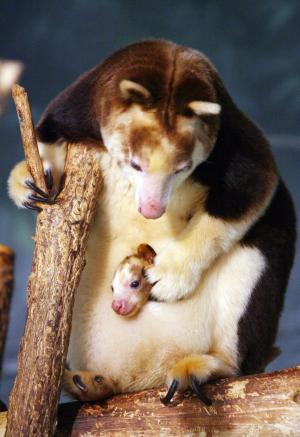
Matschie's Tree Kangaroo
Phylum : Chordata
Class : Mammalia
Infraclass : Marsupialia
Order : Diprotodontia
Family : Macropodidae
Genus : Dendrolagus
Species : D. matschiei

Body Length : 30in (76cm)
Weight : 20lbs (9kg)

IUCN Status : Endangered

The Matschie's Tree Kangaroo (named after German zoologist Paul Matschie) is a herbivorous marsupial found only on New Guinea's Huon Penninsula. Not much is known about their behavior in the wild, but they are relatively common in captivity.

Mother and Joey
Matschie's Tree Kangaroos have a whole mess of adaptations that let them live the arboreal, rainforest lifestyle. They have large front limbs and padded feet that help them to climb. They also have enormously long tails that act as counter-balances. Furthermore, the Kangaroos have fur on their necks and backs that grows in an opposite direction from the rest of their body. They can then hunch over while it's raining and have all the water run right off, keeping them dry.

Like all marsupials, pouches play a major role in reproduction. The female Kangaroos has a gestation period of only 44 days, and she gives birth to a Joey that is only an inch long. The Joey climbs up and into the pouch where he will stay without leaving for about 8 months. He will return to the pouch off and on for a few more months after that, and will finally leave his mother a year and a half after being born.

Matschie's Tree Kangaroos are on a population decline due to habitat loss and hunting.

Thứ Tư, 16 tháng 2, 2011

Long Nosed Bandicoot
Phylum : Chordata
Class : Mammalia
Infraclass : Marsupialia
Order : Peramelemorphia
Family : Peramelidae
Genus : Perameles
Species: nasuta

Length : 12-18in (30-46cm)
Weight : 2.2lbs (1kg)

IUCN Status : Least Concern

I'm going to be honest. Yesterday's animal (the Melon Aphid) grossed me out a bit. Tiny virus spreading insects that lives in massive swarms are just a wee bit unnerving to me, so today I need to turn it around and do something a little less frightening... like Bandicoots. Which I suppose could be a bit creepy if encountered after dark, (which is when they are most active) but better than Aphids at least...

There are actually about twenty different species of Bandicoot, which are marsupials found in Australia. This species in particular is found along the eastern edge of the continent. The Long Nosed Bandicoot is the largest member of its genus, and it has an exceptionally long snout (hence the name.) They are a bit plain in color, and don't have some of the fancy stripes that the other species have.

Did you know that the female Long Nosed Bandicoot is only pregnant for 12 days? The young are helpless at birth, like all tiny marsupials are, but it only takes them 60 days to be completely weaned. The female can then produce another litter just days later. Females have pouches that open toward the rear, which keeps their young from getting dirt kicked at them while mom digs for food.

Long Nosed Bandicoots are omnivores, and spend their nights foraging for roots and insects. They dig holes with their feet and stick their snouts in to sniff for meals. During the day their sleep in burrows.

Chủ Nhật, 26 tháng 12, 2010

(Image Source)
For boxing day let's take a look at a boxing beast! Red Kangaroos are the largest of the marsupials, with males weighing up to 200lbs (90kg) and standing close to 6ft (1.8m) tall. They live in the inland areas of Australia, residing in open scrub and grasslands.

Red Kangaroos (Macropus rufus) are quick and powerful, with strong legs an sharp claws. They can hop at speeds of up to 39mph (64kph) and can jump in strides of 25 ft (8m) and go as high vertically as 6f t(1.8m).  During the breeding season males will fight over mates by leaning back on their tails and "boxing" with their feet. 

Like all marsupials, Red Kangaroos give birth to tiny, tiny offspring that then continue to develop and grow inside  of a pouch. Young Kangaroos, called Joeys, are only 2.5cm at birth. They crawl into the pouch, latch on to a nipple, and don't emerge again for 2 months. Joeys remain with their mothers for about 8 months after birth.

Red Kangaroos live in small groups, called mobs. These groups are made up of females and their offspring, along with a male or two. They are herbivores, and feed on grasses and flowering plants. Red Kangaroos are preyed upon by Dingos and Humans, and large birds will sometimes go after the Joeys. They are listed at Least Concern.