Hiển thị các bài đăng có nhãn Cephalopod. Hiển thị tất cả bài đăng

Thứ Ba, 17 tháng 12, 2013

Haliphron atlanticus
The Seven-arm Octopus has a misleading name. They do actually have eight arms, like all Octopuses do, it's just that one of the arms (the hectocotylus, used for egg fertilization) is often curled up on the males' bodies, making it difficult to see. Females of the species do that have that issue.

Seven-arm Octopuses live in both the Atlantic and the Pacific oceans. It was believed to live only in the former until about fifteen years ago, when one was caught off the coast of New Zealand. Interestingly, these creatures have also been found at both the sea floor AND near the surface, which is unusual for Octopuses.

The species is also notable because they are quite large. In fact, they are the largest Octopuses in the world, and can measure over 11ft in length!

IUCN Status : Not Listed
Location : Atlantic and Pacific Oceans
Size : Length up to 11ft (3.5m)
Classification : Phylum : Mollusca -- Class : Cephalopoda -- Order : Octopoda
Family : Alloposidae -- Genus : Haliphron -- Species : H. atlanticus
Images : RL Hudson

Thứ Ba, 12 tháng 2, 2013

Enteroctopus dofleini
The Giant Pacific Octopus is regarded as being the largest of all the Octopus species. Some specimens have weighed in at 150lbs! They have arms that can reach six feet in length, and the females are generally larger than the males. As with many Octopus species, they have special pigment cells in their skin that allow them to change color to match their surroundings.

As the name denotes, this Cephalopod lives in the Pacific Ocean-- specifically in the North Pacific. You'll find these Octopuses at a wide range of depths, from the shallow coasts to waters as deep as 1,500ft. They feed on Mollusks and Crustaceans, breaking shells with their strong beaks. For the extra tough prey, they have a organ called the Salivary Papilla. They can use this to bore into shells, and secrete saliva that can corrode the tough layers.

Giant Pacific Octopuses have a surprisingly short life-span. Five years tends to be their maximum life expectancy, and most live even fewer years than that. Females pass on while guarding their young, starving themselves so that their eggs stay safe. She may lay as many as 100,000 eggs, and will spend seven months in a den, tending to her offspring until they hatch. Though males do not take part in this obsessive brooding ritual, they too die not long after mating.

IUCN Status : Not Listed
Location : Pacific Ocean
Size : Weight up to 150lbs (68kg)
Classification : Phylum : Mollusca -- Class : Cephalopoda -- Order : Octopoda
Family : Octopodidae -- Genus : Enteroctopus -- Species : E. dofleini

Thứ Sáu, 28 tháng 12, 2012

Amphioctopus marginatus
The Coconut Octopus is a rather unusual Cephalopod, in fact, they are one of only two different Octopus species that has been observed walked in a bipedal nature. Furthermore, depending on how you look at it, they actually use tools!

The tropical waters of the western Pacific Ocean is where there creatures call home, dwelling in areas where there is a sandy bottomed floor. They aren't especially large-- their heads are about 3in long, while the tentacles measure an additional 6. They feed on small Crustaceans and Clams.

Coconut Octopuses get their name from the fact that they use coconut shells for protection and shelter. They pick up discarded half shells and carry them around their soft bodies. When threatened, they can cover themselves with the shells, creating a permanent hiding place. There are many scientists who argue that this constitutes tool usage, while there are a handful that dispute the claim.

IUCN Status : Not Listed
Location : Pacific Ocean
Size : Arm length around 6in (15cm)
Classification : Phylum : Mollusca -- Class : Cephalopoda -- Order : Octopoda
Family : Octopodidae -- Genus : Amphioctopus -- Species : A. marginatus

Thứ Bảy, 20 tháng 10, 2012

Nautilus pompilius
The Nautilida Order contains six extant species and a handful of extinct ones, some of which date all the way back around 550 million years. They are primitive Cephalopods that often are given the "living fossil" moniker-- they have changed very little over the past several million years.

The Chambered Nautilus is perhaps the best known of the bunch. They are large in size (one subspecies reaches just under a foot in shell diameter) and have a very widespread distribution across the Pacific.

The shell of the Chambered Nautilus is covered in dark and light stripes-- a coloration pattern that camouflages them. The shell serves as protection, and also helps with buoyancy  as the Nautilus can fill and empty out different pockets with gas. As they grow, the shell gains new chambers, and full grown adults will have around 30 different compartments.

Aside from the shell, the Chambered Nautilus displays several other interesting traits. For one, they have no lenses or corneas in their eyes. Secondly, they have around 90 tentacles, none of which have suckers (something most other Cephalopods have).

The Chambered Nautilus is a very slow growing creatures. They are between 15 and 20 years old before they reach sexual maturity. Reproduction takes place internally, with four of the males' tentacles forming a part called the spandix. They use this to transfer a spermatophore mass to the female. The mass attaches to the female's mantle and releases the sperm. Newly hatched babies have shells that measure about 1in in diameter.

Back during the Renaissance, Chambered Nautilus shells were very popular with artists and collectors. They would attach the shells to metal stems, forming decorative cups. Some got exceptionally elaborate-- like this piece using guilt silver that looks like an Ostrich!

IUCN Status : Not Listed
Location : Pacific Ocean
Size : Shell Diameter up to 10in (25cm)
Classification : Phylum : Mollusca -- Class : Cephalopoda -- Order : Nautilida
Family : Nautilidae -- Genus : Nautilus -- Species : N. pompilius

Thứ Năm, 30 tháng 8, 2012

Hapalochlaena lunulata
The Greater Blue-ringed Octopus is, interestingly, not even the largest of the Blue-ringed Octopuses. That honor goes to the confusingly named Lesser (or Southern) Blue-ringed Octopus, which is only a hair larger. In fact, all members of the Blue-ring groups are quite small-- most are only a few centimeters in body length, with tentacles only a tad longer.

 The Greater Blue-ringed Octopus is distinctive among its family members in that it has a relatively large range. Most others live in a very specific watery area, but the Great Blue-ringed can be found in tropical waters throughout the Pacific Ocean, and in parts of the Indian Ocean as well.

These Octopuses get their names from the bright blue circles that appear when they feel threatened. I should note that these rings are visible during calm periods as well, but they are much less noticeable. Those vibrant patches serve as warnings to predators because these guys are venomous! Greater Blue-ringed Octopuses actually have two types of venom-- one that they use to deter would-be attackers, and one that they themselves use to attack prey (small little invertebrates and fish).

Great Blue-ringed Octopus venom can be incredibly dangerous to humans. They don't usually attack unprovoked, but if you do something to make them feel threatened, watch out! The toxin paralyzes and can kill in a matter of minutes!

IUCN Status : Not Listed
Location : Tropical Pacific Ocean
Size :  Body length up to 5cm
Classification : Phylum : Mollusca -- Class : Cephalopoda -- Order : Octopoda
Family : Octopodidae -- Genus : Hapalochlaena -- Species : H. lunulata

Chủ Nhật, 9 tháng 10, 2011

Euprymna scolopes
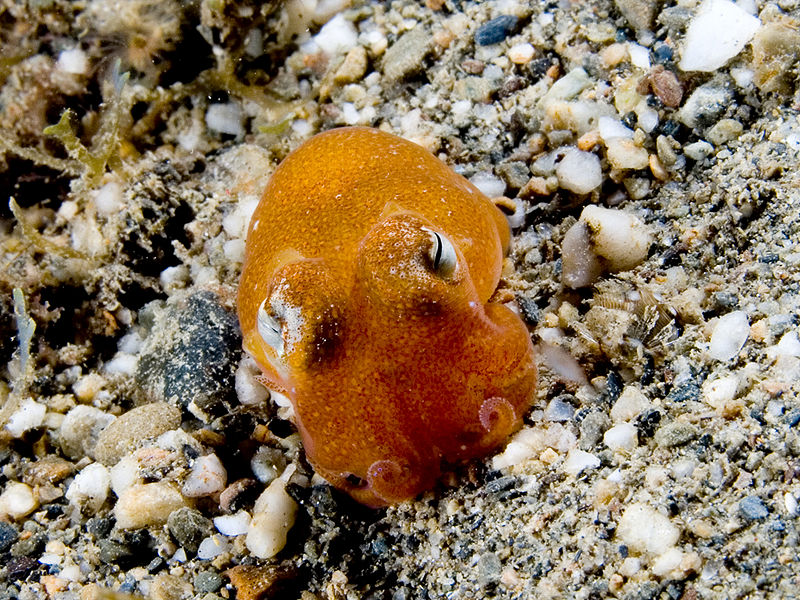
The Hawaiian Bobtail Squid is an itty bitty little thing that has a mantle length of only around one inch! As the name suggests, they can be found off of Hawaiian waters, though they also live in other shallow coastal areas of the central Pacific as well.

The most important thing that you need to know about the Hawaiian Bobtail Squid is has a symbiotic relationship with a bacteria known as Vibrio fischeri.

The bacteria inhabit an organ in the Squid's mantle. The Squid feeds the Bacteria a solution of amino acids and sugar, and in return for the meal the Bacteria gives the Squid a defensive advantage. You see, the organ that the Bacteria lives in deals with light, and the Bacteria itself is bioluminescent. The Bacteria are able to determine the amount of light hitting the top of the Squid's mantle, and then emulate that on the underside. This makes it very difficult to see the Bobtail Squid when looking upwards.

The Squids are not born with the Bacteria ready to go, they must acquire the little helpers by using an attractive mucus. At the end of the Squid's day, most of the Bacteria is expelled in order to conserve body energy.

Hawaiian Bobtail Squid feed on tiny crustaceans, and they themselves are preyed upon primarily by Monk Seals. Even if they are able to avoid the hungry Pinnipeds, the Bobtail Squids have very short lifespans, typically living only 3-10 months.

IUCN Status : Not Listed
Location : Pacific Ocean
Size : mantle length 1.2in (3cm)
Classification : Phylum : Mollusca -- Class : Cephalopoda -- Order : Sepiolida
Family : Sepiolidae -- Genus : Euprymna -- Species : E. scolopes

Thứ Sáu, 8 tháng 7, 2011

Teuthowenia pellucida
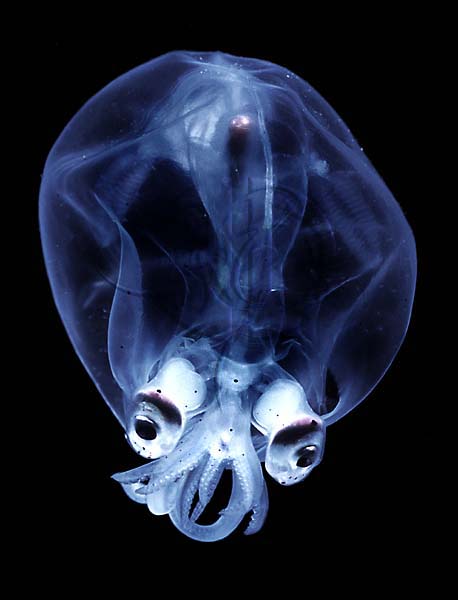
Sometimes, when I don't have any suggestions lined up, I start doing Google searches for weird animal names, just to see if they exist. Apparently there is no such thing as a  "Pumpkin Squid," but that near-futile effort did lead me to todays animal, the awesomely named Googly-Eyed Glass Squid.

There are about 60 different species of Glass Squid, all found within the Cranchiidae family. They can be found in oceans worldwide, and most share the common characteristic of having transparent bodies.

The Googly-Eyed Glass Squid is no exception to this. Their small bodies (females are slightly larger than males) are transparent, and they posses very large eyes which give them their common name. They live in the deep oceans, around 7,500ft (2300m) down.

Googly-Eyed Glass Squids have photophores on their tentacles and eyes that allow them to be bioluminescent. They also have the interesting ability to puff themselves up, making them seem much larger to predators.

IUCN Status :  Not Listed
Location : Southern Oceans
Size : Body length up to 8in (~200mm)
Classification : Phylum : Mollusca -- Class : Cephalopod -- Order : Teuthida
Family : Cranchiidae -- Genus : Teuthowenia -- Species : T. pellucida

Thứ Bảy, 21 tháng 5, 2011

Spirula spirula
Today we have another reader suggestion, Spirula spirula, also known as the Ram's Horn Squid. As the suggester points out, the shell of this creature may look very familiar, but most people probably don't know that it belongs to a tiny, deep sea cephalopod!

The Ram's Head Squid can be found in tropical waters at depths as far as 3,300ft (1,000m). They are little things, with body lengths measuring only around 1.6in (40mm). The Ram's Head Squid has eight arms and two longer tentacles, all of which have suckers. Adults are able to partially draw them in to their mantle.
Internal Shell

The shell that we spoke up earlier is actually found completely within the squid, and it helps to control buoyancy.  Because of that mechanism the Squids swim in a head-down motion.

Ram's Head Squids only live about a year and a half, and a lot of their behavior is not well known due to their small size and deep sea living. We do know that they are carnivores, that they reproduce in a way similar to many other squids. Males use a a tentacle to implant a sperm sac on to the female.

IUCN Status :  Not listed
Location : Tropical Oceans
Size : Body Length up to 1.6in (40mm)
Classification : Phylum : Mollusca -- Class : Cephalopoda -- Order : Spirulida
Family : Spirulidae -- Genus : Spirula -- Species : S. spirula

Thứ Bảy, 19 tháng 3, 2011

Vampire Squid
Phylum : Mollusca
Class : Cephalopoda
Order : Vampyromorphida
Family : Vampyroteuthidae
Genus : Vampyroteuthis
Species : V. infernalis

Length : 1ft (30cm)

IUCN Status : Not Listed

Vampyroteuthis infernalis literally means "Vampire Squid from Hell," which is a scary name for a creature so small. They are remarkably interesting because they are the sole living members of the Vampyromorphida order, and the have traits of both Octopuses and Squids. When they were discovered and described in 1903, they were initially placed within the Octopus Order.

The Vampire Squid is different from True Octopuses and Squids in a handful of ways. Their bodies posses the same color changing chromatophores that Squids have, but they lack the ability to actually change color. They have webbing between their eight arms, which is similar to Octopuses, but they also have two long filaments that can extend and retract. These filaments look similar to the two long tentacles found on Squid, but are different in function and composition. The Vampire Squid's arms, (along with their sometimes red eyes) help to give them their name. Each arm has a row of suckers, along with a row of spines that look a bit like pointed teeth.

Juvenile Vampire Squids go through an interesting metamorphosis as they grow, causing a total change in the way that they move. When they are young they move by jetting themselves around, and the two little fins on their mantle don't do much. When they reach about 2.5cm long, they grow a whole new pair of fins, and the first set is absorbed into the body. At this point the Squid propels itself with the fins rather than with jetting.

Vampire Squids, like many other crazy looking ocean dwellers, can be found in the deep seas between 1,000-10,000 ft (300-3,000m) down. They are found in temperate and tropical oceans around the world. Their bodies have proportionally huge eyes and numerous bioluminescent organs called photophores. The photophores are larger at the tips of the arms, and the Vampire Squids ability to manipulate these lights helps them to disorient prey and to escape from their own predators.

Thứ Năm, 13 tháng 1, 2011

(Image Source)
Phylum : Mollusca
Class : Cephalopoda
Order : Teuthida
Family : Magnapinnidae
Genus : Magnapinna

Length : 5-23ft (1.5-7m)
Weight : Unknown

IUCN Status : Not listed

I'm afraid that this entry might be a short one, simply because these Squid are still so unknown to us. There are five identified species, but two are still unnammed, and all five still hang in a bit of taxonomic limbo, subject to change with any sort of breakthrough.

Big Fin Squid have been found in the deep waters of the Atlantic and Pacific Oceans. As their name denotes, they have large fins that extend outward from the mantle (their main body segment.) Big Fin Squids also have ten arms, all of about equal length and thickness. Many other squid species, in contrast, have eight shorter arms with two longer tentacles.The arms of Big Fin Squids are also typically hung at right angles, as if they have elbows.

Only larval and juvenile Big Fin Squids have actually been physically studied. Videos and images of adults have been picked up by underwater cameras and ROV's (Remotely Operated Vehicle), but because these are just images it is difficult to properly study them and even establish them as specific species. A few years ago, in 2007, an ROV owned by the Shell oil company in the Gulf of Mexico picked up an image of one of these Magnapinna species.

Thứ Hai, 12 tháng 7, 2010

Image from New York Daily News
The 2010 World Cup ended yesterday, and while the world is abuzz with Spain's first win, there has also been a great deal of talk about Paul. Who is Paul? Paul is the Common Octopus "Oracle" who correctly picked the outcomes of all 7 of Germany's games, plus the World Cup Final. Treats were placed in boxes adorned with national flags. The treat eaten first was the winning team. Paul went 8 for 8. (Though he did make some blunders during the 2008 Euro) Anyway, Paul is retiring now, but in celebration of his strange cephalopod superpowers, enjoy some facts on the Common Octopus (Octopus vulgaris)!

Common Octopuses (Octopi is actually an incorrect plural term) are found in temperate and tropical coastal waters across a great deal of the planet. They live at depths shallower than 500 feet. Octopuses are carnivorous, and are active predators during the daytime. They feed primarily on crustaceans and mollusks, and they will actually stockpile their food to eat at a later time. They hunt by a variety of methods, including stalking, luring, and simply groping around for their prey. After consuming a meal, they will leave the shell in a heap known as a midden pile. These piles help scientists to study not only what Octopuses eat, but also what kinda of organisms live in the area.

Image from Animal Picture Archive
Octopuses have some pretty amazing senses. They have the largest brains of any invertebrate and have both long and short term memories. They are also capable of some pretty advanced problem solving. The Common Octopus has wonderful eyesight, and they are able to distinguish between other creatures and objects, both by sight and by touch.they also have extremely flexible bodies, and can squeeze through spaces that are only a fraction of their overall body size.

Common Octopuses also have an amazing array of defense mechanisms. They are able to change both the color, and the texture of their skin. This allows them to hide virtually in plain sight. Skin color is also able to reflect the mood of the Octopus. Another defense they have is their ink. If the camouflage fails, the Octopus will shoot a jet of ink at its attacker, which disorients them and gives the Octopus time to escape. This ink also contains a substance that affects the attackers' sense of smell, further allowing the Octopus to flee in safety.

Thứ Sáu, 21 tháng 5, 2010

Did you know that a cuttlefish is not actually a fish? It's a mollusk! They are actually more closely related to snails then they are to fish. Like squids, octopi, and nauteluses, the cuttlefish is a cephalopod. Members of class cephalopoda have been dated back 500 million years!

There are currently 120 species of cuttlefish recognized, all of which live in shallow tropical and temperate waters around Europe, Asia, Africa and Australia. Cuttlefish have a pretty interesting mechanism built in to their bodies: the cuttlebone. Made primarily of aragonite, these structures act as buoyancy mechanisms, enabling the cuttlefish to float at a steady, desirable level. The existence of this bone is also what prevents the cuttlefish from surviving at deep depths, as they will implode when there is too much pressure. Cuttlebones are very rich in calcium, and are often given to caged pets like parakeets and reptiles as supplements.

Cuttlefish have the ability to change their skin color in order to blend in with their surroundings. They do this with help from three special types of skin cells: chromatophores, iridophores, and leucophores, all of which reflect light in different ways to cause the camouflaged effect. With their stealthy camouflage in place they are  able to ambush their prey, which is caught using their eight arms and two tentacles, all of which possess a pad at the end which is covered in powerful suckers.Their diets consist of fish, crustaceans, and even other cuttlefish. They also make use of their color changing skills in mating displays and to hide from predators. Cuttlefish have one of the largest body size to brain ratios among invertebrates, and are considered to be one of the most intelligent of all invertebrates. Their cleverness and thinking skills are pretty astounding when you realize that many of their mollusk relatives don't even possess brains!