Hiển thị các bài đăng có nhãn Ratite. Hiển thị tất cả bài đăng

Thứ Năm, 21 tháng 3, 2013

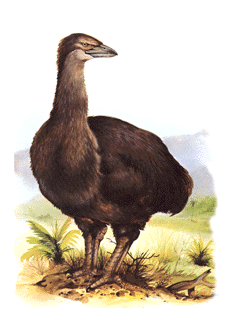
Elephant Bird
"Elephant Bird" is the name given to members of the Aepyornithidae Family. These gigantic, flightless Ratites lived on Madagascar, and all are extinct. Though they are distant relatives to Ostriches, it is believed that their ancestors branched off from those birds as far back as 85 million years ago.

There were half a dozen different Elephant Bird species, and all were quite large-- some stood over 10ft tall! They were even an inspiration for Marco Polo's fantastical tales of the legendary Roc. They were similar in size to the Moa of New Zealand, but were much heavier. The Elephant Birds could reach 900lbs, while the Moa were only around 550.

It is difficult to get the full evolutionary history of the Elephant Birds, because Madagascar is a rainforested island, and fossils do not do well in such conditions. We do know that they survived into modern times, and may have still been around in the 17th century based on reports. Semi-fossilized eggs have also been located, and some even have young birds still inside them!

Humans were most likely the culprits in the extinction of the Elephant Birds. We know that they were hunted for many years, as evidenced by tool marks on bones. Their eggs were also consumed. They may also have died out with help from diseases brought over by introduced birds like chickens.

Status : Extinct since 17th Century, possibly earlier
Location : Madagascar
Size : Height up to 10ft (3m), Weight up to 900lbs (408kg)
Classification : Phylum : Chordata -- Class : Aves -- Order : †Aepyornithiformes
Family : †Aepyornithidae
Image : Cryptomundo

Thứ Năm, 14 tháng 2, 2013

Emu

Dromaius novaehollandiae
The Emu is the second largest bird in the world, behind only the Ostrich. These Ratites can stand over 4ft tall at the shoulder, and with their long necks can reach over 6ft. They also have incredibly long legs that give them a stride distance of nearly 3m. These legs also pack a literal punch-- Emus can seriously injure attackers, and have been known to kick down fences!

And what about those weird feathers? Because they don't need specialized flying feathers, they grow a shaggy covering that keeps them cool and insulated from direct sunlight. And did you know that they do actually have tiny wings under there? They can flap them, but they are too small to really do anything with.

You'll find the three Emu subspecies in Australia, where they live in just about every type of environment. (Not-so-fun-fact: There were once two other Emu species. Both went extinct after the arrival of Humans). They tend to live either alone or in pairs, though they will occasionally migrate in larger groups when nesting or searching for food.

Emus forage diurnally, feeding on various plants and insects. They also have to eat rocks and charcoal, which aid in the digestion of plant matter. You might be surprised to learn that Emus do have have a number of natural, non-human predators. Dingoes and Wedge-tailed Eagles are two animals that will attack a full grown Emu, going after their exposed necks. Several other creatures will take eggs and juveniles.

Currently, Emus are abundant in mainland Australia. They are also found all around the world in captivity, and are even farmed for their meat, leather, and oil.

IUCN Status : Least Concern
Location : Australia
Size : Height up to 75in (1.9m)
Classification : Phylum : Chordata -- Class : Aves -- Order : Struthioniformes
Family : Dromaiidae -- Genus : Dromaius -- Species : D. novaehollandiae

Thứ Năm, 29 tháng 12, 2011

I don't have very much to say about today's animal, as there isn't a whole lot known about it. The frustrations of extinct species, right?

Modern Ostrich
I picked the Asian Ostrich today because I read this really interesting article on Chinese Phoenixes. They have been depicted in art for thousands and thousands of years, but where they really an Ostrich?

Giant Ostriches lived up until the end of the last Ice Age, around 10,000 years ago. Phoenix Imagery has been appearing for 7,000 years, so was the Giant Ostrich, which roamed about China, the source of this myth?

Makes you wonder what other now extinct creatures inspired the animals of legend!

IUCN Status : Extinct for around 10,000 years
Location : Asia
Classification : Phylum : Chordata -- Class : Aves -- Order : Struthioniformes
Family : Struthionidae -- Genus : Struthio -- Species : S. asiaticus

Chủ Nhật, 20 tháng 3, 2011

Upland Moa Illustration by Peter Schouten
Phylum :Chordata
Class : Aves
Order : Struthioniformes
Family : †Dinornithidae
Genus : †Megalapteryx
Species : †M. didinus

Height : 4ft (1.3m)
Weight : 55lbs (25kg)

Status : Extinct since 1500CE

I feel like this might be a little bit of a cheat here, since I did actually cover Moas before, albeit in a very general fashion. Today though, I'll be talking about one specific species of Moa, the Upland Moa, which was the smallest of the species, as well as the last to go extinct.

Upland Moas, as the name suggests, lived in the higher, cooler elevations of New Zealand's South Island. One remarkable feature of this species is that they are the only Moas to have feathers all the way down their legs and feet. The feathers and their small size were adaptations to their cold weather environment.

Mummified Moa Head
How do we know about these feathers? Mummification of course! Because Upland Moas lived in such cold, dry habitats, their bodies have been subject to the process of natural mummification. We have examples of mummified Upland Moa heads and feet, which allow us to know more about the species than mere bones would. For example, we know from these specimens that Upland Moas had small olfactory chambers, which means that they may have had greater vocal skills then other Moas.

Their high elevation habitat is probably what allowed these birds to live longer then the other Moas. They only had one predator before the arrival or man, the Haast's Eagle, and due to their remote location it took humans longer to find and hunt them. They went extinct sometimes around 1500CE.

Thứ Ba, 7 tháng 12, 2010

Did you know that there are actually five species of Kiwi, the national symbol of New Zealand? And that the largest of these is the Great Spotted Kiwi? Well now you do! This specific, nocturnal, species is currently listed as vulnerable, and is found in only a few forested, mountainous areas on the South Island.

(Image Source)
Great Spotted Kiwis (Apteryx haastii) have some rather interesting anatomical features. First off, females are actually larger than males, growing up to 20 inches in length, as opposed to 18, and weigh up to 7lbs, as opposed to 5. Like all Ratites, Great Spotted Kiwis are flightless. They have wings, but they are extremely small and lack the powerful breast muscles that allow for flight. To compensate, they have strong legs that allow them to move about quickly, and also allow them to attack with the ability to cause fatal wounds. Males use their feet to fight over territory, and the birds are even able to fend off mustelid predators with them as well.

The Great Spotted Kiwis, and the other four Kiwi species, are also unique in that they have nostrils at the very ends of their beaks rather than closer to the head. They have excellent senses of smell, which makes up for their rather poor eyesight. Their noses help them to track down food, which includes insects and fruit.

Great Spotted Kiwis mate for life, which might be as long as twenty years. Only one gigantic egg is laid, which weighs up to 15% of the female's body mass. It is incubated by both parents for 70 days. Chicks become self sufficient within only two weeks, but they stay by the nest for a month or so.

Once numerous across the South Island, Great Spotted Kiwis are now on a population decline. They evolved in an environment with few ground predators, so the introduction of dogs, cats, weasels and other invasive predators has led to a decrease in birds. Conservation measures are being taken to remove predators from the equation, but the total number of birds is now believed to be less than 22,000.

Thứ Năm, 9 tháng 9, 2010

When people think of flightless birds, they think Ostrich, Emu, maybe even Kiwi. But what about the Rhea? There are two species of Rhea, both native to the grasslands of South America. Like the aforementioned birds, Rheas are ratites; birds that lack an anchor for their wing muscles, and thus cannot fly. Rheas still have large (for a Ratite) wings, but they are used for balance while running.

Image Source
The largest of the Rheas, the Common or American Rhea (Rhea americana), cant grow to heights of 5 feet, while the Lesser or Darwin's Rhea (Rhea pennata) grows to only 3 or 4. They are omnivores, and will consume fruits, seeds, lizards, insects, and even carrion. Rheas are solitary through the breeding season, but will form flocks during the winter. These flocks sometimes intermingle with those of other species.

Interestingly, it is the male Rheas that do most of the egg-guarding and chick-rearing. What is even more interesting is that Rheas are polygamous, and the males take more than one mate. All of his breeding partners will lay their eggs in the same place to be watched over by the male. A Rhea egg can weight 1.5lbs.

Like Ostrich, Rhea meat can be eaten, and the industry is regulated by the USDA which considers it to be "red" meat. Rhea feathers and skins are also used for various purposes, including clothing and decoration.

Thứ Ba, 17 tháng 8, 2010

Moa

I just love huge birds. Huge Ravens, Huge Eagles, Huge Hummingbirds. So obviously, gigantic extinct flightless creatures of awesome would also capture my interest. Too bad humans killed them all.. they went extinct in only a few hundred years ago. I should also mention that when I say Moa, I'm actually referring to eleven separate species within six genera.
Image from Zoological
Society of London / LiveScience

Like yesterday's gigantic insect, Moas inhabited New Zealand, where they evolved into giant, flightless creatures because there were no land mammals (aside from bats) to compete with. The Moas only predator (until man) was the similarly gigantic Haast's Eagle, now also extinct, but that had a 10ft wingspan.

The largest species of Moa stood 6ft tall at the back, and none of them had wings, even vestigial ones, which is very unique among birds. Feathers show that they were red and brown, and their eggs measured roughly 24cm in length. Because of their lack of predators, it is believed that Moas lived 50 years or more. Most species exhibited sexual dimorphism, with the females being larger and heavier than the males. Interestingly, the Moas closest relatives are not the extant flightless Kiwis, nor are they the Australian Cassowaries and Emus. Tinamous, smaller South American birds, are now said to be their nearest cousins.

The downfall of the Moa began around 1280CE, when people first inhabited the islands of New Zealand. The Mos were not used to these new hunters, and they became easy prey.  Their habitats were diminished, and they were hunted for their meats and bones. By the 1400s, they were believed to be extinct. Carbon-14 testing supports that timeline, though hunters claimed to have spotted Moas for several hundred years after. Even today, there are individuals who claim to see Moas.

Thứ Năm, 15 tháng 7, 2010

I've been reading this quite delightful book called Birdology, which devotes each of its chapters to a different type of bird, and the author's experiences with the bird. Well, chapter two is all about the Cassowary. Cassowaries are large, flightless birds endemic to Northern Australia and New Guinea. They are among the largest birds in the world, and their closest living relatives are the Australian Emus.

Image from CCWild
There are three extant species of Cassowary, all belonging to genus Casuarius. They are the Southern Cassowary, the Northern Cassowary, and the Dwarf Cassowary. All three species are similar in appearance. The birds sport large crowns called casques on their heads. The true purpose of the casque is unknown, but speculation is that they may help to produce low frequency sounds. Cassowaries have long, course, black feathers that cover most of their bodies. They neck is naked, and sports blue and red skin. The species differ in size, casque appearance, and type of (or lack of) wattle. Male Cassowaries are smaller than the females.

The only time I've ever
seen a Cassowary
Cassowaries are solitary birds most of the time. If a male successfully courts a female, the couple will remain together for a few weeks until the eggs are laid. (If unsuccessful, he can be seriously injured!) Once laid, the female departs, and has nothing to do with the incubation and care of her offspring. All of those duties go to the male. He incubates for about 50 days, and then cares for his offspring for an additional nine months, teaching them how to find food and avoid predators.

Cassowaries are responsible for numerous attacks on human beings, and are listed as the world's most dangerous bird. The inside third toe in each of their feet is actually a spike that grows nearly five inches long. When threatened, the Cassowary is capable of leaping several feet into the air and attacking with their clawed feet. When not being threatened, they are very shy creatures, and can be extremely difficult to spot in the wild. They are also relatively uncommon in zoos, due to their nature. Native people in New Guinea hunt Cassowaries, and use their claws and bones to make weapons.