Hiển thị các bài đăng có nhãn Crustacean. Hiển thị tất cả bài đăng

Thứ Tư, 12 tháng 2, 2014

Eriocheir sinensis
Today we're going to learn about the Chinese Mitten Crab-- a Crustacean named for its large, furry front claws.

You may not think too much about the environmental impacts this crab, whose body is about the size of a fist, but they are actually a very troublesome invasive species! Chinese Mitten Crabs are native to eastern Asia, but they have now spread to Europe and North America as well.

Chinese Mitten Crabs are troublesome because they make large migrations, displacing native species at every step of the journey. They breed in the oceans, grow up in freshwater rives, and hatch in estuaries. Due to their movements they can even be found hundreds of miles from the sea! In all of those different habitats the Crabs compete with native species for food and burrows. They also damage fishing nets, and have caused that industry to lose great amounts of money.

Not everyone is frustrated with the Chinese Mitten Crabs though-- they are a delicacy in parts of China and some can sell for over $100 a kilogram!

IUCN Status : Not Listed
Location : Native to Asia
Size : Carapace up to 4in (10cm) in diameter
Classification : Phylum : Arthropoda -- Class : Malacostraca -- Order : Decapoda
Family : Varunidae -- Genus : Eriocheir -- Species : E. sinensis
Image : NHM

Thứ Sáu, 17 tháng 1, 2014

Lysmata amboinensis
The Pacific Cleaner Shrimp is a Crustacean of many, many names. Their list of alias includes the Skunk, Scarlet, and Northern Cleaner Shrimp (because of their location and identification).

The "Cleaner" part comes from the fact that these small, 2in long Shrimp feed on dead tissue, debris, and parasites of much larger aquatic species. In fact, larger fish are known to seek out the reefs that the Pacific Cleaner Shrimp live on, just so the shrimp can help to  get rid of trobulesome parasites! They will even go inside of a fishes' mouth!

Pacific Cleaner Shrimp are found in the tropical waters of the Indian and Pacific Oceans. They live relatively close to the surface, hanging out in the coral reefs.

Amazingly, every single Pacific Cleaner Shrimp is born male. As they age they go through metamorphosis and molt, and eventually becoming hermaphrodites.

IUCN Status : Not Listed
Location : Tropical Indo-Pacific Waters
Size : Length up to 2in (6cm)
Classification : Phylum : Arthropoda -- Class : Malacostraca -- Order : Decapoda
Family : Hippolytidae -- Genus : Lysmata-- Species : L. amboinensis
Image : Chris Moody

Chủ Nhật, 5 tháng 5, 2013

Armadillidium vulgare
Despite the name, the Common Pillbug is not a bug at all. It is actually a Crustacean! They live on land (unlike many of their more well known relatives) and feed on decaying plant matter.

Common Pillbugs are named for their ability to roll up into little balls when they are alarmed. Interestingly, their genus name Armadillidium, is named for another rolly-polly creat
ure-- the Armadillo!

These critters are found in abundance throughout continental Europe and the British Isles. They have also been introduced to parts of North America. They live on land, and hide in dark, moist places during the daytime hours.

Many Crustaceans breed in water, but not these Pillbugs! They actually reproduce on land, and pay their eggs in large sacs. The eggs incubate within those sacs, and tiny juvenile Pillbugs emerge from the sac fully formed.

IUCN Status : Not Listed
Location : Europe
Size : Length up to 18mm
Classification : Phylum : Arthropoda -- Class : Malacostraca -- Order : Isopoda
Family : Armadillidiidae -- Genus : Armadillidium -- Species : A. vulgare
Image : Folini

Thứ Ba, 5 tháng 2, 2013

Corystes cassivelaunus
The Masked Crab gets its name from patterns that sometimes appear on its elongated carapace-- they can look like faces!

Aside from those designs, the Masked Crabs are yellowish to reddish brown in color, have very long antennae, and long pincers that can be twice the length of the body... well, for males at least. A females pincers are only about the same length as the carapace. Overall they are small crabs, only growing carapaces of a few cm.

This species is the only one listed within the genus Corystes and it is found in the Mediterranean and the North Atlantic. They are burrowers-- the dig backwards into the sand in order to hunt after the invertebrates that live in the substrate. While underground, the Masked Crabs stick their antennae into the water above, fusing them together to form a breathing tube.

IUCN Status : Not Listed
Location : North Atlantic
Size : Carapace length up to 1.6in (4cm)
Classification : Phylum : Arthropoda -- Subphylum : Crustacea -- Class : Malacostraca
Order : Decapoda -- Family : Corystidae -- Genus : Corystes -- Species : C. cassivelaunus

Thứ Sáu, 18 tháng 1, 2013

Nephropsis atlantica
The Scarlet Lobsterette is a small little Lobster (though still of a decent size when you compare them to all Crustaceans.) They measure it at only 4in long, which makes the diminutive name appropriate. They have bright red bodies, and are covered in small bristles.

You'll find these little guys in the East Atlantic, where they dwell in water as deep as 1,800m... though a "shallower" 1,400m range is more common. Due to their deep sea living they have unpigmented eyes, and they are not often photographed (hence the illustration).

They are interestingly the only Lobsters in their region that are not commercially fished, in part because of their depth range, but also because of their small size. They belong to a genus that contains a handful of other deep-sea dwelling Lobsters.

Scarlet Lobsterettes feed on a variety of different materials, both plant and animal. They also scavenge for their food.

IUCN Status : Not Listed
Location : Eastern Atlantic
Size : Length up to 4in (10cm)
Classification : Phylum : Arthropoda -- Subphylum : Crustacea -- Class : Malacostraca -- Order : Decapoda -- Family : Nephropidae -- Genus : Nephropsis -- Species : N. atlantica 

Thứ Hai, 8 tháng 10, 2012

Gecarcinus quadratus
The Halloween Crab goes by many names, including the Red Land Crab, Whitespot Crab, and Moon Crab. I personally like Halloween Crab though, since it really reflects the interesting colors. They have black carapaces, orange-red legs, and purple claws!

Halloween Crabs live in the Pacific coast mangroves and forests of Central and South America. They actually live in the forests as adults, and return to the ocean in order to reproduce. Did you know that they live as far away as 18 miles (30km)  from water? Not where you normally think Crabs to be!

While living in the forest, the Crabs forage nocturnally for different plant matter, including leaves and sapling. They also dig long burrows into the ground for protection. These burrows can measure nearly 5 ft long!

Halloween Crabs are sometimes kept in captivity, and can be very tricky pets due to their excellent climbing skills.

IUCN Status : Not Listed
Location : Central and South America
Size : Carapace length 2in (5cm)
Classification : Phylum : Arthropoda -- Subphylum : Crustacea -- Class : Malacostraca
Order : Decapoda -- Family : Gecarcinidae -- Genus : Gecarcinus -- Species : G. quadratus

Thứ Ba, 7 tháng 8, 2012

Chthamalus stellatus
Did you know that Barnacles, those weird bumpy things that attach themselves to rocks, are not only animals, but they are Crustaceans just like Crabs and Lobsters? Let's learn about one species today!

These Barnacles, named for Italian biologist Giuseppe Saverio Poli, can be found in Southern Europe and off the coasts of England and Ireland. They attach themselves to rocks and other firm objects in inter-tidal zones. Once attached, the Barnacles don't really go anywhere. They feed by reaching their tiny legs out from their shell and latching on to plankton and debris.

Poli's Stellate Barnacles have chalky-white shells that have kite-shaped openings as juveniles, and oval openings as adults. Underneath that shell, their tissue is bright blue with black and orange markings. The Barnacles are usually cone-shaped, but they become more tubular in crowded areas. They grow to a size of around 14mm, but the size is dependent on their habitat and food supply.

One thing I found particularly interesting is that all Poli's Stellate Barnacles are hermaphrodites. If isolated, the Barnacles can actually self reproduce, though in most cases they will take on a male or female role. "Male" Barnacles have very long sexual organs that they can use to search for "Females" in the nearby area. Keep in mind that this whole time the Barnacle itself remains latched on to a surface, and does not otherwise move. "Females" keep their fertilized eggs inside their shell with them until they hatch, and there can be up to 4,000 eggs at a time!

After hatching, the larvae are free-swimming and go through several molts until they hit their Cyprid stage. At this point in their life they are completely unable to feed, and must find a rock or something else to latch on to in order to metamorphose into their final shelled adult form. These Barnacles can live up to 5 years, and reach full maturity after around 10 months.

IUCN Status : Not Listed
Location : Europe
Size : Diameter up to 14mm
Classification : Phylum : Arthropoda -- Subphylum : Crustacea -- Class : Maxillopoda
Order : Sessilia -- Family : Chthamalidae -- Genus : Chthamalus -- Species : C. stellatus

Chủ Nhật, 3 tháng 6, 2012

Homarinus capensis
The Cape Lobster is a species of Crustacean that lives off the coast of South Africa. The main things to know about these guys is that they are incredibly elusive. From 1792 to 1992 only fourteen specimens were collected.

In 1992 the discovery of one of these rare Lobsters prompted a surge in discovery, and another 20 or so have been identified since... though most have been as parts regurgitated by fish.

Why are Cape Lobsters so hard to find? South Africa's waters have been more explored, studied, and cataloged than any other country's on the continent, why is the story here? Well, the Cape Lobsters are very small, especially when compared to the lobsters we normally think of. Their entire length is only around 4in, and their main carapace tops out around 2. This keeps them out of most Lobster traps.

Another cause for their elusiveness is that very little is known about their habitat and biology, and much of the existing information has been proven incorrect (they don't live in fresh water, for example). Cape Lobsters most likely live in rocky substrate areas, which are difficult to dredge or trawl in, so the Lobsters don't show up as a bycatch.

Cape Lobsters were once placed in the same genus as their larger American and European cousins. In 1995 it was determined that their relationship is more distant than previously thought, and they are now members of a monotypic genus.

IUCN Status : Data Deficient
Location : South Africa
Size : Length up to 4in (10cm)
Classification : Phylum : Arthropoda -- Subphylum : Crustacea -- Class
: Malacostraca
Order : Decapoda -- Family : Nephropidae -- Genus : Homarinus -- Species : H. capensis

Thứ Ba, 24 tháng 4, 2012

Parabogidiella ??
I just love new species, don't you? And today's animal is so new that it doesn't even have a species name yet!

Meet the newest member of the Parabogidiella genus. This tiny little half-inch Shrimp-like creature was discovered just last month in an underground pool in New Mexico.

Like many cave dwellers it lacks skin pigmentation, and it is also blind. Scientists found it in a subterranean body of water in the Carlsbad Caverns. The cave has been explored before, but this is the first time water samples were taken. These little Crustaceans were down there this whole time, and may have been in that cave for thousands of years, right under our noses!

There isn't much else to say, yet, about this new critter. But fingers are crossed that it will get a name soon!

IUCN Status : Not Listed
Location : New Mexico
Size : Length around .5in (1.3cm)
Classification : Phylum : Arthropoda -- Class : Malacostraca -- Order : Amphipoda
Family : Bogidiellidae -- Genus : Parabogidiella -- Species : P. ?

Chủ Nhật, 15 tháng 1, 2012

Penaeus monodon
Today we learn all about the Giant Tiger Prawn, one of the most widely distributed Shrimp in the world. They can be found throughout the coastal regions of the Pacific and Indian Oceans, and have the potential to become a troublesome invasive species in the Gulf of Mexico.

Giant Tiger Prawns are members of the Shrimp Infraorder. Two major differences between Shrimp and Prawns are the number of claws (3 sets in Prawns, 2 in Shrimp) and the abdominal bend that exists in Shrimp but not in Prawns.

When you think of Shrimp, you don't usually imagine something very large. Jumbo Shrimp being an oxymoron and all that. But Giant Tiger Prawns can grow to be a foot long! Their large size has led them to be farmed for food in some areas.

In the past few months, a handful of Giant Tiger Prawns have been found in the Gulf of Mexico. Their large size and huge appetite could severely upset the balance in that ecosystem. No one is sure yet where the Prawns came from, or how much effect they could have, but they could be incredibly damage to to the native Crustacean populations.

IUCN Status : Not Listed
Location : Indian and Pacific Oceans
Size : Length up to 1ft (30cm)
Classification : Phylum : Arthropoda -- Class : Malacostraca -- Order : Decapoda
Family : Penaeidae -- Genus : Penaeus -- Species : P. monodon

Thứ Sáu, 26 tháng 8, 2011

Pseudocarcinus gigas
Tasmanian Giant Crabs are some of the largest crabs in the world. While they aren't as long-limbed at the Japanese Spider Crabs, they are incredibly heavy. These massive crustaceans can weigh over 20lbs (9kg) and sport a large claw that is 17in (43cm) long!

As the name suggests, Tasmanian Giant Crabs can be found off the coast of Tasmania and southern Australia. They live at depths of between 20 and 600m, but are most common in the 200m area. They are long lived and slow growing.
Females of the species are actually decent parents, as far as invertebrates go. They will carry their eggs with them for up to fourth months. What's pretty spectacular is that their can be almost 2 million eggs!

Since the early 20th century, Tasmanian Giant Crabs had been caught  up as a byproduct of Lobster fishing. In 1992 it became possible to fish for the Giant Crabs directly, and the industry has been carefully monitored and regulated. These careful actions allow for the Crabs to be taken without causing over-fishing and damage to species balance within the ecosystem.

IUCN Status : Not Listed
Location : Australia
Size : Length up to 5ft (1.5m)
Classification : Phylum : Arthropoda -- Subphylum : Crustacea -- Class : Malacostraca
Order : Decapoda -- Family : Menippidae -- Genus : Pseudocarcinus-- Species : P. gigas

Thứ Bảy, 16 tháng 7, 2011

Hymenocera picta
There are two species of Harlequin Shrimp we are going to talk about today. One, Hymenocera elegans, can be found in the Indian and Pacific Oceans. The other, H. picta, resides exclusively around Hawaii. The former has a light colored body with bluish spots, while the latter sports red and purple.

Both species are quite stunning, and don't look very much like the traditional shrimp that you may picture. They look almost leaf-like in their appearance, with flattened front claws and petal-like antennae. Harlequin Shrimp also differ from other shrimp based on their diet- it is almost completely made up of starfish!

These beautiful crustaceans can be kept in captivity, but be sure to keep them out of tanks with any prized starfish in them! The shrimp will slowly eat the starfish alive, starting at the arms and moving inward. Their specialized diet can obviously pose a challenge for captive owners.

IUCN Status : Not Listed
Location : Pacific and Indian Oceans
Size : Length up to 1.5in (4cm)
Classification : Phylum : Arthropoda -- Subphylum : Crustacea -- Class : Malacostraca
Order : Decapoda -- Family : Gnathophyllidae -- Genus : Hymenocera

Thứ Ba, 28 tháng 6, 2011

Kiwa hirsuta
The Yeti Crab, or Yeti Lobster, is a relatively new species as far as human discovery is concerned. Scientists discovered this interesting little crustacean in 2005, hanging out in waters 7,540ft (2,300m) deep.

Located in waters south of Easter Island, the Yeti Crab is incredibly unique. So unique, that an entire new family has to be created for it! This is quite a remarkable tidbit, as most new species found are able to fit comfortably into pre-existing taxonomic groups.

But wait there's more! We haven't even discussed the Yeti Crab's most remarkable feature: the furry arms! These arms support colonies of bacteria that the crab may cultivate for food. Another theory is that the crab carries the bacteria around to counteract the toxic chemicals that spew from sea-floor vents. Scientists aren't totally sure yet on either count.

We still have much to learn about the Yeti Crab, and countless other species that are new or yet to be discovered.

IUCN Status : Not Listed
Location : South Pacific
Size : Length 6in (15cm)
Classification : Phylum : Arthropoda -- Subphylum : Crustacea -- Class : Malacostraca
Order : Decapoda -- Family : Kiwaidae -- Genus : Kiwa -- Species : K. hirsuta

Thứ Ba, 15 tháng 3, 2011

American Lobster
Phylum : Arthropoda
Class : Malacostraca
Order : Decapoda
Family : Nephropidae
Genus : Homarus
Species : H. americanus

Length : 8-24in (20-61cm)
Weight : 2-9lbs (1-4kg)

IUCN Status : Not Listed

The American Lobster, as its name might suggest, can be found in the waters of the Atlantic, running from Canada down to the Carolinas. They do not swim, instead they move about by crawling thanks to four pairs of walking legs. The fifth pair, (or rather, the first if going from head to tail) makes up the large claws.

Molting is a very important activity in the life of a Lobster. As they grow towards adulthood, juvenile Lobsters will molt their carapace multiple times a year. They essentially grow a whole new shell under their old one, and then seek out a safe place to shed. The Lobsters are vulnerable for a time after their old shell has been discarded, because the new one is still soft. It will harden over time, and adult Lobsters molt about once a year.

Molting has a big part in Lobster reproduction, as females can only mate when their new carapaces are soft, right after molting. They can lay thousands of eggs at once, which are carried on the underside of the female's tail for as long as a year!

American Lobsters are opportunistic feeders. They dine on Plankton, Mollusks, Fish, Algae, Worms, and even other Lobsters. They have also been known to consume their own recently molted shells!

The harvesting of American Lobster is a $300,000,000 industry, and overfishing exists in some areas of southern New England. Measurements are in place by the NOAA that outline the protection of breeding females, the minimum size a Lobster must be at to be caught, and what types of traps can be used. The largest American Lobster ever caught weighed 44lbs (20kg).

Thứ Sáu, 7 tháng 1, 2011

(Image Source)
Japanese Spider Crabs are the world's largest living arthropod, with a legspan that stretches nearly 13ft (4m). Their actually body, however, reaches only about 15in (37cm) across. These Crabs are found on the seafloor in the Pacific Ocean off the coast of the Japanese archipelago. They are found at depths of 150-800m, though 200m is very typical. Females will move to even shallower depths in order to lay their eggs.

(Image Source)
The body of the Japanese Spider Crab is made up of a body with eight legs and two long feeding arms that, in males, exceed the length of the legs. These arms are shorter in females. They are reddish-orange in color, with white spots. The eyes are located at the front of the body, and two horns protrude between them.

Japanese Spider Crabs hang out on the sea floor where they feed off of other crustaceans and material of dead animals that has floated downwards. They reportedly can live up to 100 years, making them a very long-lived species.

Japanese Spider Crabs have not been evaluated by the IUCN, but they are fished for consumption purposes. However, the number caught has gone down in recent years due to protection programs. Fishing continues in Saruga Bay, but overfishing in that area has caused fishermen to look deeper and deeper for these large crustaceans.


Thứ Sáu, 10 tháng 12, 2010

Of the nine members of the genus Bathynomus, B. giganteus is the largest. These crustaceans, closely related to shrimp, look like something out of science fiction, but they are in fact real, living creatures that crawl around in the deep sea of the Atlantic and Pacific oceans. Giant Isopods live at depths of over 2,000 feet and can grow to nearly a foot and a half in length!

(Image Source)
Like the Giant Squid and the Giant Tube Worm, Giant Isopods are an example of deep sea gigantism, which causes animals on the sea floor to grow far larger than their near-surface counterparts. One thought on why this happens is that the large size helps compensate for the huge amount of water pressure that is placed on the creatures by their deep habitat. Giant Isopods have a rigid exoskeleton that also lets them roll up into a ball to avoid danger.

Giant Isopods are opportunistic, carnivorous feeders, and they have to be! They live in an area where food is scarce, and so they will gorge on whatever they can find. This often includes parts of dead fish and larger marine creatures, and it is believed that they may also hunt slow moving deep sea dwellers as well. They are also capable of surviving for weeks without food, and adaptation that helps them to survive.

Another adaptation comes in the form of their reproductive habits. Giant Isopods lay eggs, rather large ones in fact, and these eggs are incubated in a pouch created by the female. When the eggs hatch, the young have already bypassed the entire larval stage, and look like tiny versions of the adults. This helps them to survive easier early in life.

Thứ Năm, 2 tháng 12, 2010

Antarctic Krill (Euphausia superba) are the largest of all the krill, small, semi-transparent crustaceans that can be found the world over. They grow up to two inches long, and have a slight hint on red on their backs.

It is estimated that there are over 500 million tonnes of Krill in the ocean, and that that biomass is the most for any multi-celled creature on the entire planet. They swim in dense swarms that can contain 10,000-30,000 individuals per square meter.

(Image Source)
Antarctic Krill feed on phytoplankton, which is abundant due to updrafts of nutrients from the cold waters. Phytoplankton feed from nutrients and the sun, and Krill feed on them, meaning they lose very little energy as they are so close to the source on the chain. This make Krill a desirable meal for larger animals because they too will lose very little energy. Baleen Whales feed almost exclusively on Krill, scooping up these swarms in a mouthful. Good thing female Krill lay up to 10,000 eggs at a time!

Unfortunately, Antarctic Krill numbers, and the numbers of other Krill species, have dropped nearly 80% since the 1970s. Increased Carbon Dioxide levels have already proven to be a huge detriment to the species. A continued downward trend could have drastic implications for the large marine animals that depend on them for food.

Thứ Sáu, 3 tháng 9, 2010

As the name might imply, Ocypode quadrata is found in the Atlantic coastal areas of North and South America. They are one of 28 extant species within Ocypode that share the common name of Ghost Crab. Members of the genus are found throughout the world. They get their name from their ability to blend in with their surroundings and their partially translucent bodies.

Image Source
Atlantic Ghost Crabs live in burrows that they dig themselves. These are placed above the tideline, go down at a 45 degree angle, and can become 3-4 feet deep. They are built from wet sand for sturdiness, and the crabs use burrows for both shelter and for hibernation. Atlantic Ghost Crabs cannot swim, but they must live near water as it is required for their respiration. When hibernating, oxygen is stored in special sacs, allowing them to remain dormant for about 6 weeks. Females also need water in order to reproduce, as that is where they lay their eggs. Young crabs are even more camouflaged than the adults, and can be extremely difficult to see.

The eyes of the Atlantic Ghost Crabs can rotate a full 360 degrees, which is a good thing when you have so many natural predators. Birds and Raccoons regularly feed on Ghost Crabs, and in some areas the crabs are consumed by Humans as well. Atlantic Ghost Crabs are most active at night, and are very opportunistic omnivores.

Thứ Ba, 27 tháng 7, 2010

The common name Pistol Shrimp can refer to one of the 600 species belonging to the family Alpheidae. They are also sometimes referred to as Snapping Shrimp. Most species are found in tropical and temperate saltwater, though others are able to live in colder seas, and even in freshwater caves. They feed off of fish and other crustaceans and typically live within burrows.

Shrimp and Goby
They are an interesting little family of Crustaceans in that they share a handful of bizarre characteristics. The first is physical: all species have one "normal" sized claw, while the second claw is much, much larger. They use these claws for what is probably their most interesting trait; their title as one of the loudest creatures in existence. Even though they are small, growing not much larger than a few inches, Pistol Shrimp are able to produce 218 decibel sounds. This is louder than a gunshot, (typically around 190 decibels) and comparable to sounds made by the 50 ton Sperm Whale. They do so by snapping their large claws closed, which creates something called a cavitation bubble. When this bubble collapses, it not only produces an incredible loud pop, but it also, very briefly, creates extremely hot temperatures, up to 4700 degrees Celsius! (that's nearly 8,500 Fahrenheit) This bubble is able to stun prey, and on a human beings feels like getting snapped hard by a rubber band.

Pistol Shrimp also have an interesting relationship with Goby fish. The two creatures share a burrow and remain in physical contact at all times. The Shrimp have terrible eyesight, but the Goby's is exceptional. If the Goby spots danger, it twitches to warn the Shrimp, and both are able to move to safety. In return, the Shrimp maintains the den that they share. This relationship exists even with captive shrimp and fish.

Thứ Năm, 3 tháng 6, 2010

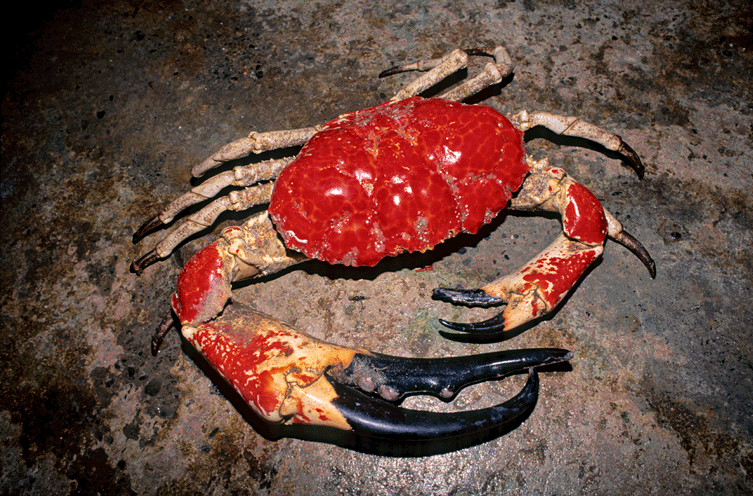
There are three species of King Crab fished commercially in Alaska, the Red King Crab, the Blue King Crab, and the Golden King Crab. A fourth species, the Scarlet King Crab, is also found in Alaskan waters, but is rare and does not support a commercial fishing industry. All four species belong to the overall super-family, Lithodoidea, which houses 113 living species overall.

Golden King from Calacademy.com
King crabs have five pairs of legs. The back pair are much smaller then the rest, and are usually hidden in the crab's carapace (body). They serve an important function during the mating season however, as females use them to tend to the embryos that she keeps under her tail, and they males use them in the fertilization process. The middle three sets of legs are used for walking, and the final set, that which is closest to the front of the body, sports pincers. In most crabs, the right claw is substantially larger than the left.

Like most animals, the King Crab grows larger as it ages. However, its carapace does not grow with it. As they age, the crabs must molt and grow new shells (which are made primarily of calcium). This molting process happens much more often when they are juveniles, and less when they are adults and have more or less plateau'd in size. King Crabs can live 25-30 years, and crabs that make it to those ages can be as many as five feet in leg span. King Crabs feed on all sorts of small marine life, including each other. They are preyed upon by fish, octopuses, and otters.

Red King from Alaska Fisheries Science Center
The Red King Crab is the most harvested of the Alaskan King Crabs. Crab fishing is also one of the most dangerous of all professions, with fatalities over 20 times greater than the average U.S. rate. The amount of danger involved in the Alaskan King Crab Industry has led to the creation of the Discovery Channel series, Deadliest Catch.