Hiển thị các bài đăng có nhãn Waterfowl. Hiển thị tất cả bài đăng

Thứ Tư, 6 tháng 11, 2013

Poliocephalus rufopectus
The New Zealand Grebe, or Weweia, is a small, dark waterbird found only on it's namesake islands.

These Grebe are wonderful swimmers, and are very well adapted to the water. They have movable webbed toes that are great for paddling, along with slim necks that allow them to dive underwater efficiently and find food. They feed on aquatic invertebrates, and can stay underwater for about half a minute.

New Zealand Grebes live near freshwater lakes, and do their nesting year round beside them. 2-3 eggs are laid at the time, and the offspring are precocial. After 2 months the chicks are completely independent from their parents.

Wierdly, the New Zealand Grebes went extinct from the South Island during the 1960s, and no one really knows why. Their population is currently stable, and the birds are protected. Monitoring and other measures are being taken to make sure the mysterious disappearance 50 years ago does not repeat itself.

IUCN Status : Vulnerable
Location : New Zealand
Size : Length up to 28in (70cm)
Classification : Phylum : Chordata -- Class : Aves -- Order : Podicipediformes
Family : Podicipedidae -- Genus : Poliocephalus-- Species : P. rufopectus
Image :  Zoologist.ru

Thứ Tư, 17 tháng 4, 2013

Bucephala albeola (male)
It's been absolutely pouring all day, and all this water is making me think of Ducks. So lets learn about one today, shall we?

The Bufflehead is a Duck that is found in the lake, ponds, and oceans in and around North America. They migrate seasonally, spending winters further south and their summers breeding in more inland areas of Canada and Alaska. Sometimes they end up in far away places during these migrations-- birds have been found in Japan and in Western Europe!

(female)
Buffleheads feed on a variety of different aquatic plants and animals-- it all depends on their location. Ducks that live near lakes and ponds consume more insects, while ocean-dwelling ducks consume mollusks and crustaceans.

Buffleheads are relatively unique among Ducks in that they remain monogamous for several years. They nest in trees, utilizing old cavities that were often created by Northern Flickers or Pileated Woodpeckers. Around 10 Ducklings are born each season, and when they are only a day old they leap down on to ground from their nest-- a jump that can be several feet!

As with many Ducks, Buffleheads exhibit sexual dimorphism. Males are white with black backs. They also have very large white patches that wrap around the back of the head, which is otherwise iridescent green and purple. Females are grey-brown all over, with a small white cheek spot.

IUCN Status : Least Concern
Location : North Africa
Size : Body length up to 16in (40cm)
Classification : Phylum : Chordata -- Class : Aves -- Order : Anseriformes
Family : Anatidae -- Genus : Bucephala -- Species : B. albeola
Image : Benutzer, DickDaniels

Thứ Sáu, 8 tháng 3, 2013

Chen canagica
The Emperor Goose is an interesting looking. It sports grey feathers over most of its body, but has a bright white head and neck... only it's not the front of the neck (like you see in other birds), the white patch actually goes down the back side!

Emperor Geese are also unusual (for Geese) in that they don't live in very large flocks. They tend to stick to small family groups. They do migrate though, breeding further north and wintering further south... though they don't go very far overall-- the species is found only in Alaska and parts of Russia.

The Aleutian Islands are a popular spot for wintering birds, which makes them especially vulnerable. Because they all move to the same spots, an catastrophic events could spell doom for the Geese. They are currently listed as "Near Threatened," and a hunting ban has been put into place.

Emperor Geese feed on grasses and other plants, and they breed out on the open tundra. Females do all the incubating for the eggs (up to 7 at a time), but the males are responsible for protecting the nest from predators and from other male Geese.

IUCN Status : Near Threatened
Location : Russia, Alaska
Size : Length up to 27in (.7m)
Classification : Phylum : Chordata -- Class : Aves -- Order : Anseriformes
Family : Anatidae -- Genus : Chen -- Species : C. canagica
Image : Sandy Cole

Chủ Nhật, 3 tháng 2, 2013

Lophodytes cucullatus (male)
The Hooded Merganser is a small species of duck that can be found in North America, living in wetlands that are near forested areas. They are migratory, moving north in order to breed (with large population around the Great Lakes) and south in order to avoid the cold winters.

You can easily identify the Hooded Mergansers, as "hood" barely describe the extravagance of their head feathers. Males have very large crests that are a stark black and white pattern. Females also have these crowns, though theirs are a cinnamon brown.

Hooded Mergansers are particularly interesting when it comes to their breeding and child-rearing habits. Some females will actually lay their eggs int he nests of other females. Though brood parasitism like this is seen in other species, the Mergansers are notable because they only lay their eggs in the nests of their own kind. A single female will lay around a dozen eggs, but some clutches will number over 40!

The chicks don't stay in their nests long after they are born. Within 24 hours the mother will hop out and survey the surroundings. If the coast is clear, she will call her chicks down... which can be quite a leap as they nest up in trees or in boxes. They then have to march after their mother, sometimes as far as half a mile, until they reach a body of water.

IUCN Status : Least Concern
Location : North America
Size : Length up to 19in (49cm), Wingspan up to 26in (66cm)
Classification : Phylum : Chordata -- Class : Aves -- Order : Anseriformes
Family : Anatidae -- Genus : Lophodytes -- Species : L. cucullatus

Thứ Năm, 1 tháng 11, 2012

Netta rufina (male)
The name "Pochard" refers to about half a dozen different species of diving duck, including today's animal, the Red-crested Pochard. They dive and dabble in order to find food, with meals consisting of aquatic plants and the occasional insect.

The males of this species are hard to miss, and are the inspiration for the common name. They have very large, orange heads, bright red bills, and dark chests (females are a pale brown, with a darker crest and white face).

Most Red-crested Pochards migrate long distances each year, moving between breeding and wintering sites (some in South and Central Europe are year-round residents). They breed in Europe and Central Asia around April and May, and then molt during the remainder of the summer, leaving them flightless for around four weeks. During the autumn they fly south to Africa or South Asia, arriving around October and staying until the following spring.

Red-crested Pochards are typically gregarious, and can be found in flocks that contain hundreds of individuals. During the winter they can often be found in flocks with other Diving Duck species. They do tend to nest somewhat apart though during the breeding season, but on occasion their ground nests can be found within 30m of one another.

IUCN Status : Least Concern
Location : Europe, Asia, Africa
Size : Weight up to 2.2lbs (1kg)
Classification : Phylum : Chordata -- Class : Aves -- Order : Anseriformes
Family : Anatidae -- Genus : Netta -- Species : N. rufina

Thứ Năm, 4 tháng 10, 2012

Anas querquedula
The Garganey is a species of dabbling duck that has a massive range covering nearly the entire Eastern Hemisphere (at one point or another). Their unusual name comes from an Anglicized version of an Italian word which is derived from the Latin gargala-- "Tracheal Artery."

The male Garganey is identified by the thick white line that runs over each eye, as well as by their brown neck and chest, and grey plumage elsewhere. Females are less distinctive, and look very similar to the female  Common Teals, which are a close relative (share the same genus). They have brown bodies, but darker face markings than the Teals.

During the breeding season you'll find these ducks in Europe and western Asia. They build their nests on the ground, near water, and lay as many as 14 eggs at the time. Incubation takes about three weeks and the young will fully fledge after 40 days.

The ducks don't stay at their breeding sites for long, since when winter comes they all migrate elsewhere. Some populations end up in Africa, others head towards India, and others still make their way out to Australia and various Pacific Islands.

It is estimated that there are around 2,700,000 Garganey ducks in the world right now-- quite the number! However, the population is on a decline, due to the reclamation of wetland breeding sites in Europe. Introduced species (like Mink) also affect their nest sites. The Garganey is legally hunted in some areas, and the practice appears to be sustainable.

IUCN Status : Least Concern
Location : Europe, Asia, Africa, Australia
Size : Length up to 16in (41cm)
Classification : Phylum : Chordata -- Class : Aves -- Order : Anseriformes
Family : Anatidae -- Genus : Anas -- Species : A. querquedula

Thứ Ba, 11 tháng 9, 2012

Somateria spectabilis (male)
Take a look at the male King Eider in its breeding plumage. What a gorgeous duck! Their blue, yellow, and green face, contrasted with the stark white chest and black body, makes for a truly spectacular looking bird.

Of course, they don't look as brilliant all year-- outside of the June and July breeding season the colors dull significantly.

And of course, like many other ducks, the females are significantly less dramatic looking-- their feathers are reddish brown, barred with black and white. But those brown barred colors certainly help around breeding time, as the females are left alone to incubate their eggs. They nest on the ground and press their bodies low to stay hidden. They rarely even get up to feed during that three week incubation period!

King Eiders are highly gregarious birds, and can form flocks that number into the tens of thousands. They breed on the tundras of the Northern Hemisphere, and spend their summers on the Arctic and Sub-Arctic coasts, never travelling much further south than Scotland or New England. They feed on aquatic plants and animals, and can even dive down over 80ft to forage!

IUCN Status : Least Concern
Location : Northern Hemisphere
Size :  Length up to 24in (61cm)
Classification : Phylum : Chordata -- Class : Aves -- Order : Anseriformes
Family : Anatidae -- Genus : Somateria -- Species : S. spectabilis

Thứ Hai, 6 tháng 8, 2012

Anser cygnoides
The Swan Goose is a very large Goose that breeds in China, Russia, and Mongolia, with some small populations also being found in surrounding countries. They breed in wetland areas of the steppe and taiga, and during the winter they migrate to more coastal areas. Though they are waterfowl, these Geese aren't often found in the water-- they graze on dry land. They feed on sedges and berries, typically at night, with their diet shifting each season to accommodate what is available.

Swan Geese are the ancestors of two different Domesticated species-- the Chinese Goose and the African Goose. Most other Geese trace their lines back to the Greylag Goose which is native to most of Europe and Asia. Swan Geese are the second largest Geese in their genus, just behind the Greylag.

Unfortunately, Swan Geese are listed as Vulnerable. Though their domestic descendants can be found around the world, they themselves are threatened by unsustainable hunting and habitat loss. It is estimated that there around around 90,000 left, though the population is on a fast decline.

Their wetland breeding areas are being  used for development and agriculture, so the birds are being forced into very small ranges. The major downside to these small breeding ranges is that a single localized natural disaster can completely wipe out a huge portion of the population. The birds are protected in several areas of Russia, Mongolia, and Korea, but there is much more to be done to keep these Geese from going extinct.

IUCN Status : Vulnerable
Location : Asia
Size : Length around 3ft (.9m), Weight up to 7.7lbs (3.5kg)
Classification : Phylum : Chordata -- Class : Aves -- Order : Anseriformes
Family : Anatidae -- Genus : Anser -- Species : A. cygnoides

Thứ Hai, 7 tháng 5, 2012

Gallinula chloropus
Meet the Common Moorhen, a very distinctive looking bird that has black plumage, a bright red and yellow beak, and gigantic feet. Those feet are used to walk across floating vegetation and mud. They aren't webbed, like the feet of many other waterbirds, but the Common Moorhens can swim pretty well nonetheless.

These birds are the most widely distributed members of the entire Rail Family, and can be found on every continent save Antarctica! There are currently twelve different subspecies, which all differ slightly by size and plumage.

One very distinct thing about the Common Moorhens is their breeding behavior. While most of their relatives have the males fight over the females, it is the female Moohens that fight over the males! After mating, both parents will incubate and care for the young, and newly hatched offspring are precocial, feeding themselves after only a few days.

The species as a whole is not at threat for extinction, but some local populations are in trouble. The Hawaiian and Mariana subspecies are considered Endangered, due to habitat loss.

IUCN Status : Least Concern
Location : Worldwide
Size : Body Length up to 15in (38cm)
Classification : Phylum : Chordata -- Class : Aves --Order : Gruiformes
Family : Rallidae -- Genus : Gallinula -- Species : G. chloropus

Thứ Hai, 2 tháng 4, 2012

Male Polysticta stelleri
Hey look! Another Steller's animal! I think we're almost through all of them... Sea Cow, Sea Eagle, Sea Lion... and now an Eider.

Eiders are Sea Ducks, and there are four different species (Steller's Eider actually belongs to a separate genus from the other three). Today's animal is actually the smallest of the Eiders, measuring only around 18in in length. Males and females have different coloration- Males have white heads, light coloring on their sides and wings, and black barring. Females are more uniformly dark brown.

Steller's Eiders live in the Arctic, and are actually less tied to sea than others of their type. They tend to nest on the tundra near smaller bodies of water, and travel in very large flocks that can easily number into the thousands. Steller's Eiders are a migratory species. They breed further north in the summer, and then travel as far as 2,000miles to their southern wintering and molting grounds.

Unfortunately, Steller's Eiders are listed as Vulnerable. Habitat loss, climate change, hunting, and pollution are all factors have all contributed to their decline. They are protected in Russia and the United States, and captive breeding programs are underway.

IUCN Status : Vulnerable
Location : Arctic
Size : Length around 18in (45cm)
Classification : Phylum : Chordata -- Class : Aves -- Order : Anseriformes
Family : Anatidae -- Genus : Polysticta -- Species : P. stelleri

Chủ Nhật, 25 tháng 3, 2012

Aix sponsa
Wood Ducks are known as one of the prettiest of all the ducks, and in in my opinion is takes the top prize out of the North American species. They are found throughout the continent, with some populations remaining sedentary and some migrating between the north and south.

If you're looking at the Wood Duck and thinking how similar it is tot he Mandarin Duck, you're definately on to something. Those are the only two living species that share the genus Aix!

As with many birds, only the male Wood Ducks posses the bright colors. They have iridescent green and purple crested heads, with additional bold patterning throughout the body. Females are grayish-brown, though they also sport a crest.

During the breeding season Males will perform different diving and preening gestures to attract a mate. Once they are paired up they build nests in cavities or in man-made nest boxes. The rise of nest boxes may have caused some confusion within the species, as the rate of brood parasitism has increased. Broos Parasitism is when female ducks lay their eggs in different nests, so that their chicks are raised by different parents. Though they only lay 10-11 eggs, some nests have had over 30 in them!

Back in the 19th century Wood Ducks were hunted extensively, and the population suffered. They are still hunted today, and are the most popular Duck after the Mallard, but conservation and wetland management has allowed the population to rebound to steady, healthy levels.

IUCN Status : Least Concern
Location : South East Asia
Size : Length around 21in (54cm)
Classification : Phylum : Chordata -- Class : Aves -- Order : Anseriformes
Family : Anatidae -- Genus : Aix -- Species : A. sponsa

Thứ Ba, 20 tháng 12, 2011

On the seventh day of Christmas, my true love gave to me... Seven Swans a'swimming...


Cygnus melancoryphus
Ah yes, another day another bird. Did you know that if you were to actually buy all these gifts (the real versions in the song, not the animal equivalents like Dragonflies) you would shell out the most money for the Swans?

The Swans in the song are probably not the Swans we're talking about today. I'd place bets on the Mute Swan, which is widespread in Europe and Asia. But I've already written about that particular species, so today we'll learn about it's different, South American cousin.

Black-necked Swans are named for their black necks that contrast with an otherwise white body. They also sport bright red knobs at the base of the bill that enlarge (on males) during the breeding season.

The Black-necked Swan is interesting in that it is both the largest native Waterfowl in South America, and also the smallest of all the Swans. They also have the designation of being one of the fastest Swans, and are capable of flying at speeds of up to 50mph (80kph).

Black-necked Swans are social birds during the non-breeding season, but when it comes time for mating and nesting they become aggressive and territorial. Partners are typically monogamous for life, but will find a new mate if their previous one dies. Though the female does all of the incubation,both parents help to care for the cygnets. They will even let the little Swans ride on their backs for the first few weeks of life!

IUCN Status : Least Concern
Location : South America
Size : Wingspan up to 70in (178cm), Weight up to 15lbs (6.8kg)
Classification : Phylum : Chordata -- Class : Aves -- Order : Anseriformes
Family : Anatidae -- Genus : Cygnus -- Species : C. melancoryphus

Thứ Hai, 19 tháng 12, 2011

On the sixth day of Christmas my true love gave to me... six Geese a'laying...


Neochen jubata
Do not fear bird people! After yesterday's Dragonfly we return to the world of feathered friends. Allow me to introduce you to the Orinoco Goose, a small species of Goose found in the northern, rainforested areas of South America. The are the only true forest Goose.

I find Orinoco Geese to be rather lovely in appearance. The contrast between the cream neck, the pink legs, and the chestnut and black wings creates a pleasing color composition (using my Art History degree!). Unlike many of our other Christmas birds so far, both male and female Orinoco Geese display the same plumage, though the males are slightly larger.

Once upon a time the Orinoco Goose was one of the most populous waterfowl species along the Orinoco River. Unfortunately, hunting and deforestation has caused their numbers to decline and they are now rare in many parts of their original range. Projects are underway to foster and protect the species, including the building of nest-boxes. Orinoco Geese nest in large trees near bodies of water, but they've been losing those nesting sites as trees get cut down. Nest-boxes placed on poles allow for the Geese to reproduce again in areas that were deforested.

IUCN Status : Near Threatened
Location : South America
Size : Length up to 30in (75cm)
Classification : Phylum : Chordata -- Class : Aves -- Order : Anseriformes
Family : Anatidae -- Genus : Neochen -- Species : N. jubata

Chủ Nhật, 27 tháng 11, 2011

Cygnus olor
Mute Swans are some of the most common Swans in the entire world. They are found across Europe and Asia, and have even been imported to North America, where they have also become widespread in many areas near larger bodies of water.

The common name comes from the fact that Mute Swans aren't especially vocal. They can make hisses, whistles, and snorts, but they aren't very loud due to the orientation of their trachea. Most of their communication comes from visual displays.

Mute Swans are monogamous, and tend to have the same mate for life, but this is not always the case. Swan divorce has been observed, and widowed Swans will choose new mates. In the cases of "remarriage" the younger Swan will almost always join the territory of the older Swan. Both mates help to incubate the eggs and defend the nest.

Because they are so widespread Mute Swans aren't in any real population danger. They do, however, pose slight threats to other species, especially in their non-native areas. In North America they compete with Loons and Trumpeter Swans for food and territory.

IUCN Status : Least Concern
Location : Europe and Asia
Size : Length up to 65in (1.65m), Wingspan up to 95in (2.4m)
Classification : Phylum : Chordata -- Class : Aves -- Order : Anseriformes
Family : Anatidae -- Genus : Cygnus --Species : C. olor

Thứ Sáu, 23 tháng 9, 2011

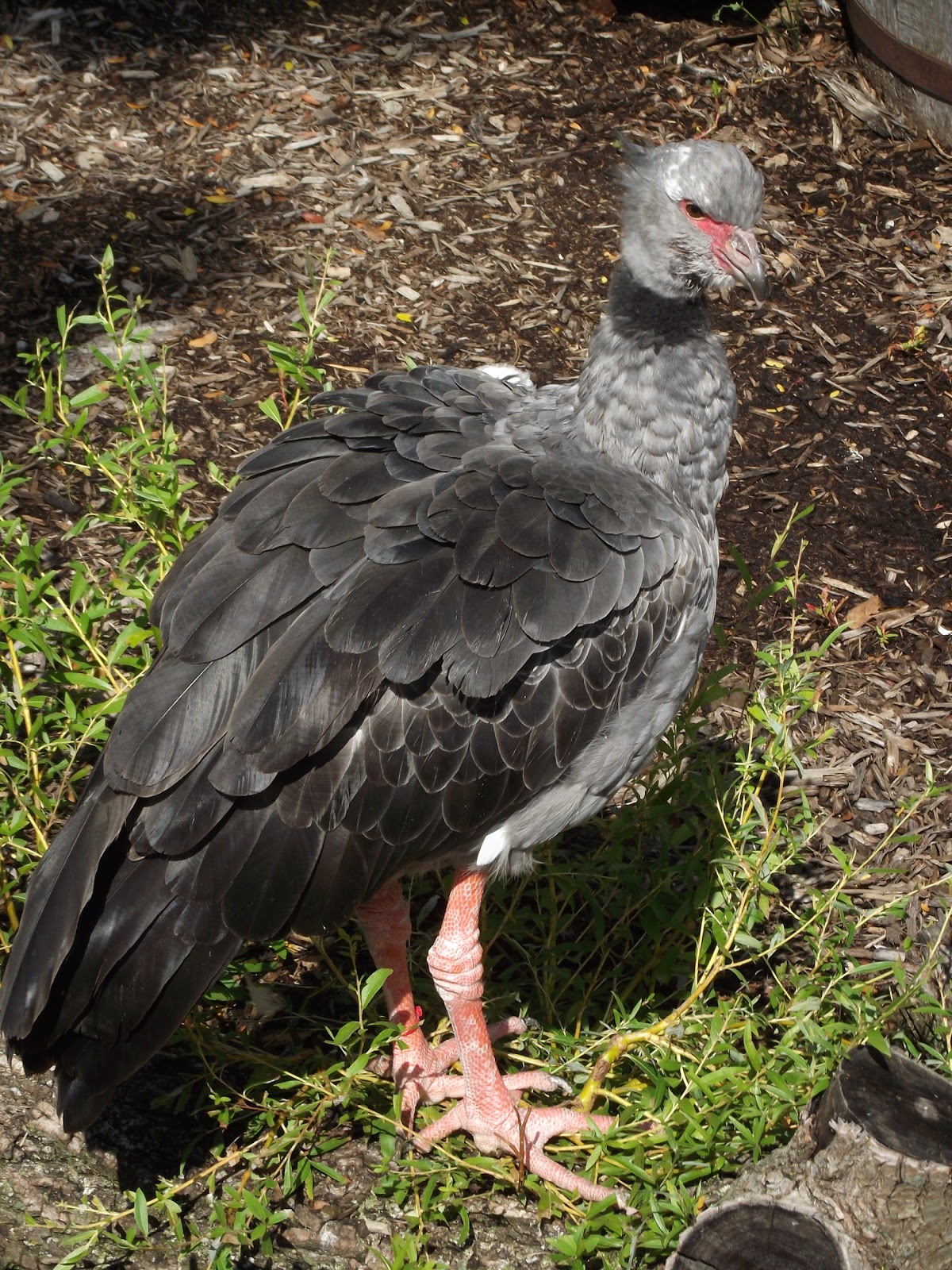
Chauna torguata from the
Milwaukee County Zoo
The Crested, or Southern, Screamer is a large Goose-sized bird native to southern South America. They can be found near tropical and subtropical aquatic areas. Though they live close to water, and are able to swim, they spend a lot of their time on land. They don't even have webbed feet!

Crested Screamers get their name because boy, are they loud! Their vocalizations can be heard more than 2 miles (3.2km) away! But keep in mind, they aren't the prettiest sounding birds. Their vocalizations includes booming trumpeting noises and gutteral drumming.

A pair of Crested Screamers will typically remain together monogamously for a few breeding seasons. Sometimes the pair bond will even last for a lifetime. (Which is about 15 years) The couple will build a huge nest in an area near water. This nest may be used multiple times over the years, and is vigorously defended. Up to seven eggs are laid, and the hatchlings leave the nest and are able to feed on their own very shortly after birth. After only 3 months they will leave their parents and join groups of other young, non-breeding birds.

Crested Screamers are relatively common birds throughout their range. Farmers will even snag them as chicks and raise them along with their chickens. When the Screamer grows up it watches over the flock and warns (loudly) against danger.

IUCN Status : Least Concern
Location : South America
Size : Length up to 3ft (.9m), Weight up to 10lbs (4.5kg)
Classification : Phylum : Chordata -- Class : Aves -- Order : Anseriformes
Family : Anhimidae -- Genus : Chauna -- Species : C. torquata

Thứ Hai, 12 tháng 9, 2011

The Nene is a smallish Goose endemic to the Hawaiian Islands. It is also the state bird of Hawaii. There were once five Goose species found only on those islands, and unfortunately the Nene is the only one left.

Branta sandvicensis
Though the Nene is rare, it has much more in common with other North American Geese than you may think. Scientist have now uncovered the fact that Nene and Canadian Geese evolved from a same common ancestor, and that the Nene (and other Hawaiian Goose species) branched off from their relatives when a flock landed on the islands around 500,00 years ago!

Nene are opportunistic feeders that will eat just about any type of vegetation. They have a long breeding season, and mate on land, which is unusual among Geese. Females do the incubation work, while males guard the nest. While the young birds are precocial and grow quickly, they remain with their parents until the next breeding season.

The introduction of new mammal species, hunting, and habitat loss have caused this bird to become Vulnerable. The yearly hatching percentages are now low due to inbreeding in the remaining population.  Efforts are being made to increase predator control, monitor breeding grounds, and provide public education about the bird.

IUCN Status : Vulnerable
Location : Hawaii
Size : Height up to 16in (41cm)
Classification : Phylum : Chordata -- Class : Aves -- Order : Anseriformes
Family : Anatidae -- Genus : Branta -- Species : B. sandvicensis

Thứ Tư, 17 tháng 8, 2011

I did my yearly venture to the Wisconsin State Fair this past weekend, and through the masses of Beef Cattle, Dairy Goats, and Pigs, I stumbled upon an unusual breed of Duck that I hadn’t encountered before- Indian Runner Ducks! (Unfortunately they were roped off while I was there and could not get any good pictures. Alas.)
Indian Runner Ducks

These strange looking birds resemble bowling pins more than regular ducks. They stand upright, like Penguins do, and they conveniently were once referred to as “Penguin Ducks!” They are a hardy, but high-strung breed, and are excellent foragers.

The name “Indian Runner Duck” is a bit confusing, as there is no evidence that these birds actually came from India itself. Rather, it is believed that they originated in the East Indies, on the islands of Bali, Java, and Lombok. “Penguin Ducks” were brought to England by the 1830’s, and may have been in the Netherlands even earlier, due to the trade conducted by the Dutch East India Company.

The first standards for the breed were developed at the turn of the 20th century, and have been changed and added to over the years. There are now nearly a dozen recognized color varieties, including Silver, Trout, Fawn & White, and Apricot. They are notable not only for their uprights posture and running movement style, but also because they are amazing egg layers. A single Duck can lay 200 eggs per year!

Status : Domesticated
Location : Originated in the East Indies
Size : Diameter up to 20in (50cm)
Classification : Phylum : Chordata -- Class: Aves -- Order : Anseriformes
Family: Anatidae -- Genus: Anas -- Species: A. platyrhynchos -- Subspecies: A. p. domestica

Thứ Bảy, 2 tháng 7, 2011

Chelychelynechen quassus
Moa-nalo refers to four species found within three different genera. All of whom were once found on the Hawaiian, all are now extinct, and all were gigantic ducks. Moa-nalo (that is both the singular and plural form) could stand as tall as 3 ft (.9m)!

At some point millions of years ago, the ancestors of these unusual birds arrived on the Hawaiian Islands. There, like many other island bird species that are lacking predators, they lost their ability to fly and instead became stocky ground foragers. Interestingly, the Moa-nalo were strict vegetarians, unlike many other ducks. (We know this thanks to studying beak shapes and fossilized dung.)

The Moa-nalo were left in peace, wandering around and doing their thing until about 1,200 years ago, when humans first arrived on the island. In a story that parallels that of the fated Dodo of Mauritius, these large flightless Hawaiian birds were unaccustomed to people and because easy prey. They all died out around 1,000 years ago, and remained unknown to science until the 1980s. Moa-nalo actually means "lost fowl" in Hawaiian.

Status :  Extinct for around 1,000 years
Location : Hawaiian Islands
Size : Weight up to 17lbs (7.5kg), Height up to 3ft (.9m)
Classification : Phylum : Chordata -- Class : Aves -- Order : Anseriformes
Family : Anatidae -- Genera : Chelychelynechen, Thambetochen, Ptaiochen

Thứ Hai, 30 tháng 5, 2011

Cygnus atratus
Before stumbling upon this species I had always thought that black swans were just a color variation. But not so!   Their is actually an entire, unique species of bird that can be found in Australia, as well as in introduced populations in New Zealand and North America.

Despite the name, the  Black Swan is not completely black; they actually have white flight feathers that are not visible when the wings are folded down. They also have bright red bills. Black Swans have the longest neck of any swan, are also one of the largest of all the waterfowl species, with a wingspan of up to 2m!

Black Swan in Flight
Black Swans mate for life, and actually perform a courting behavior called a "Triumph Ceremony" that helps to strengthen the bond of the pair. These dances are also used to threaten outsiders and mark territories.

Females lay 5-6 eggs at a time, and they are incubated and cared for by both parents. Cygnets are precocial and greyish-brown in color. Young Swans will often form their own flocks until they pair up for mating.

IUCN Status :  Least Concern
Location : Australia
Size : Length up to 55in (140cm), Wingspan up to 6.5ft (2m)
Classification : Phylum : Chordata -- Class : Aves -- Order : Anseriformes
Family : Anatidae -- Genus : Cygnus -- Species : C. atratus

Chủ Nhật, 14 tháng 11, 2010

I apologize for the absurdly late post today, got a bit sidetracked with some other stuff. But one of those projects was a short trip to the zoo! In 40 degree weather! Not a whole lot was outside in that kind of climate, but there were loads and loads of Mallard Ducks. More Mallards than I've probably ever seen in one place, so tonight we're gonna dive into the wonderful world of ducks!

Mallards are the most widespread of all ducks, and are found in freshwater areas across the Northern Hemisphere, and have been introduced to many other locations. Mallards have become so widespread that some localized populations have changed enough to be considered their own separate species. Some Northern Mallard populations are migratory, while others remain in their location year round. Mallards can fly at speeds of up to 40mph.

Did you know that the Mallard is the ancestor of all the domestic ducks we have today, save the Muscovy Duck? When you think of the wild Mallard, and even many domestic variations, the bright green-headed male typically comes to mind. Females are far more drab in color. They are "dabbling ducks," which means that they do not dive for their food; they stay at the surface and feed off of plants, insects, and amphibians, occasionally dipping underwater.

Mallard Ducks form pairs during the breeding season, but the females are left by the males upon laying eggs (the males are very territorial up to that point). Between six and fourteen eggs are laid, and the chicks are able to swim and feed themselves right after hatching, but they will stay with their mother for about two months.