Hiển thị các bài đăng có nhãn Piciformes. Hiển thị tất cả bài đăng

Thứ Tư, 2 tháng 10, 2013

It isn't tough to figure out how this bird got it's common name-- just look at this picture! These birds, native to the Amazon, have sleek black bodies feathers, blue skin around the eyes, large colorful beaks, and brilliant white throats.

Once upon a time the two subspecies (called Cuvier's and Red-billed Toucans) were considered to be two totally different species. But now we know that they are all the same, and the two subspecies will even mate and hybridize with each other.

When it comes time to breed, a pair of Toucans will take over an abandoned nest, or find a cavity high up in the trees (they do not build their own nests). Both parents will help with incubation, and with feeding their young chicks who are born helpless. The young Toucans grow fast though! They flegde after about 6 weeks.

White-throated Toucans generally live in pairs, or in very small groups. They feed on fruits as well as on insects and small reptiles. And though they can fly, they do so very awkwardly, and never for very long distances. Good thing they tend to live in very dense forests where the next tree isn't too far away!

IUCN Status : Least Concern
Location : South America
Size : Length up to 2ft (61cm)
Classification : Phylum : Chordata -- Class : Aves -- Order : Piciformes
Family : Ramphastidae -- Genus : Ramphastos-- Species : R. tucanus
Image : OpenCage

Thứ Tư, 5 tháng 12, 2012

Andigena laminirostris
The Andes mountains of South America are where you'll find the Pale-billed Mountain Toucan. They live in the humid forests that sit just under 10,000ft.

You'll identify these birds by all their various color patches. They have blue chests, chestnut wings, splashes of red and yellow near the tail, and ivory, black, yellow, green, and red on the face and bill. They are similar in look to the other species of Mountain Toucan (all of which have a Andean range), but each of the birds differs in the face and bill.

As with all Toucans, the Pale-billed Mountain Toucan is a frugivore, and is a vital spreader of seeds for their habitat. They eat as many as 100 different kinds of fruit (I didn't even know there were that many fruits growing in one place!), and either digest or regurgitate the seeds. This diet even plays into their courting rituals-- males will feed fruit to the females to gain favor.

Pale-billed Mountain Toucans will form monogamous pairs once they reach sexual maturity at age 3. The couple will often take over the nest of another bird and line it with sticks and regurgitated materials. Both the mother and father incubate and care for the chicks.

Sadly, the species is on the decline and is listed as Near Threatened. Habitat loss from logging, human settlement, and agriculture plays a big part in this. The birds do live within nature reserves, more more conservation action is needed outside of those areas.

IUCN Status : Near Threatened
Location : South America
Size : Length up to 21in (53cm)
Classification : Phylum : Chordata -- Class : Aves -- Order : Piciformes
Family : Ramphastidae -- Genus : Andigena -- Species : A. laminirostris

Chủ Nhật, 18 tháng 3, 2012

Dryocopus pileatus
The Pileated Woodpecker is a large Woodpecker, the largest in North America in fact. It also has a pretty substantial range that covers the forested, non-mountainous areas of the continent.

You can identify the Pileated Woodpecker by its black body, red cap, and white bar that runs down the throat. The only difference between males and females is a red stripe that runs from the beak to the throat in males. They are similar in look to two other Woodpeckers that we have talked about here, the Ivory-Billed and Imperial, but those species have slightly different ranges, and are also extremely rare, if not extinct. The Pileated Woodpecker on the other hand, is very common.

You can tell that a Pileated Woodpecker is in your area by their loud call and by the pattern that they leave behind in dead trees. Insects like ants and beetle larvae make up big chunks of their diet, and in order to get to these meals they drill large rectangular patterns in the wood. Sometimes these holes are so deep that they cause small trees to break completely in half! Often times though, the tree is left very much intact, and the holes that they dig become nesting sites for other bird species.

When it comes to their own nesting, the male Woodpecker will excavate a large cavity, usually in a dead tree. He will use this nest site to attract a mate, and together they will raise 3-5 young each season. Pairs often remain monogamous for life, but the nest sites are rarely used more than once. Once again, these cavities are used by other birds for their own mating habits.

IUCN Status : Least Concern
Location : North America
Size : Body Length up to 19in (49cm)
Classification : Phylum : Chordata -- Class : Aves -- Order : Piciformes
Family : Picidae -- Genus : Dryocopus -- Species : D. pileatus

Chủ Nhật, 5 tháng 2, 2012

Pale-mandibled Aracari at the Milwaukee County Zoo
Meet the Pale-mandibled Aracari, a species of bird that belong to the Ramphastidae family, making them relatives of the Toucans (can't you tell?) They can be found in the forests of Ecuador and Peru.

Pale-mandibled Aracaris are named for... well... their pale-colored beaks. Their bodies are primarily black, but they sport some really beautiful splashes of color, including bright yellows, oranges, and reds on their chest and underbelly, and a huge pop of red on the back.

These birds are prolific frugivores, meaning that they eat lots and lots of different fruits. In the wild they actually feed off of over 100 different types of plant! They also will eat insects to get some extra protein.

They lay small clutches of of 2-4 eggs that take only 2 weeks to hatch. The young birds fledge after about 40 days.

IUCN Status : Least Concern
Location : South America
Size : Body Length up to 2ft (60cm), Weight up to 20lbs (9kg)
Classification : Phylum : Chordata -- Class : Aves -- Order : Piciformes
Family : Ramphastidae -- Genus : Pteroglossus -- Species : P. erythropygius

Thứ Tư, 19 tháng 10, 2011

Illustration of Imperial Woodpeckers
A while back I wrote about the Ivory-Billed Woodpecker, a species from the southern United States that is believed to extinct.... though unconfirmed sightings pop up from time to time.

The same can be said for the Imperial Woodpecker. This relative of the Ivory-Billed (they belong to the same genus) has not been officially seen in its Mexican homeland since 1956.

Habitat destruction, a fragmented population, and hunting all led to the decline of this species. The last confirmed bird was seen in 1956, though numerous searches have been undertaken to find any living specimens. One search, in 1994-1995, lasted 11 months and turned up nothing. Unconfirmed reports have popped up over the years, with one of the most recent in 2005.

Unfortunately, not a whole lot is known about this rare and possibly gone-forever Woodpecker. If they were still around, they'd be the largest living Woodpecker species. Males sported red crests, while the females' were all black. They fed primarily on beetle larvae.

IUCN Status : Critically Endangered, Possibly Extinct since 1956
Location : Mexico
Size : Length up to 24in (60cm)
Classification : Phylum : Chordata -- Class : Aves -- Order : Piciformes
Family : Picidae -- Genus : Campephilus -- Species : C. imperialis

Thứ Năm, 3 tháng 3, 2011

Ivory-Billed Woodpeckers by Audubon
Phylum : Chordata
Class : Aves
Order : Piciformes
Family : Picidae
Genus : Campephilus
Species : principalis

Length : 18-20in
Wingspan : 31in

IUCN Status : Critically Endangered, but quite possibly Extinct

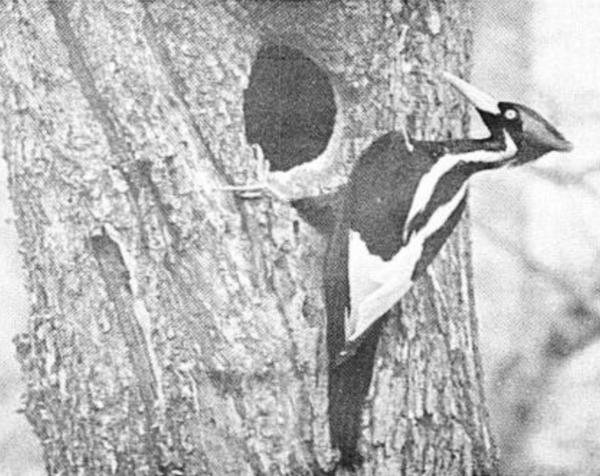
The Ivory-Billed Woodpecker is/was one of the largest of all the Woodpeckers. Now, I say "is/was" because the current status of this bird is unknown. It was previously thought to be extinct, but then in 2005 a few birds were sighted in Arkansas. However, despite years of effort, and searches over thousands of square miles, no other birds have been located.

Ivory-Billed Woodpeckers were found in the South-East United States, living in old growth forests. During the 19th century these habitats were destroyed, causing the birds to lose their homes. By the mid 20th century, they were believed to be extinct in the United States. Report in Cuba continued until the 1980s, but that population is now also believed to be gone.

Ivory-Billed Woodpecker circa 1935
Before they were lost, a decent amount of information was obtained about the behavior of the species. For example, pairs mate for life and share the responsibilities of raising their young.They feed off of beetle larvae, and excavate nests high up in trees. Ivory-Billed Woodpeckers also have distinctive calls and raps, which ornithologists have been listening for in their search for these rare birds.

The Cornell Lab of Ornithology continued to put together searches for the Ivory-Billed Woodpeckers, but no birds have turned up since the initial 2005 push. They suspended their searching in 2010. Other projects began in Florida, but they too came up relatively empty. Maybe they are still out there, maybe they aren't. It's another sad story of a species lost.

Thứ Ba, 11 tháng 1, 2011

(Image Source)
I'm looking out the window right now and it's pretty miserable. The sky is gray, there is slushy snow everywhere... I think I need a little color. And what better animal than the Toucan to brighten up a day?

There are around 40 different species of Toucan (sources I've seen differ, but 42 seems like a pretty accurate one). Of all these species, today's feature, the Keel-Billed Toucan (Ramphastos sulfuratus), is on the larger side, and definitely sports one of the most colorful bills. They grow to be about 20in (52cm) long, and sport bills that can be as much as 1/3 their entire body size! They weigh up to 500g, with males being slightly larger than females. Keel-Billed Toucans have predominantly black bodies, with yellow chests. Their bill comes in a dazzling array of greens, blues, oranges, and reds.

The bill of the Keel-Billed Toucan is actually not at all heavy. It is in fact made from spongy, hollow bone that is covered in keratin, which itself is very lightweight. Their bills have very tiny ridges on the sides, and cover up a long, thin tongue. Keel-Billed Toucans primarily feed on fruit, which is often swallowed whole. The bill allows them to eat some fruits that other birds cannot, as it enables them to cut up the meal into pieces. Theses Toucans also eat insects, eggs, and the fledglings of other birds.
(Image Source)

Keel-Billed Toucans live in small troops of about half a dozen to a dozen birds. They roost and nest in tree cavities, which are often holes created by Woodpeckers. They live in dense forested areas, and have short, wide wings that allow them to move through the trees. Keel-Billed Toucans also have two toes that face forwards, and two backwards, which allow for easier perching and hopping from branch to branch.

Pairs are monogamous, and lay 2-4 eggs per brood, and may produce 2-3 broods per year.

Keel-Billed Toucans are listed as being of Least Concern.