Hiển thị các bài đăng có nhãn Deer. Hiển thị tất cả bài đăng

Thứ Tư, 9 tháng 4, 2014

Odocoileus hemionus
The Mule Deer is a species that has a large range spanning across the western half of North America.They are named for their large, Mule-like ears and can be further identified by their black-tipped tails.

Mule Deer are an incredibly adaptable species. They live in grasslands forests, and even deserts, and are able to consume whatever vegetation is available in those areas in order to satisfy their nutritional needs.

Food supply dictates the movements of these Deer, but so does the rut season. Each fall males will fight each other for the breeding rights of females within a territory. They move from place to place breeding with as many females as they can (and if they do not get pregnant the female will mate with more than one male). At the end of the season the males lose their antlers and begin to grow a new pair that will be ready for battle next rut season.

Female Mule Deer typically give birth to twins, but a new mother may have only one fawn. Fawns are born in spring and will stay with their mothers through summer, leaving when the fall rut begins again.

Mule Deer are very widespread and have a large overall population. They are listed as being of least Concern.

IUCN Status : Least Concern
Location : North America
Size : Shoulder height around 40in (1m), Weight between 200-350lbs (90-158kg)
Classification : Phylum : Chordata -- Class : Mammalia -- Order : Artiodactyla
Family : Cervidae -- Genus : Odocoileus-- Species : O. hemionus
Image :  Oregon Dept of Fish and Wildlife

Thứ Sáu, 8 tháng 11, 2013

Panolia eldii
The Eld's Deer is an endangered mammal that lives in only three isolated populations in south and southeast Asia. These three groups are distinct enough to be considered different subspecies, and all three face dangers from hunting, habitat loss, and lack of genetic diversity.

Eld's Deer are sometimes called Brow-antlered Deer, and they have very slender bodies and large ears. Males also have distinctive curved antlers that are regrown each year.

Outside of the breeding season the Deer tend to be solitary. They feed on different grasses and wetland plants, and are active throughout the day. When it comes time to breed, the females will gather up into groups of up to 50, and males will compete with one another for breeding rights. The gestation period lasts about 8 months, and a single fawn is born.

Sadly, these deer aren't doing too well. They occur in a few protected areas, but there is inadequate funding to keep those locations safe, and insufficient manpower to deal with poaching. The deer are also so fragmented that inbreeding is common, which weakens the genetic diversity and causes health issues within the group.

IUCN Status : Endangered
Location : Southeast Asia
Size : Height up to 50in (1.3m), Weight up to 380lbs (172kg)
Classification : Phylum : Chordata -- Class : Mammalia -- Order : Artiodactyla
Family : Cervidae -- Genus : Panolia-- Species : P. eldii
Image :  Raul654

Thứ Tư, 9 tháng 10, 2013

Hyelaphus kuhlii
Today's animal is the Bawean Deer, which is also sometimes referred to as the Bawean Hog Deer or Kuhl's Deer. These ungulates are found on only one small Indoneasian island, Bawean, and are at a very high conservation risk.

Hunting by both humans and predators have historically keep the Deer population low, but now habitat loss and climate change have been added to the list of dangers and the Deer are considered to be Critically Endangered.

The Bawean Deer are small and brown, with their fawns having a spotted pattern. Males also posses antlers that come in handing when fighting for mates or territory. The Deer usually live alone or in very small groups, and they use a series of barks and squeaks to communicate. These vocalizations serve many purposes, like reuniting a mother and her fawn, or as a challenge call between males. Interestingly though, they don't seem to have an alarm sound for danger-- they just quietly run away.

There are around 250 Bawean Deer left in the wild, and hunting has been outlawed since 1977. There is still hope for the species, but it will definitely be an uphill battle!

IUCN Status : Critically Endangered
Location : Bawean, Indonesia
Size : Height up to 2.3ft (70cm)
Classification : Phylum : Chordata -- Class : Mammalia -- Order : Artiodactyla
Family : Cervidae -- Genus : Hyelaphus-- Species : H. kuhlii
Image : Bardrock

Thứ Tư, 24 tháng 4, 2013

Rucervus duvaucelii
The Barasingha is a medium-large Deer that is found in the swamps, marshlands, and grasslands of southern Asia. In fact, they are sometimes referred to as "Swamp Deer."

On average, the Barasingha live in groups of around 10-20 deer, though during the breeding season these herds can become much larger. At that time the males will fight fiercely for the right to breed with large harems of females. Their large antlers that have as many as 20 tongs are instrumental in these fights.

Sadly, these Deer are now considered Vulnerable, and are no long found at in in large portions of their historical range. It is estimated that 3,000-4,000 remain in the wild. Poaching is a big factor in the decline, as is habitat loss. Not only do these eat the tall grasses that are being destroyed, but they also rely on those grasses to hide their young.

Interestingly, though these Deer are rare in their natural habitat, they are bred for stock hunting in some parts of the United States. Permits to hunt them on these private reserves can cost as much as $6,000. While this sounds really morbid, portions of those high fees in Texas are actually going to fund conservation back in India. In fact, the exotic hunting industry is one of the largest financial supporters of Barasingha Conservation on the planet!

IUCN Status : Vulnerable
Location : South Asia
Size : Height up to 53in (1.3m), Weight up to 600lbs (272kg)
Classification : Phylum : Chordata -- Class : Mammalia -- Order : Artiodactyla
Family : Cervidae -- Genus : Rucervus -- Species : R. duvaucelii
Image : F. Spangenberg

Thứ Sáu, 16 tháng 11, 2012

Odocoileus virginianus (Bucks)
It's that time of year again-- deer season. I live in a state where Deer hunting is a norm and a common topic of conversation  and was actually surprised that I hadn't covered White-tailed Deer on this blog in the past!

The White-tailed Deer is well known throughout North and Central America, and they have even been introduced to parts of Europe and New Zealand. They are one of the most widely distributed mammals in the Americas, and it is no surprise that there are around three dozen different recognized subspecies. They are incredibly adaptable, and live in a huge range of habitats. Grasslands, woodlands, subtropical forests, scrublands, and even suburban neighborhoods all play host to these Deer.

Doe
White-tailed Deer are named for the undersides of their tails, which they raise when alarmed. Those tails communicate danger to one another, but is not their only form of communication. The Deer also produce a variety of sounds (Does and their Fawns bleat to find each other), and mark their territory using scent glands.

White-tailed Deer vary in size, depending on that territory and location. The Key West subspecies is the smallest (weighing around 80lbs), while Bucks in the northern United States and Canada can reach near 300lbs. Bucks are larger than Does, and also are the only sex to sport antlers, which are shed and regrown each year after the rutting season.

Rut takes place in the late fall, and during that times males will compete against one another for breeding rights. A Buck may reproduce with multiple Does each season, and has nothing more to do with the female or her eventual offspring after copulation. Does can have up to three fawns at a time, and they hide their small, spotted offspring in the undergrowth while they go off to feed (mothers of multiples will hide each fawn separately). The young deer are weaned by the end of summer, but will often hang around with mom for another year or two.
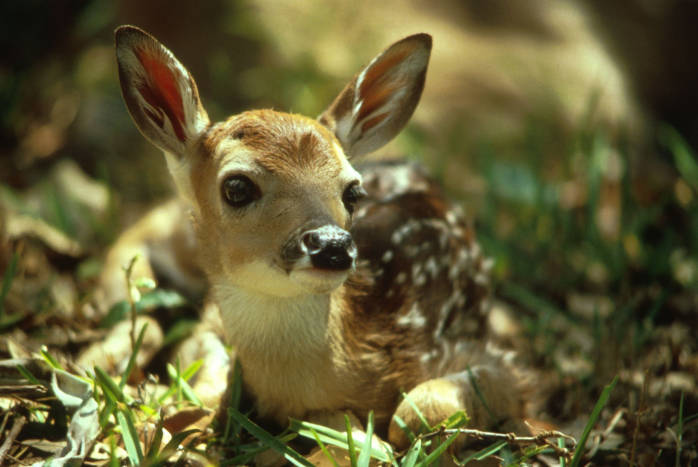
Fawn

Because White-tailed Deer live in so many places, they are able to eat many different kinds of plant life. Leaves, grasses, acorns, cacti, fruits, and mushrooms are all consumed by the species. They can also cause problems in farms, orchards, and gardens when they decide to go after corn and other crops.

Overall, White-tailed Deer are listed as being of Least Concern, though some of the subspecies (like the aforementioned Key West variety) are listed separately with their own conservation classification.

IUCN Status : Least Concern
Location : North and Central America, introduced to Europe and New Zealand
Size : Weight up to 300lbs (136kg)
Classification : Phylum : Chordata -- Class : Mammalia -- Order : Artiodactyla
Family : Cervidae -- Genus : Odocoileus -- Species : O. virginianus

Thứ Ba, 21 tháng 8, 2012

Rucervus schomburgki
The Schomburgk's Deer, named after British consul to Bangkok Richard H. Schomburgk, was first described in 1863. Less than 75 years later this graceful species was extinct.

It appears that the Schomburgk's Deer was endemic to Thailand, based on sightings and information, though they may have also lived in Laos and parts of China as well. They were large, graceful Deer with dark brown fur and lighter undersides. Males had antlers that could measure nearly a meter long each, females had no antlers. Their range was in open, swampy plains that were free from dense vegetation, and they lived in small groups that consisted of one male, a handful of females, and their offspring.

The habitat that they lived in played a major role in their extinction. In the late 19th and early 20th century, those same swampy plains were converted into commercial rice paddies. The deer moved into the few locations available to them, but would get even more condensed during the floods. They would flock to higher ground, but would then be easy targets for hunters. By 1932 the last wild Deer was killed, and the final captive specimen died 6 years later.

There is only one mounted Schomburgk's Deer in the entire world (at the Paris Natural History Museum), in addition to a handful of skulls, skins, and antlers. Some believe that the Schomburgk's Deer might still be out there, as a relatively fresh set of antlers was uncovered in 1991, but there have been no confirmed sightings, and the species remains listed as Extinct.

IUCN Status : Extinct since 1938
Location : Thailand
Size : Shoulder height around 3.3ft (1m)
Classification : Phylum : Chordata -- Class : Mammalia -- Order : Artiodactyla
Family : Cervidae -- Genus : Rucervus -- Species : †R. schomburgki

Thứ Ba, 14 tháng 2, 2012

Pudu puda
There are two species of Pudu in the world, the Northern and the Southern. Both are found in South America, appropriately hanging out int he northern and southern stretches of the Andes, respectively. They also (in my opinion) have some of the cutest babies in the entire animal kingdom. Just watch the video if you don't believe me.

The Northern Pudu is the smallest species of deer in the entire world, and the Southern is only a hair bit larger. They have stocky bodies and skinny little legs, and the main difference between males and females is the presence of antlers in the former.

Not much is known about Pudu behavior in the wild because they are both solitary and secretive. They come together only during rut, and the female gives birth to a single fawn that she raises alone. Fawns wean after 2 months, are full grown by 3, and are sexually mature by 8. However, they often stay with their mothers for 8-12 months before leaving and becoming fully independent.

Pudu are active during both the night and day time, and they forage for food along a network of trails and pathways that they create through frequent use. They mark these territories using scent glands. Sometimes Pudu are simply too small to reach their meals, forcing them to stand up on their hind legs to feed.

Both species of Pudu are listed as Vulnerable. This is due to hunting and habitat loss. Captive breeding programs have been set up, and there plans to reintroduce them to the wild.


IUCN Status : Vulnerable
Location : South America
Size : Height up to 18in (45cm), Weight up to 30lbs (13.5kg)
Classification : Phylum : Chordata -- Class : Mammalia -- Order : Artiodactyla
Family : Cervidae -- Genus : Pudu -- Species : P. puda, P. mephistophiles

Thứ Hai, 23 tháng 1, 2012

Rusa unicolor
Meet the Sambar, one of the most widely spread Deer species in the world... and also one of the most confusing. Sambar can be found throughout South and Southeast Asia, and they have been introduced into the United States, Australia, and New Zealand. However, they vary greatly in size depending on their specific location. This has led to a lot of taxonomic confusion, and currently you might see them refereed to as both Rusa unicolor and Cervus unicolor.

Sambar can grow to some pretty huge sizes. Males have been recorded at over 600lbs! (That is more than double the average weight of the American White-Tailed Deer, for reference) Their antlers can also grow up to a meter long!

Like many Deer, Sambar are crepuscular, meaning that they are most active during dawn and dusk. They are typically solitary, though sometimes small groups of females and their young will forage together. Males live alone, and form aggressively defended territories during the breeding season.

Sambar have adapted very well to different habitat types, and can be found in all types of forested areas, from the very wet to the very dry. The habitat variety has also allowed them to consumes many different types of vegetation. Unfortunately, their adaptability has not kept them off of the Red List. They are currently ranked under "Vulnerable," due to hunting and habitat loss through many countries in their large range.

IUCN Status : Vulnerable
Location : South and Southeast Asia
Size : Length around 80in (2m), Average weight up to 400lbs (180kg)
Classification : Phylum : Chordata -- Class : Mammalia -- Order : Artiodactyla
Family : Cervidae -- Genus : Rusa-- Species : R. unicolor

Thứ Sáu, 5 tháng 8, 2011

Stag Moose Reconstruction
Between 40,000 and 11,000 years ago, these huge deer roamed about North America. Stag Moose have been found in a handful of sites in and around the American Midwest, and more rarely further south and east.

When fossils were first uncovered in the early 19th century, scientists were confused about what this animal actually was. Was it a deer? An Elk? A Moose? Stag Moose were originally placed with the genus Cervus in 1825, and it wasn't until a near complete skeleton was found in 1885 that it was given its very own genus, Cervalces.

Stag Moose were large animals, typically a little bit taller then our modern Moose. They had Moose-like bodies, but deer-like heads and a pair of huge, irregularly pronged antlers.

It is believed that Stag Moose went extinct due to displacement. Moose had moved in to North America via the Bering Land Bridge around that time, and the competition probably played a part in the Stag Moose's decline.

Status : Extinct for around 11,000 years
Location : North America
Size : Height up to 5ft (1.5m)
Classification : Phylum : Chordata -- Class : Mammalia -- Order : Artiodactyla
Family : Cervidae -- Genus : †Cervalces -- Species : †C. scotti

Thứ Bảy, 23 tháng 7, 2011

Moschus moschiferus
Last week the several members of the North Korean women's soccer team failed a doping test. The explanation given was that the steroids were accidentally taken along with traditional medicine made from Musk Deer glands. So in the light of Musk Deer making national news, lets learn a little bit about these strange ungulates!

There are actually around half a dozen species of Musk Deer, but today we'll focus on the Siberian variety, Moschus moschiferus. (Interestingly, it was once believed all Musk Deer were subspecies of the Siberian Musk Deer!) As the name might suggest, these guys live in Siberia, but also in parts of Mongolia, China, and North and South Korea. They can be found in mountainous forests and in the Taiga.

Musk Deer are considered to be more primitive than other deer. For example, males have no antlers. Instead, they have a pair of long canine teeth that grow into tusks. They also have musk glands, three different types to be exact. One is between the toes, one is at the rear, and one is on the stomach near the navel. This musk is used to mark territory, and to stimulate females into ovulating.

The Musk from Siberian Musk Deer is highly desired for medicinal and cosmetic purposes. A kilogram can sell for up to $45,000! Many extractors will kill the deer to remove the glands, but musk can be taken from live animals. Despite protections and export quotas being put into place, poaching continues to be the number one threat to the species.

IUCN Status : Vulnerable
Location : Siberia, east Asia
Size : Shoulder height up to 21in (54cm)
Classification : Phylum : Chordata -- Class : Mammalia -- Order : Artiodactyla
Family : Moschidae -- Genus : Moschus -- Species : M. moschiferus

Thứ Tư, 22 tháng 6, 2011

The Andean Huemul, or Andean Deer, is an endangered ungulate that lives in the mountains and valleys of the southern Andes.

Andean Huemuls are diurnal, and live in small family groups. They feed primarily by browsing. During the mating season males will attempt to breed with as many females as possible. The resulting fawns are a bit unique when they are born; they have no spots for camouflage, they are solidly colored. Fawns will be hidden by their mothers until they are stronger.

It is estimated that there are only 1,500 Huemul left in the wild, most of which live in Chile. Competition with introduce livestock, loss of habitat, and hunting are all causes for their decline.

The Andean Huemul is featured on the Chilean coat of arms, and is considered a national symbol. They have been protected in the country since 1929, but poaching still occurs and captive breeding has been less than successful.

IUCN Status : Endangered
Location : Argentina and Chile
Size : Height up to 35in (90cm), Weight up to 175lbs (80kg)
Classification : Phylum : Chordata -- Class : Mammalia -- Order : Artiodactyla
Suborder : Ruminantia -- Family : Cervidae
Genus : Hippocamelus -- Species : H. bisulcus

Thứ Năm, 14 tháng 4, 2011

Male Muntiacus muntjak
The Indian or Common Muntjac is a small species of deer found in South and Southeast Asia.They are also known as "Barking Deer" due to the dog-like barking sound that they create when they are startled. When they feel especially threatened they may repeat this call over and over for as long as an hour.

Male Indian Muntjacs have both antlers and tusks, which they use while competing over females and territory. Outside of the breeding season they are solitary animals. Rutting can take place at pretty much any time of year, and females give birth to one offspring at a time.

Indian Muntjacs are rather interesting due to their diet. Despite being deer, they are omnivores. They feed on grasses, fruits, and seeds, but they also eat small mammals! The Minutjacs use their feet to stomp prey to death, and are able to tear at meat with their tusks.

Indian Muntjacs are hunted in many parts of their range, and they are used for meat, skins, and medicines. Muntjacs actually serve a positive purpose for humans in that their barking can warn against the presence of major predators.

IUCN Status : Least Concern
Location : South and Southeast Asia
Size : Weighs 15-30lbs (6.8-13.6kg), Shoulder height approx. 20in (50cm)
Classification : Phylum : Chordata -- Class : Mammalia -- Order : Artiodactyla
Family : Cervidae -- Genus: Muntiacus -- Species : M. muntjak

Thứ Tư, 26 tháng 1, 2011

(Image Source)
Phylum : Chordata
Class : Mammalia
Order : Artiodactyla
Family : Cervidae
Subfamily : Cervinae
Genus : Elaphurus
Species : davidianus

Height : 4ft (1.2m)
weight : 290lbs (135kg)

IUCN Status : Extinct in the Wild

The Pere David's Deer is named after French Missionary Pere (Father) Armand David, who first publicized the species to the outside world in 1865. They are also sometimes referred to as Milu. The deer had become more or less extinct in their native China, but the emperor had kept a large herd within his Imperial Hunting Park. David worked tirelessly to export some of these deer to Europe, and it was lucky that he did, because a terrible flood killed most of the park's herd not long after. All remaining deer in China were killed and consumed by soldiers during the Boxer Rebellion.

With all the deer in China gone, the European specimens were all the world had left. The Duke of Bedford collected 18 individuals from different zoos and brought them to Woburn Abbey, where he worked on a captive breeding program. Though the two World Wars resulted in some setbacks, by 1946 there were over 300 deer at the park.

(Image Source)
In 1985 the first captive bred herd was released into Beijing Milu Park, and 1986 another group was brought to Dafeng Milu Natural Reserve, north of Shanghai. There are now several hundred Deer in Chinese reserves. The overall world population is increasing, and does not seem to be adversely affected by the inbreeding that had to take place over 100 years ago.

Pere David's Deer historically lived in swampy marsh areas. They are reddish brown in the summer, and take on a more gray color in the winter. Males have antlers that they shed off each year. Females have a long gestation period that can last up to 9 months, and they typically give birth to one or two fawns.

Chủ Nhật, 22 tháng 8, 2010

Also known as Thorold's Deer, Cervus albirostris is one of the largest species of deer, with males reaching up to 500lbs and measuring 6ft in length. They are native to cold, high elevation grasslands in China and Tibet. Their brown coats get substantially thicker in the winter to accommodate the colder weather. They are also an incredibly sure-footed species for their size, with hooves that are well suited to climbing.


White Lipped Deer at the Lincoln Park Zoo
White Lipped Deer live in single sex herds for most of the years, with the males apart from the females and calves. During the mating season however, the herds will intermingle, and deer of all ages and sexes can be found. Herds typically number around 50-60 individuals at the height of the mating season, though even larger ones, with 200-300 members, have been reported. Males fight aggressively for mates, with help from their up to 4ft long, 15lb antlers. The gestation period is 7-8 months, and only one calf is born. A female White Lipped Deer may have 7-8 calves in her lifetime.

White Lipped Deer are considered vulnerable in the wild, due to over-hunting and habitat loss. Their antlers are used in traditional medicines. There are about 100 in captivity (I'm lucky enough to live near a zoo that has them.)

Thứ Sáu, 9 tháng 7, 2010

Are you ready for some tiny, tiny deer? I hope so, because after a few days of not-so-cuddly looking critters, I think I cute little mouse-deer is much needed. And when I say little, I mean little. Water Chevrotains are not the smallest ruminants in the world, but they are definitely up (or down?) there.. though they are the largest of the Chevrotain species.. Adults stand between 30 and 40cm at the shoulder, and top out near 26lbs. Females are about 20% larger than males.

Image from Blue Forest Safaris
Water Chevrotains are so named because they live near water. One of their methods of fleeing a threat is to dive into the water, where they are capable of hiding while completely submerged. (Watch the video!) They are hunted by most of the carnivores that overlap their tropical central African habitats. Chevrotains themselves eat a variety of fruits and flowers, but they have also been known to consume insects and other scavenged meat. They are nocturnal.

They have a pretty interesting body shape. Their back legs are up higher than their front, and they typically walk with their heads pointing downwards. This gives them a bit of a cone shape overall. Water Chevrotains stand, and run, in that way because it helps to get them through thickets and other thick areas. Their feet look a bit like pigs' feet, and the males of the species have canine teeth that stick out, giving them little tusks. They are solitary creatures for most of the year, and come together to breed.

Thứ Sáu, 4 tháng 6, 2010

Caribou are also known as Reindeer, though that's mostly a European thing. In Canada and Alaska, wild creatures are Caribou, while the domesticated animals are sometimes called Reindeer. So because this is Alaska Week, and because I'll mostly be discussing the wild specimens, we're going to go with Caribou.

There are seven subspecies of Rangifer tarandus, only one of which, the Barren Ground Caribou, is found in Alaska. Two others, the Peary and Woodland, have ranges in Canada, while the other four are found in Europe and Greenland. There are over a million individual Caribou in Alaska, divided into 32 herds. These herds migrate, sometimes travelling up to 3,700 miles in a year. These migrations have been tracked and studied by scientists for years due to their massive range and overall distance.

Caribou are unique as a deer species in that both the males and females have antlers, which they shed yearly. Antlers in males are substantially larger than those in females, whose antlers are smaller and more irregular. Male caribou can also reach weights of over 400lbs, with figures of up to 700lbs recorded. Females top out at around 250. Caribou have some pretty neat hooves to help them with both their food supply and their migrations. They have very wide set feet with spongy footpads to help them move over snowy and wet surfaces. In winter the pads shrink, which exposes the hoof edge to form a kind of ice pick / shovel. These hooves give them better traction by allowing them to dig into icy terrain. They also help to uncover lichens, which is one of their most popular food sources.
Lounging (taken at Milwaukee County Zoo)

Caribou were domesticated several thousand years ago (the exact date seems up in the air, but between 5,000-2,000 years ago seems the most likely) Domesticated Caribou (more often referred to as Reindeer) are vitally important to many Arctic societies. In Scandinavia and and Siberia, the entirely livelihood of a culture can depend upon the herd. Notable examples are the Sami's, who used and still use the reindeer for multiple purposes including transportation (not only do they pull sleighs, you can ride them!), food, and clothing. Domesticated Caribou are not as common in North America, but the usefulness of the wild populations has had an impact on those cultures as well.

Thứ Bảy, 22 tháng 5, 2010

In North America they are called Moose, but in Europe they are referred to as the European Elk. Either way, Alces alces is one huge deer, the largest in the Cervidae (deer) family!

Adorable Moose from LA Times Article
On Tuesday, the LA Times posted a story about two adorable moose babies born at the Berlin Zoo, Hagen and Finn. Moose have an eight month gestation period, and the calves stay with their mother for roughly a year after birth, which is about the time she gives birth to her next offspring. Twins are very common in moose, and triplets can also occur as well. Calves weigh around 30lbs at birth, and as adults can hit 1,600lb as males, and 1,300 as females. These weights (and the fact that a bull can reach 7 feet tall at the shoulder) tie Moose for first place in the world's-largest-deer-ever contest. Their co-champion, the extinct Irish Elk, was of similar height and weight, though they sported antlers that were over 160 inches from tip to tip. The largest Moose recorded was about half that. Moose have antlers, not horns, which means that they do in fact lose and regrow them each year. Antler size reaches it peak by around age 10, and they rarely live longer than 16 years.

Image from Moose Learning Zone
Moose are, like all deer, are herbivores, and they feed mostly on branches. They have a handful of predators in the wild, specifically bears and wolves, who will take out both calves and adults alike. Cougars and Tigers will also hunt moose, as will Killer Whales, who wills sometimes snag moose who swim to coastal islands. Hunting seasons also exist for moose, as their habit for multiple offspring and their relatively frequent breeding cycles can cause fast overpopulation.

Oh, and don't make moose angry. They can easily harm each other during rutting season fights, and depending of the situation, can become pretty aggitated and charge humans... which entails kicking with their front feet. Did I mention they can run at about 35mph? They also really don't like dogs.

Edit: My parents, who are currently on vacation in Alaska, insisted that I add the following information: Moose are actually more dangerous to humans than bears, AND if you think you are going to hit a moose with your car, don't slow down. If you hit it fast it will roll right over the car, but if you slow down, you get upwards of 1,500lbs going right through your windshield.