Hiển thị các bài đăng có nhãn Omnivore. Hiển thị tất cả bài đăng

Thứ Sáu, 25 tháng 4, 2014

The Bornean Orangutan is one of two extant Orangutan species in the world. It is the third largest primate (after Gorillas) and is the largest primarily tree-dwelling animal in the world. Males are substantially larger than females, and average at around 165lbs.

Bornean Orangutans are largely solitary. A handful might live within a small range but they will seldom interact with one another. Males and females only meet up to breed, which happens only once every several years. A young Orangutan will stay with it's mother for about five years, and the females tend to go about eight years between births. That is the longest interim period of any animal!

Sadly, the Bornean Orangutans are in a lot of trouble. They need large forests in order to thrive, and deforestation and habitat degradation has left many homeless. They are also hunted for meat and for traditional medicines. Conservation areas are being established to help these guys in the wild, and it is believed that there are around 50,000 left in the wild.

IUCN Status : Endangered
Location : Indonesia
Size : Weight up to 165lbs (75kg) for males, 85lbs (38kg) for females
Classification : Phylum : Chordata -- Class : Mammalia -- Order : Primates
Family : Hominidae -- Genus : Pongo -- Species : P. pygmaeus
Image :  Nehrams2020

Thứ Tư, 23 tháng 4, 2014

Toxostoma lecontei
Le Conte's Thrasher is a bird named for John Lawrence Le Conte, an American entomologist. Though he was a renowed Beetle expert, he discovered this particular bird while on a Beetle-finding trip to Arizona. Le Conte ended up collecting many different birds on his Beetle trips, sending them back to the Smithsonian.

But lets learn more about this bird! The Le Conte's Thrasher is a very pale colored bird found in northern Mexico and the southwestern United States. It lives in very dry, desert areas that have little vegetation. They live in some of the most desolate parts of North America!

Their habitat is so dry that standing water is only present for a few days a year. Luckily these birds are able to get all the water they need from the insects that they eat. Invertebrates are their main prey, but they will eat fruits and seeds as well when they can find them.

These birds are currently listed as being of Least Concern, though they have become rare in some parts of their range. They need a Desert environment to survive, so areas in their former range that have been irrigated and developed are no longer suitable for them.

IUCN Status : Least Concern
Location : North America
Size : Length around 11in (28cm)
Classification : Phylum : Chordata -- Class : Aves -- Order : Passeriformes
Family : Mimidae -- Genus : Toxostoma -- Species : T. lecontei
Image :  CPNM

Thứ Năm, 17 tháng 4, 2014

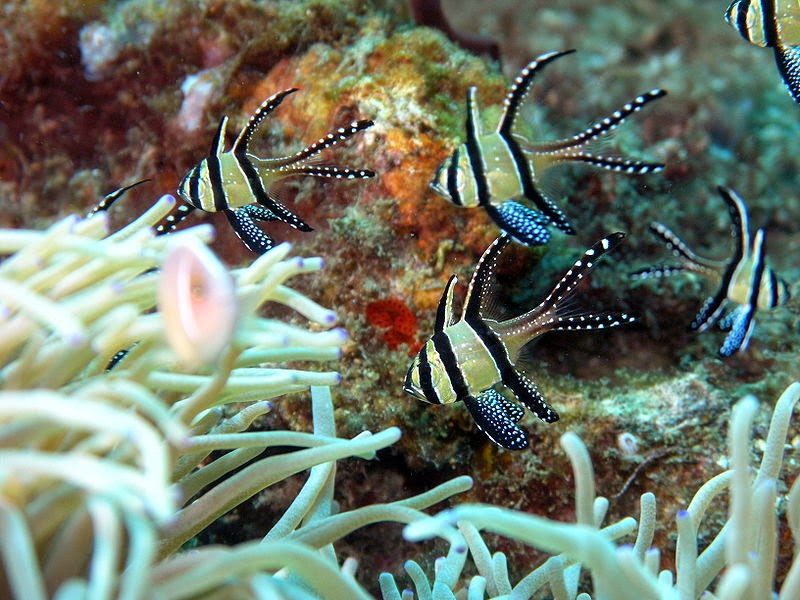
Pterapogon kauderni
The Banggai Cardinalfish is a small tropical fish that is becoming very rare in the wild, even though it has been successfully bred in captivity.

You will only find these small, 3in long fish around the Banggai Islands of Indonesia. They are the only members of their genus, and you can tell them apart from other Cardinalfish by their three-striped bodies, tasseled first dorsal fin, long second dorsal, and their deep-forked tail fins.

Banggai Cardinalfish are diurnal and live in small groups of about a dozen members. They are opportunistic feeders who dine on whatever smaller plants and animals they can find.

Courtship and mating is pretty interesting for these guys-- females are the ones who initiate. They isolate a male and the pair will perform various courtship rituals before spawning. The Cardinalfish are mouthbrooders, which means that the males take the fertilized eggs (up to 90 of them) into their mouths and incubate them for up to 30 days. During that time they do not feed. The female will stay near the male and defend the territory for the first few days, but she eventually leaves.

Banggai Cardinalfish are very popular in the aquarium industry. They breed in captivity, but more than half a million fish are still captured from the wild each year. The small range and high rate of collection has led the species to an "Endangered" listing.

IUCN Status : Endangered
Location : Indonesia
Size : Length around3in (8cm)
Classification : Phylum : Chordata -- Class : Actinopterygii -- Order : Perciformes
Family : Apogonidae -- Genus : Pterapogon-- Species : P. kauderni
Image : Jens Petersen

Thứ Ba, 8 tháng 4, 2014

Dendragapus obscurus
Meet the Dusky Grouse, one of the largest Grouses in North America. Fun fact #1? Until recently it was thought to be a subspecies of the Blue Grouse. But the Blue Grouse is actually no more. DNA analysis split it up into two full-fledged species-- the Dusky Grouse and the Sooty Grouse.

These birds can be found in the Rocky Mountains of North America, and their habitat depends on the time of years. During the winter they live near-exclusively in the coniferous forests, but during the summer breeding season they will live in grasslands and low, dry mountain forests.

The Dusky Grouse has a really curious anatomical feature. Most bird species have about 10 tail feathers, and that number is the same bird to bird. The Dusky Grouse has anywhere from 15 to 22 tail feathers-- a huge variance!

Male and female Dusky Grouses are different in appearance. Females are grey-brown ans speckled, while males are darker brown and have a bare purple throat sack ringed with white feathers. They also have an eye-wattle that varies from yellow to red.

IUCN Status : Least Concern
Location : Western North America
Size : Length up to 18in (45cm)
Classification : Phylum : Chordata -- Class : Aves -- Order : Galliformes
Family : Phasianidae -- Genus : Dendragapus-- Species : D. obscurus
Image :  National Park Service

Thứ Hai, 7 tháng 4, 2014

Oncorhynchus clarki stomias
We are bouncing all over the world now-- from India, to Antarctica, and now to the Rocky Mountains of the United States!

Today's animal is a subspecies of fish that is found only in those particular mountains-- the Greenback Cutthroat Trout. These freshwater fish once had a massive range that extended over the Rockies and the American West. Today they are limited to only 1% of that, and are found only in the state of Colorado (where it is the state fish).

The Greenback Cuttroat Trout grows to lengths of around 1.5ft, and weighs up to 10lbs. They have brilliant green and red coloration, complete with spots, and become even more vibrant during spawning.

The reason for the decline of this fish is threefold-- they were over-fished, they dealt with industrialization and toxic runoff from mining, and they had to compete with introduced fish species. The U.S. Fish and Wildlife Service has been undertaking recovery efforts for the past few decades. Unfortunately, inter-breeding and the persistence of threats have kept these fish to just a 4 mile stretch of the Bear River.

IUCN Status : Not listed, but Endangered by USA Endangered Species Act
Location : North America
Size : Length up to 18in (45cm)
Classification : Phylum : Chordata -- Class : Actinopterygii -- Order : Salmoniformes
Family : Salmonidae -- Genus : Oncorhynchus-- Species : O. clarki -- Subspecies : O. c. stomias
Image :  Joel Sartore

Thứ Năm, 27 tháng 3, 2014

Chionis albus
Meet the Snowy Sheathbill-- the only bird species in Antarctica that is primarily land dwelling and widespread. They are endemic to the continent and the nearby southern Islands, though very rare vagrants sometimes make it to South America and Africa.

Snowy Sheathbills are named for their cone-shaped bills that have a sheath made of a horn-like keratin covering their nostrils. They also have small, fleshy wattles, naked skin around the eyes, and bodies covered in white feathers.

These birds are scavengers, and will eat anything they can find. They live near the coasts, and seals are one of their favorite food sources-- they will pick as seal scabs and dried blood, eat placenta and umbilical chords, and will even eat seal feces. Yum.... The Sheathbills eat insects and seaweed as well.

Snowy Sheathbills have a large population and are widespread. They don't have any major conservation threats at present, and are listed as being of Least Concern.

IUCN Status : Least Concern
Location : Antarctica
Size : Length up to 16in (40cm)
Classification : Phylum : Chordata -- Class : Aves -- Order : Charadriiformes
Family : Chionididae -- Genus : Chionis -- Species : C. albus
Image :  David M. Jensen

Thứ Tư, 26 tháng 3, 2014

Belgica antarctica
Did you know that insects do live on Antarctica? You may have assumed that the cold weather would scare the tiny invertebrates away from the continent, but you would've assumed wrong! Today's animal is one of a handful of little Arthropods that make our southernmost landmass home year round.

Belgica antarctica has the important distinction of being the largest terrestrial-only inhabitant of Antarctica-- at a whopping 6mm in length! These insects have some seriously amazing adaptations that allow them to survive in the hard environment-- they can go without oxygen for several weeks, they can survive their bodily fluids freezing, and they are able to produce specific compounds that keep that freezing to a minimum.

Warm temperatures are actually harmful to B. antarctica. They need to stay close to freezing in order to thrive. If it gets too cold though, they are in trouble. Luckily, they spend nearly all of their time just under the surface of the snow, which keeps the heat to within a few degrees of freezing.

Belgica antarctica can live up to 2 years, and spends most of that time in four different larval stages. As adults their lifespan in very short-- only around 10 days. They live just long enough to mate and lay eggs before dying.

IUCN Status : Not Listed
Location : Antarctica
Size : Length up to 6mm
Classification : Phylum : Arthropoda -- Class : Insecta -- Order : Diptera
Family : Chironomidae -- Genus : Belgica-- Species : B. antarctica
Image :  Richard Lee

Thứ Hai, 24 tháng 3, 2014


Horabagrus brachysoma
Finally we get to our last animal of the Western Ghats series (for now...), the Sun Catfish. It goes by a whole mess of other names-- Guther's Catfish, Yellow Catfish, Bullseye Catfish, etc. Thankfully we have scientific names to sort out the confusion!

Sun Catfish make their homes in the high-vegetation-filled, slow-moving rivers and streams pf western India. Because they live in waters of varying depths and salinity levels, they aren't especially picky when it comes to diet. These adaptable fish will eat anything and everything they can swallow, and since they can grow up to 18in in length that gives them lots of options!

Sun Catfish have been captured for the pet trade, and for food. They are currently listed as "Vulnerable" due to over-exploitation and because of habitat degradation in the nearby areas.

IUCN Status : Vulnerable
Location : India
Size : Length up to 18in (45cm)
Classification : Phylum : Chordata -- Class : Actinopterygii -- Order : Siluriformes
Family : Horabagridae -- Genus : Horabagrus-- Species : H. brachysoma
Image :  N. Hepworth

Thứ Năm, 20 tháng 3, 2014

Sahyadria denisonii
Finally we move to a cold-blooded inhabitant of the Western Ghats-- the Denison's Barb. This small fish makes it home in the fast moving rivers and streams of that particular range.

Like the other creatures this week, the Denison's Bard is Endangered. Unlike those animals, it's number one threat isn't habitat loss. Primary issue for the Barb? Overfishing for the Aquarium Trade. While these animals are becoming rare in the wild, they are growing in popularity in captivity. Which is really unfortunately, because they don't breed well in captivity, which means even more are taken from the wild as a result.

Denison's Barbs grow to around 6in in length, are can be identified by the lateral black and red lines on their bodies. They live in small schools, and forage for just about anything they can find. Algae, Crustaceans, Insects, and plant detritus are all commonly consumed.

IUCN Status : Endangered
Location : India
Size : Body Length around 6in (15cm)
Classification : Phylum : Chordata -- Class : Actinopterygii -- Order : Cypriniformes
Family : Cyprinidae -- Genus : Sahyadria-- Species : S. denisonii
Image :  Stan Shebs

Thứ Tư, 19 tháng 3, 2014

Viverra civettina
The Malabar Large-spotted Civet is yet another creature endemic to the Western Ghats of India. It is also the rarest of the ones we have learned about so far.

It is estimated that there are less than 250 of these guys left alive, and because the population is fragmented, no single group numbers more than 50. Worse still is that the decline is ongoing, which means the population could be extinct very soon. They were actually thought to be extinct until the early 1990s, when a few were spotted in the wild again. But in the last 20 years sightings have been very few and far between.

Unsurprisingly, we know very little about these Mammals. Their biology and behavior has not been extensively studied. What we do know is that they live a nocturnal lifestyle, and prefer lowland forests in their range.

In the past, the Civets were hunted for their oil, and to keep them away from chickens and other domesticated poultry. Today habitat loss and a fragmented population are their biggest worries. Sadly, they do not live in any protected areas, and unless an urgent conservation plan is put into place they could be gone forever.

IUCN Status : Critically Endangered
Location : India
Size : Body Length around 13in (33cm)
Classification : Phylum : Chordata -- Class : Mammalia -- Order : Carnivora
Family : Viverridae -- Genus : Viverra-- Species : V. civettina
Image :  Kerala Tourism

Thứ Ba, 18 tháng 3, 2014

Continuing with our "Animals of the Western Ghats" theme-- today we have the Black-Chinned Laughingthrush, an Endanered bird that lives above elevations of 4,000ft.

This bird has a a confusing taxonomic past, and you will sometimes see it referred to as the Nilgiri or Rufus-Breasted Laughingthrush. It has also gone through 3 different genera before ending up in Trochalopteron!

Today, we know it as T. cachinnans, though it does have a few different subspecies. You can tell those apart based on their coloration and location. Different subspecies have varying amounts of grey and red on their breasts.

All of the subspecies exhibit similar behavior. They live at higher elevations hear forest edges. They forage for berries and insects either alone or in small groups. And they nest between February and June, building nests in low bushes near the ground. Two blue eggs are laid at a time, and the chicks are fully fledged after 3 weeks. Interestingly, the parents will completely deconstruct the nest after fledging!

Like the other animals we've been learning about this week, the Black-chinned Laughingthrush is in trouble due to habitat loss. They also have a small, fragmented range that does their population size no favors.

IUCN Status : Endangered
Location : India
Size : Length up to 10in (24cm)
Classification : Phylum : Chordata -- Class : Aves -- Order : Passeriformes
Family : Leiothrichidae -- Genus : Trochalopteron-- Species : T. cachinnans
Image :  Lee's Birdwatching

Thứ Hai, 17 tháng 3, 2014

Columba elphinstonii
Like our previous entry, the Lion-tailed Macaque, the Nilgiri Wood Pigeon is also an animal found only in the western Ghats of India. It is also, unsurprisingly, a rare and Vulnerable creature.

Nilgiri Wood Pigeons are best identified by the black and white checkerboard pattern that appears on the back of their neck. Aside from that pattern they are brown and grey, with a purple sheen that is more prominent on the males.

These Pigeons are most active during the daytime, and are most commonly seen alone or in pairs. They feed on fruits and seeds, but are not averse to snacking on the occasional insect or snail!

In the past these birds where hunted for sport, which led to a population decline. Today their major nemesis is habitat destruction. These birds rely on forests to live, and those forests are being chopped down for agriculture and human settlement.

IUCN Status : Vulnerable
Location : India
Size : Length up to 16in (42cm)
Classification : Phylum : Chordata -- Class : Aves -- Order : Columbiformes
Family : Columbidae -- Genus : Columba-- Species : C. elphinstonii
Image :  N. Kishor

Thứ Sáu, 14 tháng 3, 2014

Macaca silenus
The Lion-tailed Macaque is a Monkey found only in the western Ghat Mountains of India. The inhabit the moist evergreen forests of that range, and live in groups of between 10 and 20 members.

The Macaques are diurnal, and spend most of their time up in the trees. They travel all day, foraging as they go and stuffing food (Fruits, seeds, and small animal) into their cheeks for storage. When they reach a nightly resting point, they rub their cheeks to get the stored food out.

Lion-tailed Macaques get their name from their long tails that sport lion-like tufts at the end. They also have grey manes that contrast with their dark black-furred bodies. The dark coloration makes it difficult to see them up in the trees.

Sadly, these Monkeys are Endangered. They are found only in one specific part of India, and human settlements have been taking over their precious home range. They have also been captured for the pet trade, and for use in traditional medicines.

IUCN Status : Endangered
Location : India
Size : Length up to 2ft (62cm), Weight up to 22lbs (10kg)
Classification : Phylum : Chordata -- Class : Mammalia -- Order : Primates
Family : Cercopithecidae -- Genus : Macaca -- Species : M. silenus
Image :  N.A. Naseer

Thứ Tư, 12 tháng 3, 2014


The Maltese is a dog breed with ancient and confusing origins. It was bestowed that name "Maltese" during the 19th century, but it actually dates back much farther-- possibly to Greek and Roman times!

Maltese Dogs have always been small. Today they weigh less than 10lbs and stand less than a foot tall. It is believed that their small size came from either Spitz breeds that were bred to be tinier than normal, or from Tibetan Terriers. Either way, by around 500BC there were depictions of Maltese-looking dogs in northern Italy. These dogs were mentioned by writers like Pliny and Strabo, and were said to come from a Mediterranean Island (of which Malta is one).

By the 1800s these dogs were very popular with the upper class, though years of crossing with other breeds led to nearly a dozen different varieties. An official breed club was established, and they were recognized by the AKC in 1888. Official standards came along with the formal recognition, and today all Maltese Dogs are white furred (in the past other colors, and even mixed color dogs were seen).

The Maltese has always been a companion breed, ever since its creation thousands of years ago. They are lively and playful, and do well in small home and apartments. They also do not posses an undercoat, and shed very little. For this reason they are popular with dog owners who suffer from allergies.

Status : Domesticated
Location : Central Europe
Size : Height up to 12in (30cm), Weight up to 10lbs (4.5kg)
Classification : Phylum : Chordata -- Class : Mammalia -- Order : Carnivora
Family : Canidae -- Genus : Canis -- Species : C. lupus -- Subspecies : C. l. familiaris
Image : SheltieBoy

Thứ Tư, 5 tháng 3, 2014

Craspedacusta sowerbii
Did you know that there are Jellyfish that don't live in the ocean? Now you do!

Today's species is Craspedacusta sowerbii, and it is found in calm freshwater bodies of water, like lakes, reservoirs, and slow moving rivers and streams.

These Jellyfish have actually have a distribution that spans the entire globe. They have been located on nearly every continent (sorry Antarctica) and in almost every single U.S. State. However, you won't see them constantly-- they pop up randomly, sometimes in bodies of water where they have never been seen before!

Craspedacusta sowerbii is able to move from place to place because during colder months their polyps contract and become podocysts. These Podocysts attach to other plants and animals that carry the Jellyfish to new places. And because they reproduce asexually, they are able to massively expand their populations very quickly.

IUCN Status : Not Listed
Location : North and South America, Asia, Europe, Africa
Size : Diameter around 1in
Classification : Phylum : Cnidaria -- Class : Hydrozoa -- Order : Limnomedusae
Family : Olindiidae -- Genus : Craspedacusta-- Species : C. sowerbii
Image : Microscopy-UK

Thứ Tư, 26 tháng 2, 2014

Synodontis nigriventis
Meet a curious little fish that hails from the Congo River in Africa-- the Blotched Upside-down Catfish.

As the name and picture illustrate, these Catfish actually do spend most of their time swimming upside down. Crazy, huh? Their coloration actually reflects their preferred bodily orientation. Unlike other fish who are dark on the top and paler on the bottom (to beldn with predators who would be looking up or down at them), these guys have pales backs and dark bellies!

Why do they swim like this? For hunting reasons. By looking up at prey they can surprise it easier, catching it quickly from below. They feed on small insects and crustaceans.

Interestingly, the Catfish aren't born swimming upside down-- they don't really invert until they are around 2 months old. Overall they don't get particularly large as they age. 3-4 inches is their maximum size.

Blotched Upside-down Catfish can be kept as pets, and do best in small groups of 3 or 4.

IUCN Status : Least Concern
Location : Congo River Basin
Size : Length up to 4in (12cm)
Classification : Phylum : Chordata -- Class : Actinopterygii -- Order : Siluriformes
Family : Mochokidae -- Genus : Synodontis-- Species : S. nigriventis
Image : SeriouslyFish

Thứ Ba, 25 tháng 2, 2014

Chelydra rossignonii
Until recently (about 1996), everyone thought that the Central American Snapping Turtle, and its cousin the South American Snapping Turtle were just subspecies of the more widespread and well-known Common Snapping Turtle. But they are different species entirely! (Albeit of the same genus).

As you can probably guess, this particular Turtle lives in the countries of Central America, inhabiting slow moving bodies of water.

These Snappers are solitary animals, and they are nocturnal, which means much is still unknown about their specific behaviors and biology. They are omnivores though, and they feed on different fish, insects, and plant matter. They actually have little barbels around their mouth that they use to lure in prey... and then quickly snap it up.

Central American Snapping Turtles are listed as Vulnerable due to hunting and habitat loss. Theya re now protected in parts of their range, but enforcement is spotty.

IUCN Status : Vulnerable
Location : Central America
Size : Carapace length around 14in (36cm), Weight around 26lbs (12kg)
Classification : Phylum : Chordata -- Class : Reptilia -- Order : Testudines
Family : Chelydridae -- Genus : Chelydra -- Species : C. rossignonii
Image : Leo7

Thứ Năm, 13 tháng 2, 2014

Sylvicapra grimmia
The Common Duiker is a species of antelope native to Africa. They are sometimes also referred to as Grey Duikers because of their grey-brown coats.

Common Duikers are small, standing less than 2ft tall at the shoulder. They are found in most of southern Africa, preferring grassland habitats.

Socially, these antelope typically live alone, though sometimes they travel in pairs. Males are very territorial, and will attack any other male who comes within his land tract. Breeding

Common Duikers are nocturnal, doing most of their feeding between the dusk and dawn hours, and then resting in tall grasses during the day. They consume different seeds, grasses, leaves, and fruits. Amazingly, they will occasionally eat other animals as well! Insects, frogs, and even small birds and mammals have been eaten by Duikers!

The name "Common Duiker" really does suit them, as they are one of the most successful members of the Bovidae family in Africa. They have a huge range and a large population size.

IUCN Status : Least Concern
Location : Africa
Size : Height up to 20in (50cm), Weight up to 55lbs (25kg)
Classification : Phylum : Chordata -- Class : Mammalia -- Order : Artiodactyla
Family : Bovidae -- Genus : Sylvicapra -- Species : S. grimmia
Image : Ton Rulkins

Thứ Năm, 6 tháng 2, 2014

Pan paniscus
Human readers, meet one of your closest biological relatives-- the Bonobo! Bonobos and Chimpanzees share more than 98% of their DNA with humans. In fact-- we are so closely related to them that there are some who argue that Bonobos and Chimpanzees should belong to the Homo genus, rather than Pan.

Bonobos are smaller than Chimpanzees, but otherwise look very similar. They are even sometimes referred to as Pygmy Chimpanzees, and weren't considered separate species until 1929. Physically, Bonobos are lean and have dark black hair. Males are larger than the females-- sometimes weighing twice as much!

The wild range of the Bonobo is quite small-- they live only in the Democratic Republic of Congo which is one of the reasons why they are so Endangered. Not only is their range small, but they live in an area of civil unrest, where government protections for the species are nearly impossible to uphold, and where there are few regulations concerning habitat protection. The wild population has been on the decline for decades, and it will have difficulty rebounding because of the long reproductive cycle of the Primate. Unlike many mammals that reproduce yearly, a female Bonobo will produce offspring only once every 4-5 years.

Bonobo social groups are actually led by the females, and mother-child bonds are very important to the group. In fact, they are the only primate groups to be female-led. A male's standing is influenced by who his mother is. These communities can number over 100 members, but they tend to break up into smaller sections while foraging. Bonobos primarily eat fruit, but they will also consume leaves, insects, and small vertebrates. They have been known to eat other, smaller Primates as well.

IUCN Status : Endangered
Location : Africa
Size : Length up to 3ft (.9m), Weight up to 130lbs (65kg)
Classification : Phylum : Chordata -- Class : Mammalia -- Order : Primates
Family : Hominidae -- Genus : Pan -- Species : P. paniscus
Image : USAID, Pierre Fidenci

Thứ Ba, 4 tháng 2, 2014

The Affenpinscher is a breed of dag that dates back more than 400 years. It's name comes from the German word for "monkey," probably because they have very primate-like faces.

Like many breeds, modern Affenpinschers look different now when compared to their ancestors. They are smaller now, and generally come only in black (some other colors are also recognized, but they are rare to see). The Affenpinschers of centuries past came in many other colors more commonly, and even had white feet and chests.

When it comes to temperament, Affenpinschers are very adventurous and playful. They tend to get along well with other dogs (and other pets in general) and are very active.

Affenpinschers tend to be one of the lesser-known breeds. But last year they got a spot in the limelight when one received the Best in Show award at the Westminster Kennel Club Dog Show.

Status : Domesticated
Location : Germany
Size : Height up to 12in (30cm), Weight up to 13lbs (6kg)
Classification : Phylum : Chordata -- Class : Mammalia -- Order : Carnivora
Family : Canidae -- Genus : Canis -- Species : C. lupus -- Subspecies : C. l. familiaris
Image : Kennel Imrun