Hiển thị các bài đăng có nhãn Coraciiformes. Hiển thị tất cả bài đăng

Thứ Ba, 3 tháng 12, 2013

Ceryle rudis
The Pied Kingfisher is one of the most common Kingfishers in the world. You'll find them throughout sub-Saharan Africa and Asia, where they live in lowland regions near bodies of water.

Pied Kingfishers are very distinctive in appearance. They have white faces with black masks, stark black bills, and patchy (pied) white and black feathers on their crest, back, and wings. Males and females differ in their chest bands-- males have two, females only one.

Fish are the primary prey of the Pied Kingfisher, though aquatic insects and crustaceans will also be consumed. They hunt by hovering over the water, and once they spot prey they dive in with their large bill first and snatch it up. They can swallow small fish whole, which allows them to hunt longer (rather than returning to a nest to feed).

Pied Kingfishers do their nesting in holes that they dig out in vertical sandbanks. These holes can be more than 4ft long, and can take up to a month to excavate. As many as seven eggs are laid at a time, and mom and dad often have help in raising their brood-- chicks from the previous year often stick around to help out their younger siblings, and non-breeding adults will sometimes also lend a hand.

IUCN Status : Least Concern
Location : Africa and Asia
Size : length up to 7in (18cm)
Classification : Phylum : Chordata -- Class : Aves -- Order : Coraciiformes
Family : Cerylidae -- Genus : Ceryle -- Species : C. rudis
Image : Koshyk

Thứ Ba, 9 tháng 4, 2013

Coracias abyssinicus
The Abyssinian Roller is a striking blue bird found throughout the open habitats of sub-Saharan Africa. They are large in body size, growing up to 1ft in length with an additional 5-6in of tail feather.

You can identify these birds by their vibrant blue head and wings, and the reddish-brown feathers on their back. Males and females do look alike, and juveniles are similar as well, only more dull in color.

Abyssinian Rollers, like all Rollers, get their name from the rolling flying motion that they make, especially when trying to attract a mate. They build very rough nests in tree cavities or on building ledges (they have adapted well to human settlement) and lay up to 6 eggs at a time. These birds don't just nest high up, they hunt from perches as well. The Rollers keep and eye out for insects, rodents, and other small creatures. One spotted, they swoop down on their prey.

As mentioned, the Abyssinian Rollers have adapted to human encroachment. They have made good use of building, telephone poles, and other man made structures in order to nest and hunt. Their adaptability,  combined with their large range, puts them at Least Concern on the conservation scale.

IUCN Status : Least Concern
Location : Africa
Size : Body length up to 12in (30cm)
Classification : Phylum : Chordata -- Class : Aves -- Order : Coraciiformes
Family : Coraciidae -- Genus : Coracias -- Species : C. abyssinicus
Image : Public Domain

Thứ Sáu, 22 tháng 2, 2013

Hylomanes momotula
The Tody Motmot is a small, colorful bird found in Central America. They have a very large range that spans across several different countries, and are quite common throughout it.

Tody Motmots live tropical and subtropical lowland forests, where it can be identified by its round green body, red crest, large beak, and dark black eye stripe. They feed on fruits and small animals like lizards and insects.

This particular species of Motmot is unique in its family because it does not posses the strange, long, tennis-racket shaped tail feathers that the other Motmots have. They are also the smallest members of the group.

IUCN Status : Least Concern
Location : Central America
Classification : Phylum : Chordata -- Class : Aves -- Order : Coraciiformes
Family : Momotidae -- Genus : Hylomanes-- Species : H. momotula
Image : dominic sherony

Thứ Sáu, 15 tháng 2, 2013

Buceros rhinoceros
The Rhinoceros Hornbill can be found in several countries through Southeast Asia, and are the state birds of the Malaysian state of Sarawak. They live in rainforests at altitudes below 1,400m, and you'll probably hear them before you see them. Their large, rounded wings make flying very noisy and difficult, and they are able to blast out very loud calls to one another thanks to their sound-resonating headgear.

One of the largest Hornbill species, these birds can grow nearly 4ft in length. They are predominantly black with white feathers, and both males and females have those distinctive yellowish-orange casques on their heads. One easy way to tell the difference between sexes is by looking at their eyes-- males have red irises, while females have white.

Rhinoceros Hornbills form very strong pair bonds, and may keep those bonds for many years (in captivity they can live 30 years or more) The female needs to have exceptional trust in her partner, because she literally seals herself into a tree hole while incubating their eggs. She'll lay up to three at once, inside of a cavity, and then a wall of mud, plants, and feces is built, locking her inside with only a small hole to receive food through. She will rely completely on her partner to feed her during that time, which can last as long as 100 days!

IUCN Status : Near Threatened
Location : Southeast Asia
Size : Length up to 4ft (1.2m)
Classification : Phylum : Chordata -- Class : Aves -- Order : Coraciiformes
Family : Bucerotidae -- Genus : Buceros -- Species : B. rhinoceros
Image :  Jim Bowen

Thứ Sáu, 21 tháng 12, 2012

Merops bullockoides
Today's feature is the White-fronted Bee-eater, a bird found all throughout the Savannahs of Africa. They are identified by their white foreheads, black masks, brilliantly red throats and bright green wings. And as their name suggests, they feed on bees and other flying insects.

White-fronted Bee-eaters are not only very pretty birds, they are also very socially interesting birds-- they have one of the most complex family-based social structures of all our feathered friends.

The Bee-eaters lived in colonies that can number up to 200 individuals. These colonies have large territories that can spread over several kilometers, but they have central roosting sites comprised of holes dug into the earth for use in resting and breeding.

Within these colonies are monogamous family groups called clans, led by a single breeding pair and their numerous, non-breeding family members. These helpers (which may be siblings of the parents, adult offspring, or even in some cases completely unrelated birds) contribute greatly to the raising of offspring that are not their own. They assist in nest building, they bring food to the mother, and they even incubate and feed the young! All in all, about half of all nesting attempts have assistance from helpers!

IUCN Status : Least Concern
Location : Africa
Size : Body Length around 9in (23cm)
Classification : Phylum : Chordata -- Class : Aves -- Order : Coraciiformes
Family : Meropidae -- Genus : Merops -- Species : M. bullockoides

Thứ Sáu, 7 tháng 9, 2012

Aceros cassidix (male)
The Knobbed Hornbill is a large Hornbill that is endemic to the lowland forests of Indonesia. They are primarily herbivores, and feed on fruits and berries. They also will snatch up the occasional insect.

Knobbed Hornbills are monogamous, often for life, and are usually found in pairs. Both sexes have large yellow bills and pale blue skin around the eyes and throat. Males have a very large red casque on their heads, and light colored feathers on the neck. Females are smaller in size over, have short yellow casques, and black necks.

Female
The Knobbed Hornbills have an interesting nesting style. When it comes time to mate, the pair will build a nest inside of a tree cavity. The female will then enter that cavity and be sealed in with a wall of mud, saliva, and other debris. A small hole will be left in the wall to pass in food and to keep the nest clean. The male will  spend more than four months slipping regurgitated food into the nest for his mate and their offspring. When his food supply is not enough, the female will break out, leaving the chicks inside to be fed and kept safe for a few more weeks!

One other fun fact that I found about these birds is that they are sometimes referred to as "Year Birds" by the locals. This name references the red stripe-plates on the sides of the bills, which were thought to identify the bird's age. In truth, those plates can fall off and be replaced, so they aren't very good indicators!


IUCN Status : Vulnerable
Location : Indonesia
Size :  Length up to 3ft (.9m)
Classification : Phylum : Chordata -- Class : Aves -- Order : Coraciiformes
Family : Bucerotidae -- Genus : Aceros -- Species : A. cassidix

Thứ Sáu, 20 tháng 7, 2012

Ceyx erithaca
Today's animal is an absolutely stunning little bird, sporting bright yellow, red, and bluish-black plumage. Though we'll refer to them as the Oriental Dwarf Kingfishers, they are also sometimes called Black-backed Kingfishers, due to the darker colors that contrast with the bright feathers elsewhere.

If you're looking for a Oriental Dwarf Kingfisher, you'll find them (well... maybe... they are very elusive) in south and southeast Asia, where they live in dense forests near small bodies of water. Water plays an important role in their lives-- they breed during the very wet monsoon season and they feed on aquatic animals. And while were are speaking of breeding, these Kingfishers build tunnel-like nests that can measure over 3ft in length!

At present, the Oriental Dwarf Kingfisher is listed as being of Least Concern, but the population is on the decline. Habitat loss is the number one threat to their numbers.

IUCN Status : Least Concern
Location : Southeast Asia
Size : Length up to 5.5in (14cm)
Classification : Phylum : Chordata -- Class : Aves -- Order : Coraciiformes
Family : Alcedinidae -- Genus : Ceyx -- Species : C. erithaca

Thứ Sáu, 9 tháng 3, 2012

Coracias caudatus
Today's animal was recommended to me on the Suggestions page, and I'm so glad it was! What a beautiful bird! (Hint: I love getting suggestions!)

Lilac-breasted Rollers belong to the same genus as the Blue-bellied Rollers that we learned about last month. They also share a very similar range, spanning across sub-Saharan Africa and the southern Arabian Peninsula. They inhabit open woodlands, grasslands, and acacia country, and are typically a sedentary species.

All Rollers are named for their stunning courtship flights, and the Lilac-breasted is no exception! The males quickly fly to a height of around 10m, and then dive with closed wings in a rocking, rolling motion. I hunted around for a video of this, but came up empty. Any leads?

At any rate, if the male is impressive enough he has found himself a mate. Lilac-breasted Rollers are monogamous and typically live in pairs, though small flocks are also seen. They lay 2-4 eggs at a time in nests build within pre-excavated tree holes (thanks Woodpeckers!) Juveniles are fully feathered after only 3 weeks, but they are a greyish brown color and won't receive their full colors till they are adults.

IUCN Status : Least Concern
Location : Africa
Size : Body Length around 14in (36cm)
Classification : Phylum : Chordata -- Class : Aves -- Order : Coraciiformes
Family : Coraciidae -- Genus : Coracias -- Species : C. caudatus

Chủ Nhật, 26 tháng 2, 2012

Syma torotoro
Yellow-billed Kingfishers are medium-sized members of their family, and have a very distinctive yellow coloration that gives them their name. Their heads and bills are a very bright yellow, while the rest of their bodies are blue (on the backs) and white (on the undersides).

Yellow-bellied Kingfishers live in New Guinea and in the northern, rainforested areas of Australia. They are solitary and live on the lower trees and mangroves.

Despite the name, Yellow-bellied Kingfishers don't fish! They actually feed on insects and small reptiles. Other species of Kingfisher actually consume fish, but this one (and a few others) have branched out to other meals.

IUCN Status : Least Concern
Location : Australia, New Guinea
Size : Body Length 8in(20cm), Wingspan 16in (40cm)
Classification : Phylum : Chordata -- Class : Aves -- Order : Coraciiformes
Family : Halcyonidae -- Genus : Syma -- Species : S. torotoro

Thứ Năm, 2 tháng 2, 2012

Blue-bellied Rollers are very striking blue, teal, and buff birds that live in the forested areas of western and central Africa. They are social birds that live in small groups, and they feed primarily on small reptiles and invertebrates. Hunting is done by sitting high up in a tree and then dive bombing the prey.

The species is named for their courtship ritual. The male and female birds perform rolling flights while calling out to each other. The birds are believed to be mostly monogamous, though some males will mate with more than one female. 2-3 eggs are laid at a time, usually in a tree hole, and the female does most of the incubating. During this time the birds are incredibly territorial and will attack other birds that come anywhere near the nest!

Blue-bellied Rollers are not in any current danger. They have a large range, are abundant within it, and show no major signs of population decline.


IUCN Status : Least Concern
Location : Western and Central Africa
Size : Length up to 1ft (30cm)
Classification : Phylum : Chordata -- Class : Aves -- Order : Coraciiformes
Family : Coraciidae -- Genus : Coracias -- Species : C. cyanogaster

Thứ Năm, 6 tháng 10, 2011

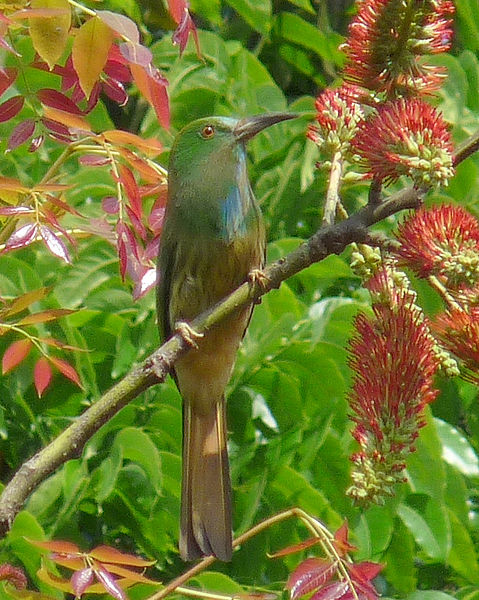
Nyctyornis athertoni
Meet the Blue-beared Bee-eater. And then say its name three times fast.

This bright bird is the largest of the Bee-Eaters, a family known for their consumption of... well... eating bees. In order to snack on their favorite prey, the Blue-beared Bee-eater harasses the nest until a swarm of guard bees shows up. As the bees pursue the bird, the bird feasts!

Blue-bearded Bee-eaters (man, that is even a marathon to type) are found in the forests of South Asia. They are named for the long feathers on their throat that puff out and look rather beard-like. These feathers also happen to be blue. Blue-bearded.

Blue-bearded Bee-eaters are common throughout their range, and have a rather large range at that. They are not currently at any risk.

IUCN Status : Least Concern
Location : South Asia
Classification : Phylum : Chordata -- Class : Aves -- Order : Coraciiformes
Family : Meropidae -- Genus : Nyctyornis -- Species : N. athertoni

Thứ Bảy, 29 tháng 1, 2011

(Image Source)
Phylum : Chordata
Class : Aves
Order : Coraciiformes
Family : Halcyonidae
Genus : Dacelo
Species : novaeguineae

Length : 18in (45cm)
Weight : 1lb (.5kg)

IUCN Status : Least Concern

The Laughing Kookaburra is one of the most iconic animals in Australia, and is native to the eastern side of the continent, though they have been introduced elsewhere. They are most commonly found in open woodlands where breeding pairs establish a year-round territory.

Laughing Kookaburras get their name from their interesting laugh-like call. This call is most often heard at dawn and dusk, and is used to announce territories. This timed laughing behavior has earned them the nickname of "Bushman's Clock." Laughing Kookaburras also produce other sounds for situations like courtship and aggression.

Juvenile Kookaburra
The Laughing Kookaburra is actually the largest member of the Kingfisher family, though they don't really eat all that much fish.  They prefer instead to feed off of reptiles and invertebrates, which they snatch up with their large (up to 4in long) beaks.

There is a strong bond within Kookaburra families. Pairs mate for life and remain in the same territory, using the same nest year after year. Young Laughing Kookaburras are helpless and naked, and don't even open their eyes for three weeks. After fledging, the juveniles often hang around for a few years, assisting their parents with future broods before establishing territories of their own.

Kookaburras are quite the cultural figures in their native land. They are the subject of a popular childrens song, have had coins and stamp featuring their likeness, and they were even one of the three animals selected as mascots for the 2000 Summer Olympics in Sydney.