Hiển thị các bài đăng có nhãn Cetacean. Hiển thị tất cả bài đăng

Thứ Ba, 15 tháng 4, 2014

Orcaella brevirostris
The Irrawaddy Dolphin is a rare species of Dolphin that is found only in the coastal waters near Australia and Southeast Asia. They are sometimes called Irrawaddy River Dolphins, even though they are not true River Dolphins. This is because they often inhabit estuaries and river mouths, and because some sub-populations have even made their homes in freshwater rivers like the Mekong and Irrawaddy.

Unfortunately, many of those sub-populations are not doing too well, and are considered to be Critically Endangered. In the Mekong, for example, there are less than 100 Dolphins. The populations in India and Bangladesh appear to be more stable, and actually account for most of the worldwide count. They are listed as Vulnerable overall because of those groups.

Irrawaddy Dolphins look a bit like small Belugas, though they are actually closer relatives to Killer Whales. They aren't especially large, maxing out around 7ft and 300lbs. They live in very small groups, and are very slow moving, passive Dolphins who feed on a large variety of fish, cephalopods, and other marine invertebrates.

The major threats to the Irrawaddy Dolphins are fishing and habitat degradation. Because they live in rivers and so close to shore they are often accidentally captured by fishing nets. They are also affected by damming and mining run off, and they have also been captured for the performance aquarium industry. They are protected by CITES, but the conservation efforts vary country to country.

IUCN Status : Vulnerable
Location : Indian and Pacific Ocean
Size : Length up to 7.5ft (2.3m)
Classification : Phylum : Chordata -- Class : Mammalia -- Order : Cetacea
Family : Delphinidae -- Genus : Orcaella -- Species : O. brevirostris
Image : Stefan Brending

Thứ Ba, 1 tháng 4, 2014

Mesoplodon layardii
The Strap-toothed Whale, also known as Layard's Whale, is a little-studied Cetacean found in the cold waters of the Southern Oceans. They have beaked faces and grow to lengths of around 20ft, with the males being slightly smaller than the females. Males also have the curious distinction of having long front teeth that just upwards from their jaw. These teeth can grow to nearly a foot in length, and are probably used for mating and communication purposes, as scarring is common in males.

We don't known much about their reproductive habits, their lifespan, or their social behaviors. They are shy creatures who don't often come near boats, which is one of the reasons why studying them has proven difficult.

Most of what we know about the Strap-toothed Whales comes from their remains. The facial scars on the males lead us to believe that they fight one another, for example. Their stomach contents have also been looked at, which is how we know that Squid is their favorite prey-- over two dozen different deep sea squid species have been identified in their stomachs!

IUCN Status : Data Deficient
Location : Antarctica, Southern Oceans
Size : Length up to 20ft (6m)
Classification : Phylum : Chordata -- Class : Mammalia -- Order : Cetacea
Family : Ziphidae -- Genus : Mesoplodon-- Species : M. layardii
Image :  Marinebio

Thứ Năm, 19 tháng 12, 2013

Balaenoptera acutorostrata
The Common Minke Whale is one of the most abundant whale species on the planet-- there are believed to be around 800,000 of them! They also happen to be the smallest of the Rorquals (baleen whales with throat grooves), and reach only 30ft in length.

Common Minke Whales are found in ocean waters worldwide. They usually swim alone, though sometimes pairs or very small groups are observed. Their small size helps to identify them, as does their slim, sleek body, cloudy-grey skin, white fin bands, and double blowhole.

Like all Baleen Whales, the Common Minke feeds on very small fish and invertebrates, filtering their prey through the baleen plates that hang in their mouths.

Because of their abundance, Minke Whales are common targets for human interaction. They are frequent stars of whale watching tours, but they are also hunted by whalers as well. In the past, Minke Whales were not popular whaling targets because of their small size. However, most larger Baleen Whales are now protected, and the Minke Whales have been thriving in their absence. As a result, countries like Norway and Japan take hundreds of the whales each year. The population is believed to be stable overall, but stocks in certain areas are dwindling.

IUCN Status : Least Concern
Location : Oceans worldwide
Size : Length around 30ft (9m)
Classification : Phylum : Chordata -- Class : Mammalia -- Order : Cetacea
Family : Balaenopteridae -- Genus : Balaenoptera-- Species : B. acutorostrata
Images : Rui prieto

Thứ Năm, 24 tháng 10, 2013

Sousa chinensis
Indo-Pacific Humpbacked Dolphins have a large range that stretches along the coasts of the Indian Ocean, as well as around Australia and the Western Pacific. They prefer shallow waters, usually sticking around depths of 60ft.

These Dolphins are named for the fatty humps on their backs, that rest just below their dorsal fin.  They are typically grey in color, but can also be white or even pink! In fact, a sub population near Hong Kong bay is famous for its pinkness!

Indo-Pacific Humpbacked Dolphins live in small groups, usually of around a half dozen members. They feed on all kinds of different reef fishes, and can stay underwater for as long as 8 minutes.

These Dolphins are pretty slow moving, especially when compared to other members of their family. They move along at around 3mph, which is similar to a leisurely human walking speed. The fastest Dolphins can swim nearly ten times that pace! Interestingly though, the Humpbacked Dolphins can perform different aerial jumps and tricks, despite their slow swim times.

Sadly, these Dolphins are listed as Near Threatened, and could be in even more danger very soon. They live near very high human population areas, and those waters are becoming polluted and heavily trafficked. The aforementioned Hong Kong Bay group has declined by 60% in the past decade alone, and could very soon be completely wiped out.

IUCN Status : Near Threatenend
Location : Indian and Pacific Oceans
Size : Length around 9ft (2.8m), Weight around 440lbs (200kg)
Classification : Phylum : Chordata -- Class : Mammalia -- Order : Cetacea
Family : Delphinidae -- Genus : Sousa-- Species : S. chinensis
Image : Mandy

Thứ Năm, 9 tháng 8, 2012

Bohaskaia monodontoides
The animal that we're going to learn about today has been extinct for around 3 million years-- but it bears a very striking similarity to some of the creatures that are still swimming around in the Earth's oceans, and also gives scientists some insight into where those modern animals came from.

Bohaskaia monodontoides is known from just a single skull that was unearthed in Virginia is 1969. It wasn't until very recently that it was studied using modern methods, and the species was only just named in spring 2012. The skull looked similar to that of a Beluga or Narwhal, yet was still different enough to be recognized as a different genus and species entirely.

Belugas and Narwhals, as you may know, live in cold waters. B. monodontoides swam in warmers seas, yet shared many of the same physical traits. Interestingly, another extinct whale Denebola brachycephala also hailed from warmer parts (the fossils were found in Baja, Mexico). It now appears that this particular group of whales evolved in the more temperate waters, but were eventually driven north were they adapted to the climate and survived. How this happened, and when it happened is not yet known, but it is pretty amazing to think that the warm-water origin discovery was due in part to a single fossil found over 40 years ago!

Status : Extinct for 3 million years
Location : North America
Classification : Phylum : Chordata -- Class : Mammalia -- Order : Cetacea
Family : Monodontidae -- Genus : †Bohaskaia -- Species : †B. monodontoides

Thứ Sáu, 8 tháng 6, 2012

Balaenoptera musculus
Happy World Oceans Day everybody! And what animal could represent the oceans better than the largest one in them? Meet the astonishing Blue Whale, the biggest creatures to have ever lived!

Blue Whales can reach lengths of up to 100ft, and weigh nearly 400,000lbs. That is incredible! Their hearts are the size of a small car, and their tongues can weigh as much as an elephant! In fact, right at birth they are already one of the largest animals on the planet. A newborn can measure over 25ft long and weigh 3 tons. (They also will grow 200lbs every single day!)

It is amazing to think that an animal so massive has a diet that is based exclusively on tiny little crustaceans called Krill. During the Arctic summers, they can consume up to 4tons of Krill in a single day! They feed by gulping a huge amount of water into their mouths, expanding their mouths and belly out in the process. They then push the Krill up into their baleen plates and strain the water out, leaving only the tasty little crustaceans behind.

Blue Whales can be found in all of the world's oceans, and they often migrate long distances between the poles and the equator every year. They typically travel alone, but are sometimes found in very small groups. Even if they are alone, they can still find one another with relative ease, considering they are the loudest animals out there. Their low frequency, 188 decibel sounds can be heard hundreds of miles away!

Comparison between an average Blue Whale,
a human, and  a Hector's Dolphin
So we've already learned that the Blue Whale is the largest animal, and the loudest. But did you know they are also one of the most long lived? Scientists estimate that their average lifespan is 80-90 years, and that ages of well over 100 are common.

Unfortunately, Blue Whale populations aren't doing so hot. They were absolutely decimated during the commercial whaling boom, with hundreds of thousands being killed before the ban. Hunting of the species has been outlawed since 1966, but recovery has been slow. Blue Whales are listed as Endangered, and there may be less than 10,000 left in the entire world, with most being found in the Northern Hemisphere.

IUCN Status : Endangered
Location : Oceans Worldwide
Size : Length up to 98ft (30m), Weight up to 200tons (180 metric tons)
Classification : Phylum : Chordata -- Class : Mammalia -- Order : Cetacea
Family : Balaenopteridae -- Genus : Balaenoptera -- Species : B. musculus

Chủ Nhật, 13 tháng 5, 2012

Eschrichtius robustus
As it is Mother's Day, we're going to learn about one really awesome mother from the Animal Kingdom-- the Gray Whale!

Gray Whale breeding season takes place in November and December, and happens while the Whales are wintering in warmer waters near the Equator. Females gestate for a whopping 13.5 months and give birth to a single calf while in their wintering grounds the following year. Calves are born in safer waters off of Baja, Mexico that are free from predators, and the mothers will help lift their infants up to the surface so that they can breathe... at least until they become stronger swimmers. Calves are around 4ft long at birth, and grow very quickly. They can drink up to 80 gallons of milk a day, and that milk is 53% fat!

Eventually, the mother an calf must travel back to colder climates in order to feed. The wintering waters are safe for giving birth, but that is because there is so little food, and thus very few predators. All Gray Whales migrate, and they actually take part in one of the greatest animal migrations in the world, travelling as far as 12,500 miles (20,000km) round trip each year. Females and calves are the first to leave the warm winter waters, destined for the nutrient rich seas of the north. But the trip is not easy! Not only is the swim difficult for the calves due to it's distance, it is also incredibly dangerous thanks to all the predators (like Killer Whales) that are out to get them.

Calves remain with their mothers for around a year, and will themselves take about 8 years to reach sexual maturity. One fact that I found particularly interesting is that the female Gray Whales are often larger than the males, which is unusual for Cetaceans. Sperm Whales, for example, have some of the most ridiculous sexual dimorphism of any mammal.

Gray Whales also have a very distinctive look to them, thanks to the various parasites and growths that collect on their skin. Calves are born completely smooth, and will collect their barnacles and lice as they age. Doesn't sound especially pleasant, does it?

Currently, Gray Whales can only be found in the Pacific Ocean. Before the growth of Commercial Whaling they also lived in the Atlantic, but they are now extinct in that particular area. Gray Whales almost disappeared from the planet completely, but they are now protected and their population is slowly rebounding. Boat collisions, fishing gear entanglement, habitat degradation, and the effects of climate change all continue to impact the species.

IUCN Status : Least Concern
Location : Pacific Ocean
Size : Length up to 50ft (15m)
Classification : Phylum : Chordata -- Class : Mammalia -- Order : Cetacea
Family : Eschrichtiidae -- Genus : Eschrichtius -- Species : E. robustus

Thứ Ba, 13 tháng 3, 2012

The Amazon River Dolphin is one of the four (possibly five) species of freshwater Dolphin found in the world. They live in the Amazon basin and go by a handful of other names, including Boto and Boutu.

Inia geoffrensis
"Pink Dolphin" is yet another name for the species, due to the coloration that many of the individuals exhibit. The precise cause of the pinkness is not known, but Dolphins in murkier water tend to be more pink than those in clearer areas. Some are even as bright as flamingos!

Amazon River Dolphins differ from other freshwater Dolphins in that they have unfused neck vertebrae. This trait allows them to turn their heads from side to side and give them extra maneuverability. They can also paddle their fins in different directions, which gives them the ability to move around submerged tree roots and through very shallow spots when the rivers flood over areas that are normally above water.

The social structure of the species is dependent on the time of year. During the flood season they tend to be solitary hunters. This is because the fish are able to disperse much farther through the new marshes, giving the Dolphins more hunting area. When the waters recede, some dolphins come together in small groups in order to share the more concentrated hunting areas. Adult Dolphins have no major predators (besides humans) and thus do not need to rely on large pods for safety and protection.

Amazon River Dolphin
Amazon River Dolphins are prominent in local legends. One popular story tells that the Dolphin turns into a handsome young man at night, who always wear s hat to cover his blowhole. He comes ashore and seduces young women, often impregnating them. During the daytime he returns to the river and the women are left under a magical spell.

Legendary or not, the Dolphins are facing some problems. Some fisherman deliberately kill them so that they do not need to compete for catches, while other Dolphins get inadvertently tangled in fishing equipment. They are also facing habitat destruction, fragmentation due to dam building, and troubles arising from the chemical runoff of mining operations. A full population survey has not been done, and the species is listed as Data Deficient.

IUCN Status : Data Deficient
Location : South America
Size : Body Length up to 8ft (2.5m)
Classification : Phylum : Chordata -- Class : Mammalia -- Order : Cetacea
Family : Iniidae -- Genus : Inia -- Species : I. geoffrensis

Thứ Sáu, 24 tháng 2, 2012

Tasmacetus shepherdi
The Cetacean World is all abuzz this week! The Shepherd's Beaked Whale, a very rare and elusive species, has just been photographed alive for the first time ever. This is all thanks to the Australian Antarctic Division research team, who stumbled across some of the surfacing whales while hunting for their much larger, Blue Whale cousins.

This species lives in deep waters near New Zealand and Australia; their distance from shore is one of the reasons that they are so rarely seen. The Beaked Whales were first discovered in 1937, but have only been seen alive a scant handful of times. Most of what we know about the species comes from beached carcasses.

One of the most exciting things about the filming is that we now know that they are social animals. It was speculated that they were solitary, or lived in very tiny groups. This time the researchers discovered a pod of 10-12 individuals!

Understandably, not much else is known about the Shepherd's Beaked Whale, though the research time hope to publish more about their findings in the future.

IUCN Status : Data Deficient
Location : Australia and New Zealand
Size : Length up to 20ft (7m)
Classification : Phylum : Chordata -- Class : Mammalia -- Order : Cetacea
Family : Ziphiidae -- Genus : Tasmacetus -- Species : T. shepherdi

Thứ Năm, 26 tháng 1, 2012

Lagenorhynchus obscurus
The Dusky Dolphin is a small little Cetacean that rarely grows longer than 2m. They can be found in coastal waters throughout the Southern Hemisphere, and are divided into three subspecies based on location. These groups live near New Zealand, in the Indian Ocean, and off of South America.

The species is known for its acrobatic skill and they are frequently seen leaping and jumping in groups. They are also very fond of boats, and like to swim and tumble alongside them. Dusky Dolphins are fast swimmers, and can reach speeds of up to 20 knots.

Dusky Dolphins live in interesting social groups. At night when they swim closer to shore their group is very small, numbering somewhere between 6 and 15 individuals. But during they day they swim to deeper water and join up with other groups in order to cooperatively hunt, play, and socialize. These gatherings can include several hundred dolphins. At night they break up again into their smaller sections.

The small social groups themselves seem to be strong, but there are no strong bonds between mated pairs. Dusky Dolphins are promiscuous breeders, and males compete with each other over females.

There are no good population estimates for the Dusky Dolphins. As a result, we don't know for sure how much hunting for food and bait, and gill-net tangling has affected their numbers.

IUCN Status : Data Deficient
Location : Coastal waters in the Southern Hemisphere
Size : Length around 6ft (1.8m)
Classification : Phylum : Chordata --Class : Mammalia -- Order : Cetacea
Suborder : Odontoceti -- Family : Delphinidae -- Genus : Lagenorhynchus -- Species : L. obscurus

Thứ Sáu, 2 tháng 12, 2011

Wholphin
I'm sure you've heard of hybrids like Ligers and Mules, but what about Wholphins? They are the result of crosses between two ocean-dwelling mammals- Bottlenose Dolphins and False Killer Whales. I should note, however, that the False Killer Whales (like regular Killer Whales) are members of the Oceanic Dolphin family along with the Bottlenoses, so the relationship isn't as far off as one might think.

While this hybrid might appear in the wild, we only know of them definitively from two individuals living at Sea Life Park in Hawaii. Back in 1985 a female Bottlenose and a male False Killer Whale lived in the same tank, and were performers in the park's aquatic show. No one expected the 14ft Whale and 6ft Dolphin to mate, but the surprise result was Kekaimalu. She herself actually gave birth to a 3/4 Bottlenose offspring in 2005 (She had two previous calves, one died shortly after birth, and one lived till the age of 9). That makes Kekaimalu and Kawili Kai the only known captive Wholphins in the world.

Wholphins are interesting because they area true mix of the species. They grow to a size somewhere in between that of the two species (Kekaimalu's calf was the size of a 1-year-old Bottlenose when she was but 1 month old!). They have an intermediate gray color, and their teeth also fall right down the middle- False Killer Whales have 44, Bottlenose Dolphins have 88, but Kekaimalu has 66!


IUCN Status : Not Listed
Location : Hawaii
Classification : Phylum : Chordata -- Class : Mammalia -- Order : Cetacea
Family : Delphinidae -- Genus : Pseudorca, Tursiops

Thứ Bảy, 17 tháng 9, 2011

Killer Whales, or Orcas, are actually Dolphins. The same is true for False Killer Whales. They are one of the largest members of the Delphinidae family, and males can grow as long as 20ft.

Pseudorca crassidens
Though they share part of a common name and some physical similarities, False Killer Whales and Killer Whales really aren't that closely related. They belong to separate genera. False Killer Whales have rounded heads with no beaks, tall dorsal fins, and dark coloration. They live in groups that can number into the dozens, and sometimes intermingle with other dolphins, like Bottlenoses. They feed mainly on cephalopods and large fish, using echolocation to locate and capture prey.

One rather interesting fact about False Killer Whales is that the world first learned of them from fossils. Live identification didn't occur until 15 years later! As you might guess, they aren't an exceptionally common species, though they can be found in temperate and tropical oceans world. For example, of the 18 species of dolphin and toothed whale found around Hawaii, they are the least populous.

According to the IUCN, there is not enough data to effectively evaluate the population of the species. They are uncommon, but also have a massive range, which makes getting exact numbers difficult, and makes it hard to determine how the species is being affected by factors like bycatch and antropogenic sound. A drastic population decrease could be incredibly troublesome for the species, because they are already uncommon, because they mature very slowly (males take about 18 years), and because they breed infrequently.

IUCN Status : Data Deficient
Location : Temperate and Tropical Oceans
Size : Length up to 20ft (6m), Weight up to 1,500lbs (700kg)
Classification : Phylum : Chordata -- Class : Mammalia -- Order : Cetacea
Family : Delphinidae -- Genus : Pseudorca -- Species : P. crassidens

Thứ Sáu, 10 tháng 6, 2011

Cephalorhynchus hectori
The Hector's Dolphin is not only one of the smallest Ceteceans in the world, they are one of the rarest as well. These tiny ocean mammals (only 4-5 feet long!) are found exclusively off the coast of New Zealand, and are listed as Endangered by the IUCN. 

There are actually two subspecies of Hector's Dolphin, the north (sometimes called the Maui's) and the south. While the south subspecies is rare with only 8,000 individuals left, the north is close to extinction. It is estimated that only 111 Maui's Dolphins are still out there. They are listed as "Nationally Critical" by the New Zealand Department of Conservation.

Hector's Dolphin
Hector's Dolphin are so rare because they only live about twenty years and they breed very slowly. Females reach sexual maturity at the age of 7 or 8, and only calve every 2 to 4 years. Their numbers have decreased due to fishing net entanglement and human encroachment, and it takes a great many years for them to repopulate.

Hector's Dolphin are gray with black and white side markings. They are easily distinguishable due to their small size, tapered faces, and short, round dorsal fins.

Like other dolphin species, the Hector's Dolphin is a carnivore that uses echolocation to find and capture food. They live in small groups of up to 8, and are extremely social with one another, using complex clicks to communicate.

IUCN Status :  Endangered
Location : New Zealand
Size : Length up to 5ft (1.5m), Weight up to 130lbs (60kg)
Classification : Phylum : Chordata -- Class : Mammalia -- Order: Cetacea
Suborder : Odontoceti -- Family : Delphinidae
Genus : Cephalorhynchus -- Species : C. hectori

Thứ Năm, 21 tháng 4, 2011

Neophocaena phocaenoides
Did you know that there are only six living porpoise species? And that today's animal, the Finless Porpoise, can be found in both salt and fresh water, making it the only freshwater Porpoise? Finless Porpoises live in coastal waters off of Asia, but there are also small populations that live in rivers, including the Yangzte. They typically swim in small groups of 2-3 individuals, though larger pods of up to 20 have been rarely observed.

Finless Porpoises, as their name suggests, do not have a dorsal fin. Instead, they have a very low ridge on their backs. They also have unfused neck vertebrae, which allows them to move their head in different directions. Overall, they are a small, streamlined Cetecean species, and they feed on Krill, Fish, Octopuses, and a handful of other invertebrate species.

Gill nets and other types of fishing gear are some of the biggest causes for Finless Porpoise death. They are also very susceptible to water pollution, habitat change, and habitat loss. The Yangtze subpopulation is quite rare, and estimates are that there are less than 2,000 left.

Finless Porpoises have appeared recently in the news, when a young Porpoise was washed a mile inland during the Japanese Tsunami. The Porpoise was rescued and returned to the ocean.

IUCN Status :  Vulnerable
Location : Asian coastal waters
Size : Length up to 5ft (1.55m), Weight up to 100lbs (45kg)
Classification : Phylum : Chordata -- Class : Mammalia -- Order : Cetacea -- Suborder : Odontoceti
Family : Phocoenidae -- Genus : Neophocaena-- Species : N. phocaenoides

Thứ Tư, 23 tháng 3, 2011

Pakicetus Illustration by Carl Buell
Phylum : Chordata
Class : Mammalia
Order : Cetacea
Family : Pakicetidae
Genus : Pakicetus

Length : 3ft (.9m)
Weight : 50lbs (23kg)

Status : Extinct since the Early Eocene (40 million years ago)

Take a look at that picture. That little guy is a possible ancestor to dozens of modern mammals. If you had to guess which, would you say dog? Cat? Weasel? Well those would all be wrong! Pakicetus (if you couldn't guess from the taxonomic cheat sheet up there) is an ancient Whale.

Pakicetus gets its name from its location and type. Paki for Pakistan, Cetus for whale. It is the earliest known, well-preserved, prehistoric whale. Pakicetus was a terrestrial, but potentially semi-aquatic animal, since its ears were not yet developed to hear well underwater. Its actual habitat is still debated because it had eye sockets and limbs that might suggest more aquatic activity than initially thought. Other early cetaceans, also found in Central and South Asia, have similar characteristics and are known from more complete skeletons.

Eventually Pakicetus and other early Cetaceans would take to the water more and more, and evolution would do its part to turn arms into fins and tails into flukes. By the end of the Eocene (about 35-30 million years ago) we had fully aquatic whales swimming in the prehistoric seas. Isn't it awesome how life moved out of the oceans, and then creatures like whales eventually went back again? And now animals whose ancestors were dog-like land mammals have become the largest animals to ever live? So cool.

Thứ Hai, 7 tháng 3, 2011

Sei Whale
Phylum : Chordata
Class : Mammalia
Order : Cetacea
Family : Balaenopteridae
Genus : Balaenoptera
Species : borealis

Length : 65ft (20m)
Weight : 99,000lbs (45,000kg)

IUCN Status : Endangered

Sei Whales (pronounced "say") are named after the Norwegian word for pollock fish, "seje." The Whales and fish moved into fishing areas around the same time. Though their name has Norwegian origins, Sei Whales can actually be found in tropical, temperate, and sub-polar oceans around the world.

Sei Whales are one of the longest whale species, with many individuals not even reaching sexual maturity until they are around 45ft (13m) long. Females are often slightly longer than males. Sei Whales also have the distinction of being one of the fastest swimming cetaceans. They can reach speeds of 35mph (55kph).

Unfortunately, whaling has had a drastic impact on the worldwide Sei Whale population. It is now believed that there around only around 57,000 whales left, which is amazingly few when you consider that during the 1964-65 season nearly 25,000 whales were killed. Nearly 300,000 Sei Whales have been taken since the advent of modern whaling. Sei Whales are now listed on CITES and are protected under the Endangered Species act.

Thứ Năm, 16 tháng 12, 2010

(Image Source)
Belugas Whales (Delphinapterus leucas) are very iconic whales with their all white adult bodies, short beaks, absent dorsal fins, and large "melon" foreheads. They are found in the waters of the Arctic, and migrate to sub-artic waters to stay away from freezing ice. Belugas can grow to sizes of up to 20ft (6.1m).

Did you know that Beluga Whales are not always white? As calves they are a darker gray color, which gradually lightens as they age. They will reach their full white color by around age 5. Females gestate for 14 months, and a newborn calf can measure 4-6ft (1.4m) long. Calves remain with their mothers for up to two years, and feed off of milk that is 28% fat in order to grow and maintain warmth in the cold waters.

Beluga Pod
Belugas are extremely social creatures. They live in pods that communicate through a variety of whistles, mimics, and clicks. They are also rather unique among Cetaceans in that they have non-fused neck vertebrae, which allows them to turn their heads and even make facial expressions!

Beluga Whales hunt using echolocation, a process that involves sending out clicks that then bounce off potential prey and echo back to the whale. The Beluga's large forehead contains a melon, which helps to amplify and focus these clicks. They feed on fish, worms and crustaceans, and consume 50-60lbs (22.6-27kg) a day.

Thứ Bảy, 9 tháng 10, 2010

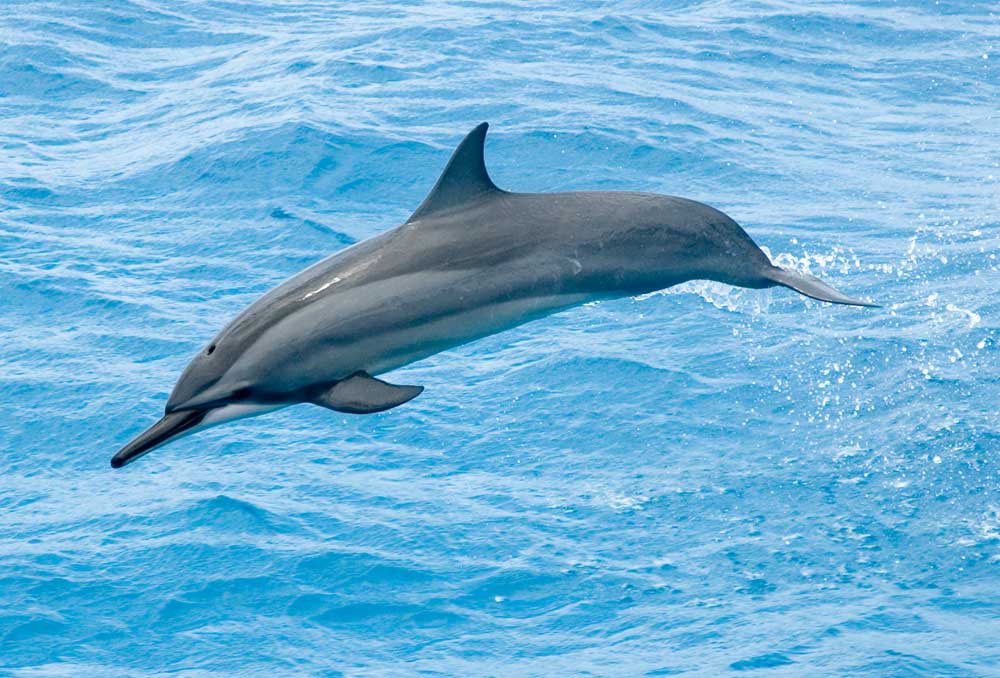
Spinner Dolphins are small cetaceans that can be found throughout the tropical waters of the world. They have slender bodies, and generally do not exceed seven feet. Spinner Dolphins weigh 130-170lbs. The external appearance of these animals is dictated by their location and subspecies. Overall though, they come in shades of gray with white bellies.

(Image Source)
It is difficult to generalize the Spinner Dolphin because the habitats and behaviors of the different subspecies vary. Hawaiian and Costa Rican Spinners, for example, tend to live in coastal areas, while most other populations are far more pelagic. The Hawaiian Dolphins also tend to live in groups that number in the hundreds, while others congregate in the thousands. Many Spinner pods travel with other cetacean groups, including Humpback Whales and Spotted Dolphins. Their tendency to coexist with other sea creatures had led to some problems. In the East Pacific, Spinner Dolphins sometimes travel with Yellowfin Tuna, which has resulted in many dolphin deaths as the Tuna are fished up.

But lets move on to less sad things. Like jumping! Spinner Dolphins are so named because of their amazing acrobatics. They can do as many as fourteen leaps in a row, and are able to jump and spin on their body axis. It is believed that these antics serve as a form of communication and as a method of removing parasites.

Spinner Dolphins reach sexual maturity at around age seven, and females calve roughly every three years. Spinners feed off of small fish and squid, and they are preyed upon by sharks and larger cetaceans. The aforementioned Tuna fishing has damaged their Pacific populations since the 1960s. Spinner Dolphins do very well in captivity, and can be found in several aquariums.

Thứ Năm, 12 tháng 8, 2010

Well, Mythological Creatures Week is now over and I certainly had an interesting time fishing for information on some well, and not so well known legendary beasts. But alas! It is time to return to the realm of fact!

Image From SuperCentenarian.com
I've been reading Philip Hoare's The Whale lately, (which will be up on the Bibliography once I actually finish it) and have stumbled across a fact that blew my mind. Bowhead Whales (Balaena mysticetus) can live to be over 200 years old. Until a few decades ago, no one really thought that these rare, Arctic dwellers lived any longer than the standard 60-70 years for whale... and then they found the harpoons. Individual whales were found that had harpoon tips that hadn't been manufactured since the 1860s and 70s. Those whales had been swimming around with broken tips in their skin for over a hundred years. More and more specimens were found with these odd instruments, and with subsequent Amino Acid testing it has now been determined that Bowheads can live to a ripe age of 200. How do they do it? Well, their year-round Arctic habitat probably helps to slow down their metabolism. They are one of the few whales that live in such conditions for their entire lives.

Bowhead Whales are baleen whales, meaning that they consume plankton which is filtered through large keratin plates in their mouths. The baleen of a Bowhead can grow up to 13ft in length, which made it highly sought after by the commercial whaling industry. Bowheads are so named because their heads resemble an archer's bow, and the almost triangular shape of their head may help them to break through the Arctic Ice. Bowheads are able to reach lengths of 50ft, and weights of 60tons. They resemble the three Right Whale species that share their family, Balaenidae, but they are the only extant species within their genus.

Sadly, the Bowhead Whale was hunted to near extinction for their oil and baleen. A ban on hunting since the 1980s has allowed their numbers to steadily rise, and now only indigenous peoples are able to collect set numbers of them each year. The total worldwide population is unknown.

Thứ Bảy, 3 tháng 7, 2010

Writing about extinct animals is always a challenge to me because in so many circumstances the information is just not there. We know about the creatures from fossils that are so often incomplete, or from unreliable sources in the case of the more recently extinct animals. The Baiji falls into neither of these categories, as its functional extinction was sadly announced only four year ago, in 2006. If there are still individuals out there, they would be the rarest mammals on earth.

Image from Wildlife Extra
Only a hundred years ago thousands of these freshwater dolphins, also known as Chinese River Dolphins, swam the length of the Yangtze. Industrialization and fishing practices have led to their fast decline, and in 2006 a six-week, multi-national expedition uncovered no specimens. Reports of an sighting surfaced in 2007, but even if a handful of individuals remain, the population is unlikely to be sustainable. They have never been bred in captivity, though the Chinese government and international agencies have made steps in the past to set up programs.

Baijis (Lipotes vexillifer) have existed for millions of years, and are recorded in Chinese history for nearly two millennia. They are one of five species of freshwater dolphin, all of whom are listed by the IUCN as between vulnerable and critically endangered.

Baijis, like all dolphins, hunt by means of echolocation. They typically feed during the day and consume a variety of fish species that are found on both the river bottoms and on the surface. Another similarity to their saltwater cousins is their social organization. They live in small groups and use a variety of clicks and whistles for communication.

Physically, the Baiji grows to be about 8 feet long and weighs 500lbs. They have grey bodies, very long snouts, low dorsal fins, and small eyes that are functional but not especially useful in the murky waters. Gestation is 10-11 months, and one calf is born at a time. Life expectancy is around 25 years, based upon dentition and captive individuals.