Hiển thị các bài đăng có nhãn Butterfly. Hiển thị tất cả bài đăng

Thứ Sáu, 1 tháng 11, 2013

The Julia Butterfly is an insect with a very large range that spreads from the southern United States all the way down to Brazil. They are residents in most of their range, though in the U.S. they sometimes move north to Midwestern states during the summer.

Both male and female Julia Butterflies are orange, though the males are more vibrant. They have a black border that runs around the edge of the wing, though the exact pattern varies with the subspecies.

You'll find Julia Butterflies living in grasslands and near forest edges. They are fast flyers, and as adults they scurry about in the daytime in search of both mates, and nectar to feed on. As caterpillars they consume Passion Vines.

Julia Butterflies are not listed by the IUCN, but they are abundant through most of their range. The population only really dips when it gets to the fringe areas.

IUCN Status : Not Listed
Location : North and South America
Size : Wingspan up to 9cm
Classification : Phylum : Arthropoda -- Class : Insecta -- Order : Lepidoptera
Family : Nymphalidae -- Genus : Dryas -- Species : D. iulia
Image : A Machado

Thứ Hai, 25 tháng 2, 2013

Hamearis lucina
The Duke of Burgundy is a small Butterfly that has a checkered orange-brown pattern on its wings. They belong to a subfamily known as the "Metalmarks," due to the metallic sheen found on their wings. Interestingly though, the Duke of Burgundy is the only member of that group to be found in Europe.

These Butterflies have a range that spreads from Spain to the Balkans, and they are also found in Great Britain. They live in both grasslands and in forested areas.

Though they look very much alike, you can distinguish between the males and females of this species by their behavior. Males are incredibly territorial, and will lash out at other males that enter their small range. Females are more relaxed, and do not stick to a set home area. They will often wander, which is how colonies are able to pop up far from existing ones.

As Caterpillars, these insects feed on Oxslip, Cowslip, and Primrose-- plants that their eggs are laid on. They remain in that phase for only a few weeks before beginning their final transformation, and will actually remain in the pupa for as long as 9 months!

Adult Duke of Burgundy Butterflies do have the mouth-parts needed to feed, unlike some other Butterfly species. They consume various types of nectar.

IUCN Status : Not Listed
Location : Europe
Size : Wingspan up to 1.2in (30mm)
Classification : Phylum : Arthropoda -- Class : Insecta -- Order : Lepidoptera
Family : Riodinidae -- Genus : Hamearis-- Species : H. lucina
Image : Mnolf

Chủ Nhật, 18 tháng 11, 2012

Ornithoptera richmondia
The Richmond Birdwing is one of the smallest species of Birdwing Butterfly... though they are still quite large as far as Butterflies go-- their wingspan can get as large as 15cm. Males and females differ in appearance. The female are larger, but have plainer, brown-grey wings. Males have black wings, but with bright, iridescent blues and greens. Both sexes have red on their thorax.

They are endemic to Australia, and as larvae they normally feed on two specific plants that are also endemic to the continent, Pararistolochia praevenosa and Pararistolochia laheyana. Those larvae need very specific conditions to survive, which is why the Butterflies live in only a very specific range (and are rare-sighted). The larvae require soft plants (like those listed above) to feed upon, but they also need a large volume of food to quell their ravenous appetite. As adults, the Richmond Birdwings are strong fliers, and are often found high up in the canopies, coming down only to feed or lay eggs.

The Richmond Birdwing has not been officially listed by the IUCN, but they are considered locally vulnerable in a few areas, but stable in others. Because their larvae have specific needs, habitat loss and the loss of native plant life are major concerns.

IUCN Status : Not Listed
Location : Australia
Size : Wingspan up to 15cm
Classification : Phylum : Arthropoda -- Class : Insecta -- Order : Lepidoptera
Family : Papilionidae -- Genus : Ornithoptera -- Species : O. richmondia

Thứ Sáu, 5 tháng 10, 2012

Leptotes plinius
The Zebra Blue is a striking little Butterfly found in south Asia and Australia. You'll find them near a variety of different plants within the Citrus and Legume families, and they are especially fond of Leadwort (or Plumbago). They are also sometimes referred to as Plumbago Blues.

The topsides of the Zebra Blues are (expectedly) a shimmery blue hue. The underside of the wing is where the Zebra name comes from-- their sport a pattern that resembles that of their equine namesake. The Zebra Blues also have two black spots on each back wing that are encircled with shiny green. Caterpillars are a pale green color.

Eggs are pale green spheres that are laid on the undersides of leaves (often the aforementioned Leadwort). After hatching, the young insects have easy access to a food source. As adults, the Butterflies fly low to the ground, near those same food source plants.

IUCN Status : Not Listed
Location : South Asia, Australia
Size : Wingspan up to 25mm
Classification : Phylum : Arthropoda -- Class : Insecta -- Order : Lepidoptera
Family : Lycaenidae -- Genus : Leptotes -- Species : L. plinius

Thứ Sáu, 18 tháng 5, 2012

Karner Blue (male)
I recently learned that the third Friday in May is Endangered Species Day... which would make that today! So let's learn a little about one animal on the United States Endangered Species List-- the Karner Blue. They are very small subspecies of the Melissa Blue Butterfly, sporting wingspans of around 1in. They have different appearances based on their sex-- males are a deep blue with silvery fringing, while females are more brown with orange spots. One fact I found particularly interesting is that the subspecies was actually discovered and named by Novelist and Lepidopterist Vladimir Nabokov in 1944.

Karner Blues are Butterflies that  are now found only in a few States. They used to live in a large band that stretched across the northern United States, but their population is now fragmented between parts of Wisconsin, Michigan, Ohio, Indiana, New York, and New Hampshire.

This pretty little insects were federally listed in 1992, due to habitat destruction and over-collection. Karner Blues are having a rough time because as Caterpillars they are 100% dependent on Blue Lupine flowers. Those plants are where the females lay their eggs, and it is on those plants that the Caterpillars feed. Blue Lupines grow in sandy areas near river valleys, which are popular locations for human settlement and development. When the habitat is changed, the Blue Lupines cannot grow and the Butterflies cannot reproduce.

In order to save the Karner Blue, we have to protect the Blue Lupines. Areas are being protected, and Butterflies are being reintroduced to revitalized areas where they once lived. One local effort is in my home state-- the Karner Blue Habitat Conservation Plan in Wisconsin is the first developed plan of its type in the country, and works with private groups to protect the habitats of these insects.

IUCN Status : Vulnerable
Location : United States
Size : Wingspan 1in (3cm)
Classification : Phylum : Arthropoda -- Class : Insecta -- Order : Lepidoptera
Family : Lycaenidae -- Genus : Lycaeides -- Species : L. melissa -- Subspecies : L. m. samuelis

Thứ Hai, 14 tháng 5, 2012

Vanessa atalanta
Today's animal is one that is very close to home for me... literally. They live on the tree outside my front door. It is the Red Admiral Butterfly, a species common throughout Europe, Asia, and North America. In warmer areas they live as residents, while colder areas see them only during the seasonal migrations.

Red Admirals can be identified by their brown wings banded with bright orange and tipped with black covered in white spots. Their wing undersides also possess those same colors, but with a more mottled pattern. As Caterpillars they are typically darkly colored and spiky, though some are more greenish or even red in hue. Red Admiral Caterpillars feed on Nettle plants. As adults they will feed on flowers, but they prefer different fruits.

In North America the Red Admirals hatch in two broods in the northern areas, and then winter in southern Texas. During their migration south they can be found living in just about every habitat imaginable, including forests, tundras, fields, and swamps. As previously mentioned there are also resident populations in warmer areas. Butterflies in Central America, for example, like in those tropical forests year round.

This year has been particularly spectacular for Red Admirals in North America. Every decade or so the migration is larger than normal, and this seems to be the year for it! The mild winter may have something to do with it, as more butterflies survived further north, meaning that more bred than normal.

IUCN Status : Not Listed
Location : North America, Europe, Asia
Size : Wingspan up to 2in (5cm)
Classification : Phylum : Arthropoda -- Class : Insecta -- Order : Lepidoptera
Family : Nymphalidae -- Genus : Vanessa -- Species : V. atalanta

Thứ Bảy, 14 tháng 4, 2012

Cethosia cyane (Male, Top)
It's not too hard to figure out why the Leopard Lacewing has its name. The males of the species sport colorful orange wings with spotted patterns and a lace-like border around the edges. While the topside is vibrant, the undersides of the wings are even more boldly patterned with dots and bars.

Females maintain the same pattern as the males, but their colors are significantly more muted. Instead of bright yellows and oranges they have dull grays and whites.

Caterpillars are also brightly colored, and remind me a lot of Coral Snakes. They have bars of red, black, and yellow that run down the length of their bodies. The Caterpillars feed on plants within the Passiflora genus, and actually produce chemicals from the plant that help to defend against predators.

Male Underside of Wing
And where can one find these lovely looking Butterflies? Well, there original range was in India and southern China, but they have recently been spotted in the Malay Peninsula as well.

IUCN Status : Not Listed
Location : South and Southeast Asia
Size : Body length around 18in (45cm)
Classification : Phylum : Arthropoda -- Class : Insecta -- Order : Lepidoptera
Family : Nymphalidae -- Genus : Cethosia -- Species : C. cyane

Thứ Năm, 22 tháng 12, 2011

On the ninth day of Christmas, my true love gave to me... Nine ladies dancing...


Vanessa cardui
Meet the Painted Lady, one of the most widespread Butterflies on the entire planet! They can be found living in temperate areas of just about every continent (except South America and Antarctica... though Antarctica isn't temperate anyway)

Painted Lady Butterflies live their lives in four stages. They start as eggs, which are laid on thistle leaves and hatch after 3-5 days. Then they live for another week or so as a spiny black Caterpillar that eats the thistle leaves that they were laid on. After that they pupate for up to 10 days before turning into an adult. The Butterfly can fly only a few hours after emerging with their fancy new wings.

Over the course of their lifetime, a Painted Lady Butterfly may travel up to 1,000 miles! This is pretty amazing when you realize that they are only adults for a couple of weeks at best. It can take multiple generations to make the full trip between migration points. In some years the migrations have been larger and more populous than others. Back in 1973, the larvae from the Painted Ladies were so abundant in Orange County, California, that exterminators had to come in due to infestation!

Painted Ladies are very popular classroom "pets." They are often raised in classrooms, as their 3 week lifecycle  makes for a great visual lesson plan on the stages of metamorphosis.

IUCN Status : Not Listed
Location : Worldwide, except South America and Antartica
Size : Wingspan 3.5in (9cm)
Classification : Phylum : Arthropoda -- Class : Insecta -- Order  Lepidoptera
Family : Nymphalidae -- Genus : Vanessa -- Species : V. cardui

Thứ Bảy, 10 tháng 12, 2011

Male (top) and Female (bottom)
Meet the largest Butterfly in the entire world- the Queen Alexandra's Birdwing. We learned about a different Birdwing species not too long ago, so you may already be aware that the members of the genus tend to grow really large, and this Butterfly is the largest of them all.

The Wingspan of the Queen Alexandra's Birdwing can grow to as large as a foot, and the females are the larger sex (males grow only to around half the size!). The sexes actually look quite different from one another. Females have broad, rounded, brown and white marked wings. Males have narrower wings that are dark, but are flecked with iridescent blues and greens.

Females of the species will lay around 27 eggs in their lifetime, depositing them on Aristolochia schlechteri  vines. Upon hatching the larvae feed on their own eggshell, and then move on to the plant. The plants produce an acid that causes the Larvae and adult Butterflies to become poisonous to predators. As adults, Queen Alexandra's Birdwings feed on the nectar of plants that are large enough to allow them to perch.

The species named after the wife of England's King Edward VII, who was ruling at the time of discovery back in 1907. They are rare Butterflies, and can only be found in the rainforests of northern Papua New Guinea. Their habitat is being reduced as a result of agricultural pursuits in the Oil Palm industry. Queen Alexandra's Birdwings are listed as Endangered by the IUCN and their international trade is banned by CITES Appendix I. Unfortunately, their large size and rarity allows them to sell for large prices on the black market, which drives further poaching.

IUCN Status : Endangered
Location : New Guinea
Size : Wingspan 12.2in (31cm)
Classification : Phylum : Arthropoda -- Class : Insecta -- Order : Lepidoptera
Family : Papilionidae -- Genus : Ornithoptera -- Species : O. alexandrae

Thứ Bảy, 19 tháng 11, 2011

Male Tithonus Birdwing

The male Tithonus Birdwing is a stunning green butterfly found in Southeast Asia and Australia. Females are also pretty good looking, with a bold pattern of black, white, and yellow. They also happen to be larger than their male counterparts, which is already pretty big. Tithonus Birdwings can have wingspans that measure almost 8 inches!

As adults, they breed in the forest valleys, but they tend to do much of their actual courtship and mating higher up on the ridges.

Female
Tithonus Birdwings are prized by collectors for their size and beauty. Many of the Birdwing Butterflies are threatened or endangered. The data behind the Tithonus Birdwing is deficient according to the IUCN, but they are protected under CITES Appendix II.

IUCN Status : Data Deficient
Location : Australia and South East Asia
Size : Wingspan up to 7.5in (19cm)
Classification : Phylum : Arthropoda -- Class : Insecta -- Order : Lepidoptera
Family : Papilionidae -- Genus : Ornithoptera -- Species : O. tithonus

Thứ Bảy, 30 tháng 7, 2011

Talicada nyseus
The Red Pierrot Butterfly has a favorite food, the Kalanchoe plant. These tiny little South Asian insects live in areas where these plants are abundant, because it is on them that they lay their eggs and feed while in the larval stage. As adults, the Red Pierrots also feed on herb flowers for nectar.

Red Pirrots are quite beautiful, especially when you look at the patterns on the undersides of the wings. The topsides are dark in color, almost black. The bottoms on the other hand, are white with black spots, with beautiful orange and black edging.

Adults aren't the strongest fliers, and are usually found fluttering near the ground. They lay their eggs on the underside of Kalanchoe leaves, and when the caterpillars hatch that bore down into the lives, living between the layers for protection. They will exit the leave in order to create the pupa.

IUCN Status : Not Listed
Location : South Asia
Size : Wingspan 3cm
Classification : Phylum : Arthropoda -- Class : Insecta -- Order : Lepidoptera
Family : Lycaenidae -- Genus : Talicada -- Species : T. nyseus

Thứ Bảy, 22 tháng 1, 2011

(Image Source)
Phylum : Arthropoda
Class : Insecta
Order : Lepidoptera
Superfamily : Papilionoidea
Family : Nymphalidae
Subfamily : Limenitidinae
Genus : Limenitis 
Species:  archippus 

Length : 2.5-3.5in (6.5-9cm) wingspan

IUCN Status : Not listed

I mentioned mimicry briefly in my Butterfly photo post, so I figured I would expand upon it a little more with today's animal. There are actually two ways that butterflies mimic other butterfly species. The first of these is known as Batesian mimicry, and this is when a non-toxic species looks like a toxic species in order to stay safe. The second type, Muellerian mimicry, is when two equally toxic species mimic each other, benefiting one another. The Viceroy Butterfly is a Muellerian mimic, and if you couldn't already tell, their partner in crime is the Monarch Butterfly.

Viceroys and Monarchs looks incredibly similar, with the small difference being a black bar that runs horizontally across the Viceroy's lower wings. The two species are not closely related, and belong to different subfamilies. However, both are toxic when consumed, so the similar coloration keeps predators from eating both of them.

(Image Source)
Viceroys and Monarchs share a great deal of their range. They are both found through North America, inhabiting fields, swamps, and marshes. They often live near Willow, Cottenwood, and Poplar trees, as these are where they lay their eggs. Caterpillars eat the leaves of these trees upon hatching, and their coloration camouflages them to look like bird droppings. Adult Viceroy Butterflies feed off of nectar, and have modified mouth parts that can reach down into plans in order to feed.

Viceroy Butterflies are the state Butterfly of Kentucky.
A few weeks back I made my way over to the Milwaukee Public Museum, where they have a butterfly wing that you can stroll through. There are a handful of species, but I unfortunately neglected to figure out what was what, so now I have a whole mess of random butterfly pictures. I might try and sort them at some point, but one of the big things they emphasized at the exhibit was that many butterfly species mimic other species as a defense mechanism, so I might just be out of luck! Gave me an excuse to use some close-up settings on the camera though!

Camera Critters

Thứ Hai, 25 tháng 10, 2010

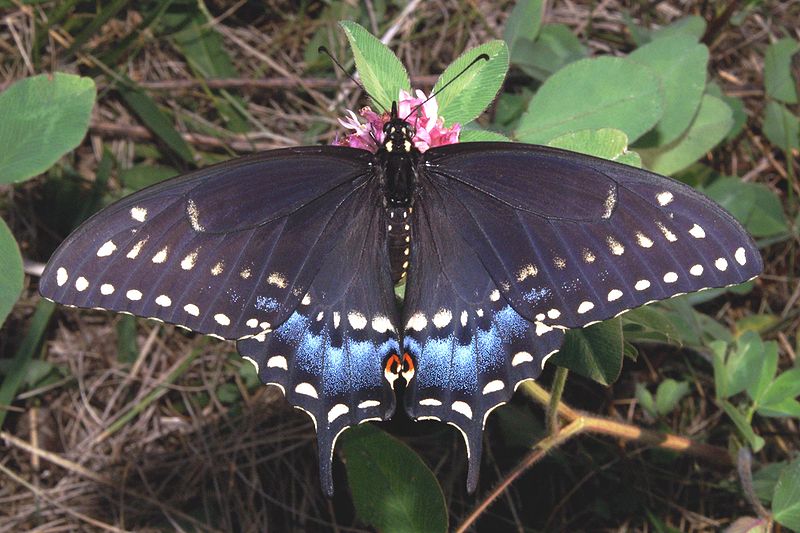
Black Swallowtail Butterflies (Papilio polyxenes) are found in many regions of both North and South America, and have a handful of subspecies that reflect different areas. They are an abundant, secure species within low numbers found only on the fringes of the range. Black Swallowtails have a wingspan of between three and four inches.

(Image Source)
These Butterflies get their name from their predominantly black body which is outlined with yellow spots or bands. Males and females can be distinguished based upon the prominence of the yellow. Females have a more spotted yellow and a more obvious band of blue across their lower wings. It is believed that the coloration of Black Swallowtails is intended to mimic that of Pipevine Swallowtail, which is bad tasting.

Larvae of the species are banded black and white with yellow spots. The eggs are typically laid on plants belonging to the Apiaceae plant family, which are consumed by the larvae upon hatching. Adults feed on nectar and can be attracted to your garden by growing the types of plants that they lay their eggs on, including dill, carrots, and Queen Anne's Lace.

Caterpillars have a rather interesting defense mechanism. They have an organ on their necks known as an Osmeterium, which raises when threatened and produces and extremely distasteful odor.

Thứ Năm, 30 tháng 9, 2010

Large Blue Butterfly is both a common name and a description for Phengaris arion (sometimes also called Maculinea arion). It is a species of butterfly that lives in 37 countries throughout continental Europe, and was reintroduced to Southern England after going extinct there in 1979 due to habitat loss. They  are found in warm, dry locations which are often also home to Thyme and Marjoram, plants that are important to the reproductive process. Large Blue Butterflies have wingspans of about 2in, and are blue with black spots.

(Image Source)
Large Blue Butterflies have an interesting life-cycle. Eggs are laid on the aforementioned Thyme or Marjoram plants and when they hatch, the caterpillars will consume the plant that they hatched upon, molting 3 times. After the third molt, the still-small caterpillars drop to the ground where they attract Myrmica sabuleti red ants with a sweet secretion from their body. The ant will feed on the secretion, and after it is finished the caterpillar will inflate the skin behind its head. The ant mistakes the caterpillar for one of its own larvae, and carries it back to the nest, where the caterpillar then proceeds to eat all of the ant larvae, hibernate, and eventually pupate.

Adult Large Blue Butterflies emerge in June and have sadly short lives. While a caterpillar may live 9 months or longer, adults typically only hand on for a few weeks at the very most. This is just long enough for them to find a mate and reproduce.

Large Blue Butterflies are listed as Near Threatened.

Thứ Hai, 26 tháng 7, 2010

Papilio cresphontes is the largest butterfly species in North America. They can be found throughout the Southern United States and Mexico, and in spattered areas across the Eastern and Central United States.

Image from Florida HTR
Giant Swallowtails are pretty easy to pick out. Not only are they large, with wingspans of up to 6 inches, but they have some pretty interesting coloration. The wings of the adults are black, but a horizontal band of yellow crosses from wing to wing, with additional mirrored yellow patterns found below, and possibly above, this band. Red marking are also sometimes found in the tail. Caterpillars are brown with white splotches, which camouflages them to look a lot like bird droppings. They are called "Orangedogs" due to an orange gland that acts as a further defense mechanism by secreting a toxin.

Giant Swallowtails feed off the nectar of a variety of plants, including Azaleas and Goldenrods. The caterpillars feed off of Citrus trees, and are considered to be pests by growers of Sweet Oranges. Giant Swallowtails prefer to lay their eggs on Citrus plants, and they do so by laying single eggs on various trees. The larvae eventually hatch, and then go through five phases before they form a chrysalis.

Thứ Năm, 13 tháng 5, 2010

Images from Wikimedia Commons
If you live in the continental United States, you've probably encountered a Monarch Butterfly (Danaus plexippus). Their range literally covers the country and a large chunk of the rest of the continent as well. They've also made their way over to Europe, Australia, and New Zealand due to lucky wind systems and cross oceanic shipping.

The Monarch was one of the species initially classified by Linneaus in 1758's Systema Naturae, and its scientific name comes strait out of mythology. In short, Danaus was a king and had 50 daughters, while his brother, Aegyptus, had 50 sons. Aegyptus wanted the 50 sons to marry the 50 daughters but Danaus refuses until he gets forced into organizing a mass wedding. He then has his daughters kill their husbands, and all but one does. The remaining son gets revenge on Danaus, and he and the daughter become king and queen to a dynasty. See where all this royalty stuff comes from? (Oh, and the species name, plexippus, comes from a name of one of the sons) It has also been speculated that the "Monarch" name is to honor King William III of England (William the Orange in his Dutch Homeland). This is interesting because the butterfly was not called "Monarch" until 1874, while William III ruled 1689-1702, nearly two hundred years earlier.

Wintering Monarchs
Anyway, mythology/history lesson aside, the Monarch butterfly is of particular interest to many due to their migration. Butterflies west of the Rockies travel to the California coast in order to survive the winter. But Monarchs east of the Rocky Mountains can travel upwards of 3,000 miles in order to arrive at congregation spots in Mexico. The generation that roosts all winter then lays its eggs on the return journey. It can take multiple generations to make the trip back to the original northern homeland, while it takes only one generation to make it to Mexico. Scientists and amateurs alike track and study these migrations each year.

And last but not least, Monarch Butterflys are poisonous. And where do they get that toxicity from? Their diets of course! They consume milkweed which gives them high concentrations of cardenolide, which is harmful to most predators.