Thứ Ba, 7 tháng 9, 2010

Mudpuppies are among the largest of all Salamanders, and can grow to about 14in in length. They can be found throughout the Eastern United States and Canada, and are completely aquatic. They prefer shallow lakes and streams, though specimens have been found at depths of 100 feet. Mudpuppies spend most of the day hiding under rocks and vegetation. They are carnivorous and feed at night off of insects, crustaceans, small fish, and snails.

Image Source
Necturus maculosus is identified by their brown spotted bodies and bright red gills. It is an interesting species of Amphibian because gills are their one and only method of breathing, unlike many other species of salamander which develop lungs during their metamorphosis. Another pretty unique trait is that Mudpuppies guard their eggs, rather than lay them an abandon them. It takes up to 5 week for eggs to hatch after being laid. Mudpuppies have a lifespan of around twenty years and don't even reach sexual maturity until about five or six.

Mudpuppies are not a threatened species, but habitat loss and pollution has affected some localized populations.

Thứ Hai, 6 tháng 9, 2010

Adult (Image Source)
Harp Seals are probably best known in their pup form; the white, fluffy, adorable little guys that seems highly represented in the children's plush toy market. Harp Seals are found in the Arctic Waters, where they live on park ice and migrate up to 2,500km each year between breeding grounds and summering areas. They come together for breeding and molting and form groups of several thousand seals. Adult Harp Seals measure up to 6ft in length, and weigh about 300lbs. They are carnivores, and are able to dive to 100m and hold their breath for 15min.

Pup (Image Source)
Harp Seals come together in large groups to mate. This usually happens right after weaning the previous season's pup. After mating, female Harp Seals are able to delay implantation, allowing her to give birth when pack ice is available. You seals are born a camouflaging white, and will feed off an extremely high-fat milk for about the first two weeks of their life. Once the pups have reached about 80lb, they are very abruptly weaned and left on their own. Pups will go through an extensive molting process before finally achieving their adult coats at sexual maturity at the age of 4-6. Harp Seals are so named because of a harp-shaped pattern found on the sides of the adult seals.

The fluffy white coats of newborn Harp Seals as made them very desirable. Harp Seals are one of the most commercially important of all the Seals, and though the hunts are now regulated in most areas, hundreds of thousands of Harp Seals are killed each year.

Chủ Nhật, 5 tháng 9, 2010

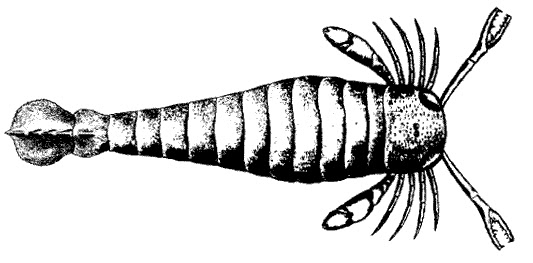
So a few weeks back we talked about one of the top predators of the Devonian Period, so now lets move back about 400 million years and talk about the terror of the Silurian seas: Pterygotus. Fossilized specimens of these gigantic sea scorpions have been found in New York and Britain.

Image Source
Pterygotus is actually a genus name, and members within it comprised some of the largest Arthropods of all time.  With the ability to reach lengths of nine feet, the only other Arthropods that ever reached similar sizes was the Carboniferous Arthropleura. They were completely aquatic, and most likely hunted by laying on the sea floor and ambushing prey. Pterygotus consumed other, smaller invertebrates. They had pincers like modern scorpions, but did not have a stringer-tipped tail. Instead, their tail was broad and most likely used as a paddle to assist with movement, seeing as their legs were very small.

Pterygotus was able to achieve such a large size because of the lack of jawed fish and other predators. No one hunted them and they had no one to compete with. Once jawed fish became more populous, Pterygotus and other large Arthropods began to die out, as they were no longer able to compete. For several million years, however, Pterygotus ruled the seas.

Thứ Bảy, 4 tháng 9, 2010

Martes martes can be found throughout Europe. While some populations have become habitat generalists, most Martens prefer forested areas, where they can live semi-arboreal lifestyles and remain protected from predators. They are about the size of a domestic cat, with a body length of roughly 20in, and an additional tail length of 10in. Males are slightly larger and heavier than females.

Image Source
European Pine Martens are a brown to reddish-brown color, with a yellowish colored patch on the neck and chest. Their coats are thicker during the winter, and more coarse during the summer. Martens were, and still are in some places, hunted for their winter coats.

European Pine Martens are omnivores, though they prefer meat above anything else. Their diet consists of smaller mammals, insects, birds, and frogs. They will also eat carrion, fruit, nuts, and honey. They are nocturnal, solitary creatures that mark their territories using scent glands. Martens become more social during the summer mating season, and after meting the females are able to delay implantation, causing their pregnancies to actually begin in early spring. Young Martens are born blind, deaf, and toothless, and will take about 6 months to become fully independent.

Thứ Sáu, 3 tháng 9, 2010

As the name might imply, Ocypode quadrata is found in the Atlantic coastal areas of North and South America. They are one of 28 extant species within Ocypode that share the common name of Ghost Crab. Members of the genus are found throughout the world. They get their name from their ability to blend in with their surroundings and their partially translucent bodies.

Image Source
Atlantic Ghost Crabs live in burrows that they dig themselves. These are placed above the tideline, go down at a 45 degree angle, and can become 3-4 feet deep. They are built from wet sand for sturdiness, and the crabs use burrows for both shelter and for hibernation. Atlantic Ghost Crabs cannot swim, but they must live near water as it is required for their respiration. When hibernating, oxygen is stored in special sacs, allowing them to remain dormant for about 6 weeks. Females also need water in order to reproduce, as that is where they lay their eggs. Young crabs are even more camouflaged than the adults, and can be extremely difficult to see.

The eyes of the Atlantic Ghost Crabs can rotate a full 360 degrees, which is a good thing when you have so many natural predators. Birds and Raccoons regularly feed on Ghost Crabs, and in some areas the crabs are consumed by Humans as well. Atlantic Ghost Crabs are most active at night, and are very opportunistic omnivores.

Thứ Năm, 2 tháng 9, 2010

We've learned about the world's largest shark, so now lets move on to number two! Basking Sharks (Cetorhinus maximus) can be found in arctic and temperate coastal areas around the world. They are extremely migratory, following the plankton supply during the seasons, and can grow over 12m in length.

Image Source
That's right. Plankton. Like Whale Sharks, Basking Sharks feed off of tiny little creatures, rather than hunting and consuming larger prey as many of sharks do. They swim around with their large mouths open, ingesting whatever finds its way in. They then close their mouth and trap all of the food with help from gill rakers. All of the excess water is then expelled through their gills. They do have many teeth, but they are small and largely unused. Basking Sharks give birth to live young, making them ovoviviparous.

Unfortunately, Basking Shark populations declined dramatically in the 20th century, due to overfishing. These Shrkas have extremely large livers that make up 25% of their overall weight. The livers are vitamin rich and contain oil that is a major motivation for hunting. The species is currently considered Vulnerable, and are unfortunately still being hunted illegally. Basking Sharks are not dangerous to humans.

Thứ Tư, 1 tháng 9, 2010

Male Red Winged Blackbird (Source)
I chose today's animal because I quite like it. I grew up seeing them everywhere, and I've always loved their striking wing colors. Red Winged Blackbirds live all over North America in marshes, fields and meadows. They are one of the most abundant bird species on the continent, with numbers of nearly 200 million.

One thing I have learned in writing this post is that only the males of the species have the distinguishable red and yellow band. Females aren't even black! They have a brown, mottle appearance, which aids to camouflage them and is a coloration found in several other species of bird. Juveniles also have a similar coloration to the adult females. Red Winged Blackbirds vary in color based upon their location. For example, in areas where they overlap with a similar looking species, the Tricolored Blackbird, males have lost their yellow band. They feed off of insects, seeds, and grains.
Female (Source)

Some populations are migratory, but others remain in their habitats year round. While making their migration, Red Winged Blackbirds can travel at speeds of about 30mph. During the breeding season males fiercely defend their territory, and will mate with multiple females within it. Each partnering produces 2-3 chicks per season. Both parents protect the nesting area. Outside of the breeding season they live in large flocks that sometimes intermingle with other species and number into the thousands.