Chủ Nhật, 10 tháng 10, 2010

The Carolina or Green Anole (Anolis carolinensis) is an arboreal lizard that is native to North America. They are found along the Atlantic Coast and can also be found in some Caribbean islands. They reach lengths of 6-7inches, and males are slightly larger than females.

(Image Source)
Anoles are able to change color, but are not true Chameleons because they can only shift between two colors, rather than a more complete blending. Temperature and sexual activity dictate which of the two colors they will be at a given time. Typically, if it is warm outside, they are found as bright green. In cooler weather, they change to a drabber brown. This is due to the fact that darker colors absorb more heat, which is a valuable trait when you're cold blooded. Males have a flap of skin on their throats called a Dewlap which also changes colors. It is normally white, but when stretched out due to mating interest or territorial protection it becomes red. Males are extremely territorial and will fight to defend their turf.

Carolina Anoles are carnivorous, and feed off of insects. They are solitary reptiles from birth. After the mother lays her eggs she has nothing further to do with them.

Carolina Anoles are often kept as pets, and are quite common in the wild. They do have one major threat however, and that is encroachment by invasive Anole species like the Brown Anole. Browns have forced the Carolinas to compete for food and habitats, which has damaged their numbers.

Thứ Bảy, 9 tháng 10, 2010

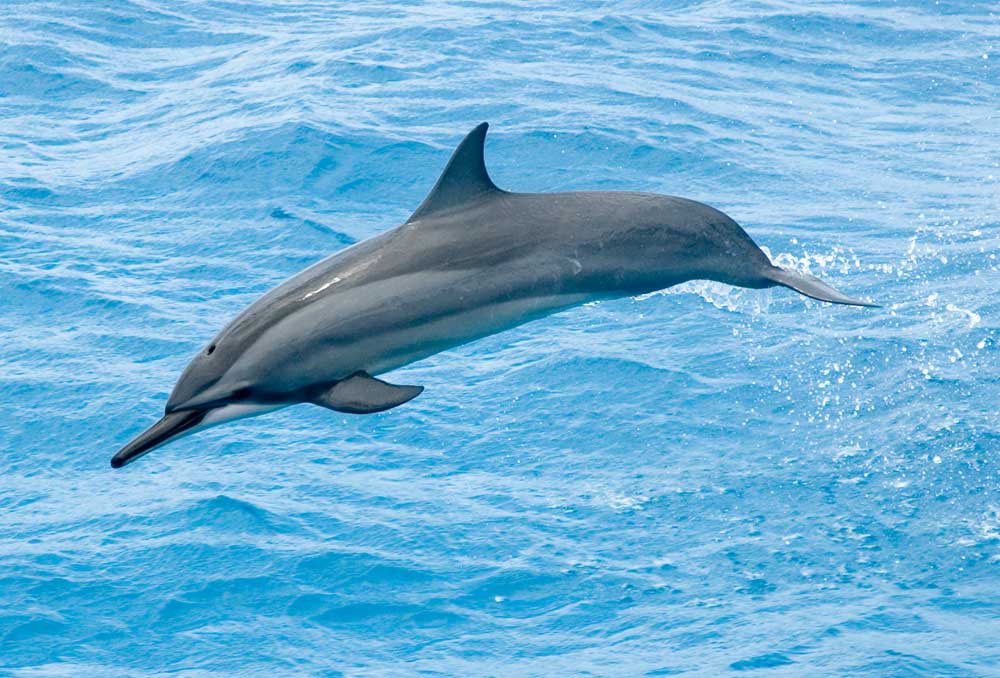
Spinner Dolphins are small cetaceans that can be found throughout the tropical waters of the world. They have slender bodies, and generally do not exceed seven feet. Spinner Dolphins weigh 130-170lbs. The external appearance of these animals is dictated by their location and subspecies. Overall though, they come in shades of gray with white bellies.

(Image Source)
It is difficult to generalize the Spinner Dolphin because the habitats and behaviors of the different subspecies vary. Hawaiian and Costa Rican Spinners, for example, tend to live in coastal areas, while most other populations are far more pelagic. The Hawaiian Dolphins also tend to live in groups that number in the hundreds, while others congregate in the thousands. Many Spinner pods travel with other cetacean groups, including Humpback Whales and Spotted Dolphins. Their tendency to coexist with other sea creatures had led to some problems. In the East Pacific, Spinner Dolphins sometimes travel with Yellowfin Tuna, which has resulted in many dolphin deaths as the Tuna are fished up.

But lets move on to less sad things. Like jumping! Spinner Dolphins are so named because of their amazing acrobatics. They can do as many as fourteen leaps in a row, and are able to jump and spin on their body axis. It is believed that these antics serve as a form of communication and as a method of removing parasites.

Spinner Dolphins reach sexual maturity at around age seven, and females calve roughly every three years. Spinners feed off of small fish and squid, and they are preyed upon by sharks and larger cetaceans. The aforementioned Tuna fishing has damaged their Pacific populations since the 1960s. Spinner Dolphins do very well in captivity, and can be found in several aquariums.

Thứ Sáu, 8 tháng 10, 2010

Not kangaroos, yet not actual rats, Kangaroo Rats are rodents of the genus Dipodomys. There are currently around 20 known species, all of whom live in arid regions of the American West and Southwest. California is especially rich in species.

(Image Source)
Kangaroo Rats are well adapted to their dry environments. They have kidneys that are extremely efficient; they are able to dispose waste without wasting precious water. They are able to take in water from the food they eat, and are able to store that food for long amounts of time in  cheek pouches. They also neither sweat nor pant as they would result in water loss. Kangaroo Rats get their name from the fact that they bounce around on their hind legs much like the large marsupials. They are able to jump several times their own body length, sometimes over six feet, to escape predators, and they have especially long tails that help for balance.

Kangaroo Rats are solitary animals and live in burrow and in territories that they defend. They use their powerful hind legs to kick sand at and attack trespassers. The sand technique is also used when fleeing from predators. They do have numerous natural predators including Coyotes, Snakes, and Owls.

Females may have three litters a year, and the overall life expectancy is between two and five years. Kangaroo Rats are not currently threatened.


Thứ Năm, 7 tháng 10, 2010

Blue marlins are incredibly large, iconic fish. In fact, they are one of the largest fish species in the entire world. Interestingly, the females are larger than the males and can reach lengths of 14ft and weight close to 2,000lbs. Males are substantially smaller and rarely weigh more than 300lbs. This means that all of those gigantic trophy fish are in fact female.

(Image Source)
There is some debate on the taxonomic status of the Blue Marlin. Some consider to be the Atlantic fish to be a very separate species from those in the Pacific and Indian Oceans. Others consider them to be all one species within the genus Makaira. For the sake of this entry we are going to go with the earlier view: that of different species. Makaira nigricans is found in tropical and temperate waters of the Atlantic Ocean, where they prefer to live near the warmer surface waters. They are migratory, solitary hunters, and will move to areas where the food supply is better. They eat a variety of pelagic fishes, and will also dive down deeper for squid and other prey. The characteristc beak of the Marlin is actually and extension of their upper jaw, and it is used to slash at schools of fish and stun victims.

Spawning occurs in tropical waters, and females may lay several million eggs at a time. They will hatch after about a week but very few of the larvae will live to reach sexual maturity. Blue Marlin females can live as long as 27 years, while the lifespan for males is around 18.

Blue Marlins are not yet a threatened species, but many fear that the amount of fishing that they are subjected to will damage the population in the future.

Thứ Tư, 6 tháng 10, 2010

(Image Source)
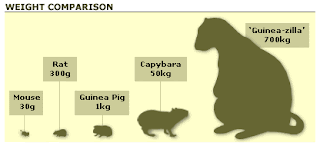
Oh do I ever love mega-fauna, especially when it's something you completely wouldn't expect. Giant Mammoth? Alright, sure, Elephants are big. Giant Bear? Yeah, that too. But what about a Giant Guinea Pig? And now, I'm not talking about something Capybara sized. (Capybaras, for reference, are the world's largest living rodents and weigh up to 130lbs) Oh no, no no no. Phoberomys pattersoni, first discovered in 1999 and just recently published about, was a massive rodent that exceeded 1,500lbs. A typical modern guinea pig weights about 2lbs. That is 750 Guinea Pigs or about the size of a Buffalo!

(Image Source)
But never you fear. Phoberomys pattersoni died out about eight million years ago, and even when it was alive, it was an herbivore that fed off of sea grasses in Venezuela's Orinoco Delta. Its hind limbs were much more powerful than its front ones, and it had a strong tail that suggests that it sat up while eating.

So what ate it? Well, back around the same time and place their also existed one of the largest Crocodylians ever; Purussaurus brasiliensis measured somewhere in the ballpark of 12m. And given that P. pattersoni was found in semi-aquatic riverside habitats, they may have interacted. It is believed that P. pattersoni went extinct because they were so big. They were too large to burrow and were unable to outrun predators like many of the lither, hoofed mammals could.

P. pattersoni was named in honor of Brian Patterson, a paleontologist who worked in the region of its discovery back in the 1970s.

Thứ Ba, 5 tháng 10, 2010

By now you should know that I definitely have some favorites in the animal kingdom. I love gigantic birds. I love anything that moos or bleets, and I definitely love anything that has enough natural toxin in them to kill a man without even trying. Morbid? Maybe, but totally awesome nonetheless. So today we're going to talk about one of the single most toxic animals on the planet: the Golden Poison Dart Frog.

(Image Source)
There are actually a whole mess of Poison Dart Frogs, all of whom are found within the Dendrobatidae family and all of whom are (you guessed it) poisonous. The Golden is the king of them all. This itty bitty two inch frog has enough venom in it to kill ten men. The toxin is actually secreted through the skin, and can cause severe problems if held. If you ingest the poison or have it come in contact with an open would... well, then you are in even more trouble. The poison actually stops nerve impulses, causing  heart attack or fibrillation.

Poison Dart Frogs get their name from the fact that indigenous tribes use their poison to coat their darts when hunting. Because of their toxicity, Golden Poison Dart frogs have only one natural predator; a snake that has developed a resistance to their poison. Interestingly, they aren't born toxic. Instead, it is the diet of the frogs that contribute to their toxin producing ability. The eat alkaloid-rich meals that allow them to create it. Frogs that live off a different diet in captivity are essentially harmless.

Though Golden Poison Dart Frogs seem small in comparison to us, they are actually pretty large within their own family. As previously stated, they can grow to about 2inches in length, and have a very uniform golden color to them, with some small populations being green or orange. They can be found in lowland Rainforest areas on the Pacific coast of Colombia. Habitat loss has caused them to become endangered.

Thứ Hai, 4 tháng 10, 2010

Though they look quite zebra-ish, the Okapi (Okpaia johnstoni) is actually a member of the family Giraffidae. They are found exclusively in the Ituri Rainforest of the Democratic Republic of Congo. One fifth of this forest has been set aside as the Okapi Wildlife Reserve, which is a World Heritage Site.

Okapi legs are striped in a pattern much like a zebra. These stripes can distinguish one Okapi from another, and, combined with the brown on the rest of their bodies, provide camouflage in a forested habitat. Okapi are so well camouflaged that scientists did not even know of their existence until 1900!

(Image Source)
Okapis share many features with giraffes, but are not nearly as tall because such heights would be detrimental in a thick forest. They have sloping bodies, with the front end being more elevated than the back, and reaching a shoulder height of around 5.5ft. Males also have giraffe-like knobs on their heads, which grow between the ages of one and five. Okapis also posses extremely long, black tongues that are prehensile and are used to grasp leaves. They are so long that they can groom their own faces with them.

Okapis are solitary animals, and males can become quite aggressive regarding their territory. Males and females  locate each other for breeding using their sense of smell, and the gestation period is a whopping 440 days. Young Okapis are able to walk 30 minutes after birth and have an rather interesting way of protecting themselves from predators. Calves will not defecate at all until they are six to eight weeks old. This prevents predators from being able to track them as easily. Mothers are extremely protective of their young, and will fight to defend them.

Okapis are listed as Near Threatened, and the global populations is estimated at between 35,000 and 50,000 individuals. Loss of habitat and hunting have affected their numbers. They are protected by Congolese law, and are a national symbol of the country.