Thứ Năm, 14 tháng 10, 2010

(Image Source)
I absolutely love the name of these guys, though their looks leave much to be desired. Footballfish is the common name for members of the Himantolophidae family, which has only one genus, Himantolophus, and eighteen species. They are also members of the order Lophiiformes, which is more commonly known as the Anglerfish order! I've covered other order members in the past, but these Footballfish are more in line with what comes to mind when one thinks of Anglerfish. They live in the deep sea, they have large, round bodies with scary looking teeth, they sport "fishing poles," and last but not least, they have some rather interesting mating habits.

So lets break this down. Footballfish (and many other Anglerfish) live in the deep sea. In this case, in tropical and subtropical waters around 3,300 ft. Footballfish display extreme sexual dimorphism, with the females being much, much larger than the males. This will come into play later. The females, with their large, round forms, are slow swimmers, and actually hunt by doing well, not much of anything at all. They have a rod known as an ilicium that has a biioluminescent bulb attached to the end. Due to the depth of water that they live in, the water is especially dark and this bulb attracts prey. Females are then able to snatch their meals right in front of them. They feed mostly off of small fish and cephalopods.

Females are also quite good at attracting potential mates. Remember those tiny male Footballfishes? Well, they never get very big, since they don't typically have the ability to feed, but they are able to track down females due to their great sense of smell and pheromones that the females emit. Once a male finds a much larger lady, he latches on to her with his mouth, and eventually his entire body dissolves into her, leaving behind only gonads which the female is then able to use to impregnate herself with. This comic sums it all up quite nicely (potentially NSW).

It should be noted that not all Footballfish species reproduce this way. Some species have males that are free-living. The whole "attach and dissolve" thing is also common in many other Anglerfish families.

Thanks to Eric for the suggestion!

Thứ Tư, 13 tháng 10, 2010

The Sacred Ibis (Threskiornis aethiopicus) is a wading bird native to Sub-Saharan Africa, Madagascar, and Iraq. They occur primarily in marshes and wetlands. Sacred Ibises stand around 30in tall, and are covered in white feathers with the exception of the neck and head. These are featherless and covered in black skin that begins to show around two years of age.

(Image Source)
Sacred Ibises get their name due to the fact that they were literally were worshiped as gods. The ancient Egyptians believed the Ibis to be the earthly manifestation of the scribe-god Thoth. They even mummified these birds, and one tomb group contained over one million Ibis mummies! Killing an Ibis was a act punishable by death, as it was also believed that the birds prevented plague. Interestingly, the birds actually did prevent a disease, Bilharzia (or Schistosomiasis). The disease is carried by a parasite that latches to snails that were a favorite snack of the Ibises. By eating these snails en masse the disease was kept at bay. Unfortunately, the Sacred Ibis is now extinct in the very country that once worshiped it, due to loss of swampland (and the disease that they once held in check has now reappeared there.)

The Sacred Ibis is able to eat a pretty wide variety of meals, thanks to their curved bills that allow them to probe into muddy areas. They eat snails, amphibians, and insects, and will also scavenge for other types of food on land, including other birds' eggs. Sacred Ibises are communal, and will sometimes even roost among other bird species. They are also very quiet, and only vocalize while on breeding grounds. Both parents assist in the guarding and feeding of chicks, who will fledge and leave the colony when they are less than two months old.

Thứ Ba, 12 tháng 10, 2010

For some reason whenever I think of fish my brain automatically reverts to strange or colorful deep sea creatures. So when I was brainstorming for an animal today, I made a very conscious effort to look at something of the freshwater variety, and thus today we're going to learn all about Angelfish!

(Image Source)
Angelfish is the common term for species within the Cichlid genus Pterophyllum, but it is also the term given for the specific species Pterophyllum scalare. Their natural habitat is the Amazon River Basin, in the Amazon itself and in other rivers of the surrounding area. They live in water that is highly vegetated, and their color actually depends on the overall clarity of the water. Angelfish are omnivorous.

Angelfish have a very distinct, compressed body shape. They can reach lengths of about five inches, and measure nine to ten inches tall. A mutation known as "veil tail" can add an additional couple of inches. In the wild they are typically silver with black bars, but multiple colors have been bred in captivity. Their shape and coloration work to camouflage them in the wild.

Angelfish have been kept as pets since the 1920s and crossbreeding for specific colors has been a hobby for decades. If you especially interesting in keeping these little guys as pets, check out some of the article links for information about feeding, water quality, breeding, and behavior with other species (they can apparently be none-to-friendly with other types of fish)

Thứ Hai, 11 tháng 10, 2010

I might not have a whole lot to write about this particular Dinosaur, but that is because it is simply so new! Sarahsaurus, named after Sarah Butler, an Austin, TX philanthropist, was first discovered in 1997 and findings regarding it have just recently been published. Sarahsaurus lived in the early Jurassic around 190 million years ago.

(Image Source)
Sarahsaurus is so awesome because of what it tells us about the dispersion of dinosaurs across North and South America. The traditional view was that Dinosaurs were so dominant that they out-competed everything else around them. A new view is rising that Dinosaurs in the Americas were successful because they were opportunistic rather than dominant. There were no Dinosaurs in the area prior to the Triassic-Jurassic extinction, and then after the previous residents went extinct, Dinosaurs like Sarahsaurus moved in.

Sarahsaurus was a Sauropodomorph, a precursor to Sauropods like Apatosaurus. Like the Sauropods, Sarahsaurus had a long neck and a small head. It also interestingly had hands! They were about the size of human hands, but much, much more powerful. It is now thought that these Dinosaurs were something more than herbivores. Their strong hands and versatile teeth point to the fact that they may have been scavengers.

Chủ Nhật, 10 tháng 10, 2010

The Carolina or Green Anole (Anolis carolinensis) is an arboreal lizard that is native to North America. They are found along the Atlantic Coast and can also be found in some Caribbean islands. They reach lengths of 6-7inches, and males are slightly larger than females.

(Image Source)
Anoles are able to change color, but are not true Chameleons because they can only shift between two colors, rather than a more complete blending. Temperature and sexual activity dictate which of the two colors they will be at a given time. Typically, if it is warm outside, they are found as bright green. In cooler weather, they change to a drabber brown. This is due to the fact that darker colors absorb more heat, which is a valuable trait when you're cold blooded. Males have a flap of skin on their throats called a Dewlap which also changes colors. It is normally white, but when stretched out due to mating interest or territorial protection it becomes red. Males are extremely territorial and will fight to defend their turf.

Carolina Anoles are carnivorous, and feed off of insects. They are solitary reptiles from birth. After the mother lays her eggs she has nothing further to do with them.

Carolina Anoles are often kept as pets, and are quite common in the wild. They do have one major threat however, and that is encroachment by invasive Anole species like the Brown Anole. Browns have forced the Carolinas to compete for food and habitats, which has damaged their numbers.

Thứ Bảy, 9 tháng 10, 2010

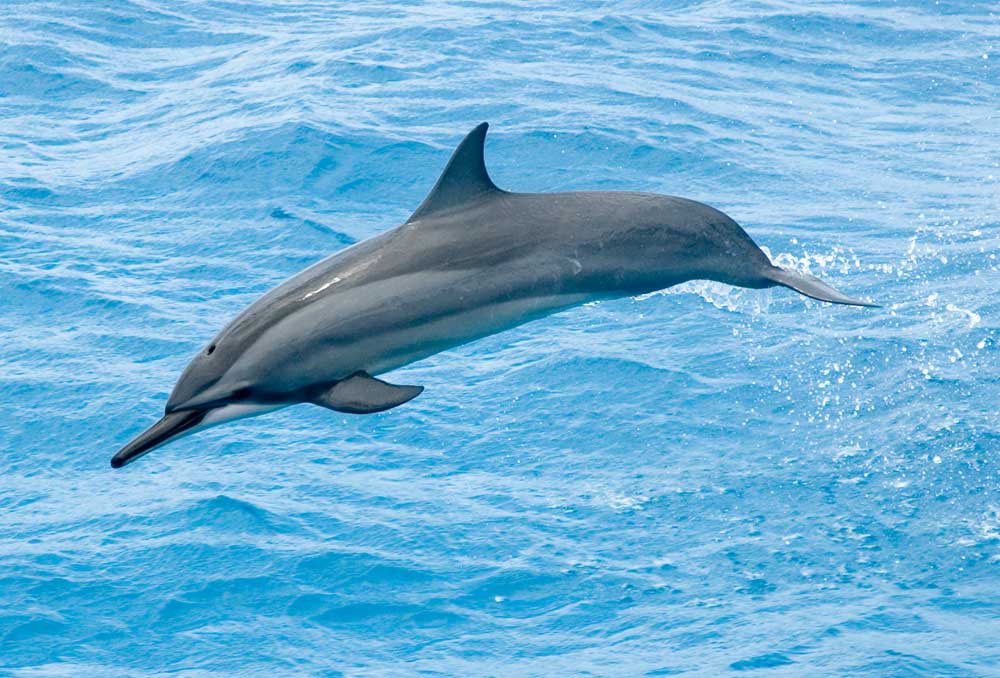
Spinner Dolphins are small cetaceans that can be found throughout the tropical waters of the world. They have slender bodies, and generally do not exceed seven feet. Spinner Dolphins weigh 130-170lbs. The external appearance of these animals is dictated by their location and subspecies. Overall though, they come in shades of gray with white bellies.

(Image Source)
It is difficult to generalize the Spinner Dolphin because the habitats and behaviors of the different subspecies vary. Hawaiian and Costa Rican Spinners, for example, tend to live in coastal areas, while most other populations are far more pelagic. The Hawaiian Dolphins also tend to live in groups that number in the hundreds, while others congregate in the thousands. Many Spinner pods travel with other cetacean groups, including Humpback Whales and Spotted Dolphins. Their tendency to coexist with other sea creatures had led to some problems. In the East Pacific, Spinner Dolphins sometimes travel with Yellowfin Tuna, which has resulted in many dolphin deaths as the Tuna are fished up.

But lets move on to less sad things. Like jumping! Spinner Dolphins are so named because of their amazing acrobatics. They can do as many as fourteen leaps in a row, and are able to jump and spin on their body axis. It is believed that these antics serve as a form of communication and as a method of removing parasites.

Spinner Dolphins reach sexual maturity at around age seven, and females calve roughly every three years. Spinners feed off of small fish and squid, and they are preyed upon by sharks and larger cetaceans. The aforementioned Tuna fishing has damaged their Pacific populations since the 1960s. Spinner Dolphins do very well in captivity, and can be found in several aquariums.

Thứ Sáu, 8 tháng 10, 2010

Not kangaroos, yet not actual rats, Kangaroo Rats are rodents of the genus Dipodomys. There are currently around 20 known species, all of whom live in arid regions of the American West and Southwest. California is especially rich in species.

(Image Source)
Kangaroo Rats are well adapted to their dry environments. They have kidneys that are extremely efficient; they are able to dispose waste without wasting precious water. They are able to take in water from the food they eat, and are able to store that food for long amounts of time in  cheek pouches. They also neither sweat nor pant as they would result in water loss. Kangaroo Rats get their name from the fact that they bounce around on their hind legs much like the large marsupials. They are able to jump several times their own body length, sometimes over six feet, to escape predators, and they have especially long tails that help for balance.

Kangaroo Rats are solitary animals and live in burrow and in territories that they defend. They use their powerful hind legs to kick sand at and attack trespassers. The sand technique is also used when fleeing from predators. They do have numerous natural predators including Coyotes, Snakes, and Owls.

Females may have three litters a year, and the overall life expectancy is between two and five years. Kangaroo Rats are not currently threatened.