Chủ Nhật, 17 tháng 10, 2010

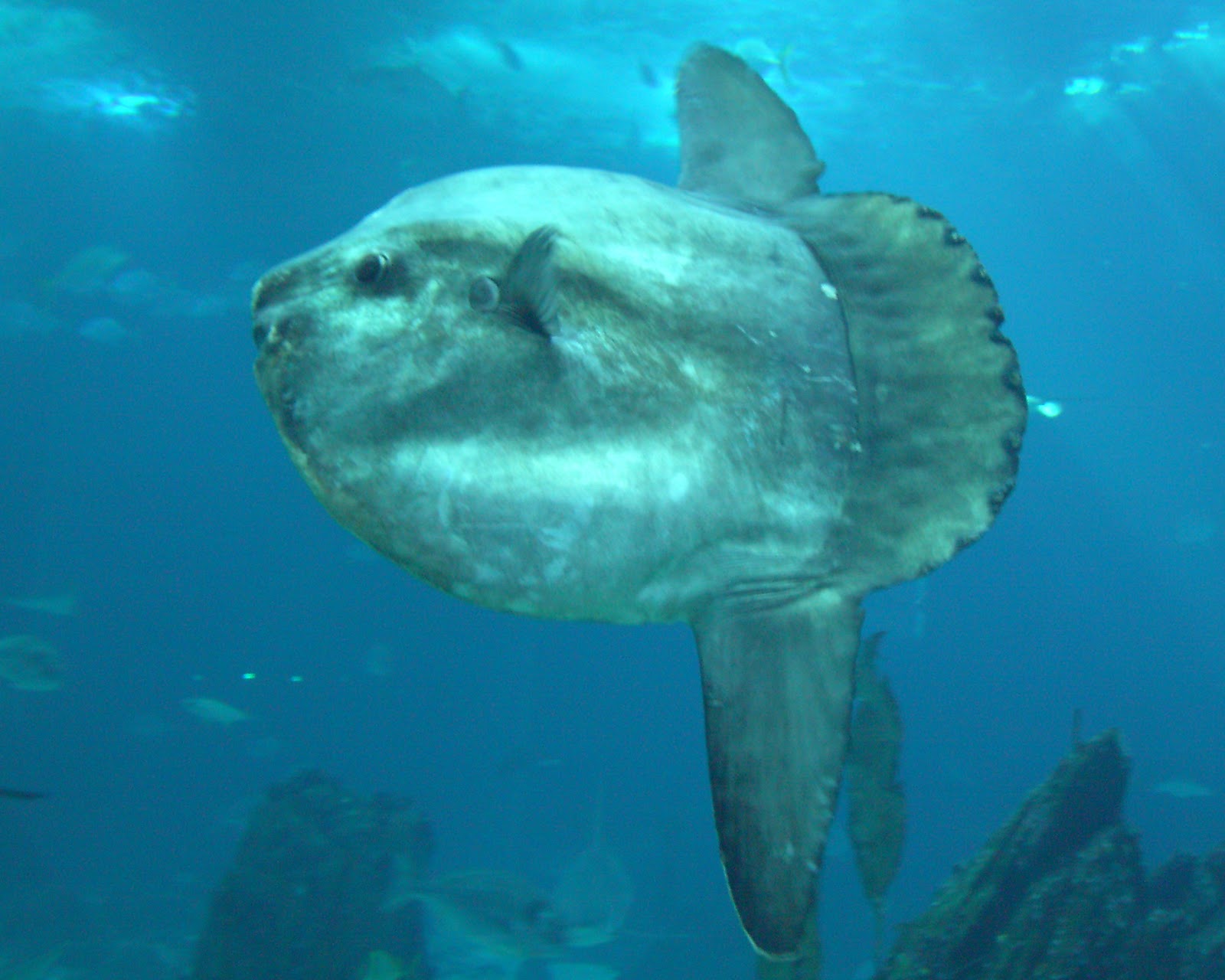
The Mola Mola (Mola mola), or Ocean Sunfish, is the largest bony fish in the world, and has been recorded at sizes of eleven feet from fin-tip to fin-tip. But you many ask, what about Whale Sharks! Basking Sharks! Certainly they are larger! But sharks you see, are cartilaginous, meaning they are made from cartilage rather than bone. This makes the massive, 3000lbs Mola Mola, the most massive of all bony fish.

Interestingly, the Mola Mola shares some characteristics with their large, sharky neighbors. Despite their large size, they eat only very small little meals with their parrot shaped beaks, comprised mainly of plankton, small fish, and jellyfish. Mola Mola are found in tropical and temperate waters around the world and are a pelagic species.

(Image Source)
Mola Molas have a couple of really interesting behaviors and characteristics. The first are swimming and basking. If the image is no indication, the Mola Mola has a laterally compressed body. In essence, it kinda looks like a dinner plate. It moves about by flapping its two large fins back and forth. Molas also bask on the ocean surface, laying side up. It is believed that this serves some sort of purpose is regulating body temperature and removing parasites. Did you also know that Mola Molas don't have scales? Their entire body is covered in an elastic, thick skin.

Mola Molas are also one of the most prolific egg layers in the undersea world. One small female was found with 300 million eggs in her ovaries, and a large specimen would most assuredly be carrying even more. Once the eggs hatch the Mola larvae resemble tiny little pufferfish, and they lose their spines as they grow. Pufferfish and Mola Molas actually belong to the same taxonomic order, Tetraodontiformes.

Thứ Bảy, 16 tháng 10, 2010

The Blakiston's Fish Owl might possibly be the largest of all the owl species. Bubo blakistoni weighs a massive 4kg and sports a wingspan of up to 190cm. They live in one very specific area in the entire world, namely a small little chunk of Northeast Asia. Their are two subspecies, one that lives on the mainland in areas that are part of Russia and China, and one on the northern Japanese islands and Russia's Kuril Islands. Their may be birds in North Korea, but the nature of that political situation makes it difficult to go in and get an estimate.

(Image Source)
Blakiston's Fish Owls are quite endangered. There are only a few thousand left, if that, and the island subspecies is down to only a few hundred. This decline in population has been a result of habitat loss. Blakiston's Fish Owls live in very old, dense forests that are near large rivers, and this type of habitat has been on the decline due to construction and forest clearing. Another major threat to these birds is general human encroachment. Birds in Japan sometimes get hit by cars or trapped in power lines.

Despite the name,  Blakiston's Fish Owls eat more than fish. They also feed off of small mammals, waterfowl, crustaceans, and amphibians. The most common hunting tactic observed is dropping down on prey from a low perch. Small meals are brought back to a perch and consumed, while larger targets will be partially consumed on the spot.

Blakiston's Fish Owls mate for life, and each breeding pair inhabits a specific territory. They are believed to non-migratory over large distances, though they might make small, seasonally based movements.. They pair does not breed each year, and it is suspected that breeding is dictated by environmental factors. One or two eggs are laid at a time, and the female incubates while the male hunts and brings back food. After the eggs have hatched, both parents take turns hunting. Chicks fledge around 50 days.

Blakiston's Fish Owls are protected by the nations that they are native to, and there are a handful of captive breeding and release programs. A major problem in their conservation is that despite the fact that the birds are protected, their habitat is not. A national park has been proposed for part of their Russian range, but as of right now it is only a suggestion.

Thứ Sáu, 15 tháng 10, 2010

The Yangtze Soft-Shell Turtle (Rafetus swinhoei), also known as the Shanghai Soft-Shell or Swinhoe's Soft-Shell, is the rarest, most endangered turtle in the entire world. There are only four known specimens in existence, and all are getting quite old. They are also one of the largest of the Soft-Shell Turtles, members of the family Trionychidae. Soft-Shell Turtles are so named because their shells have a more pliable, almost leathery feeling carapace that is essentially really thick skin.
(Image Source)

Yangtze Soft-Shell Turtles are natively found in South East Asia, though their is only one believed specimen in the wild today. They measure up to a meter in length and have tails and pig-like snouts. Females are slightly larger than males. Yangtze Soft-Shelled Turtles are omnivores, and feed off of plants, fish, snails, crustaceans, and small amphibians.

As already mentioned, the Yangtze Soft-Shell Turtle is the most endangered Turtle in the world. It might also possibly be the most endangered animal, period. Their species was potentially irreparably damaged due to loss of habitat and hunting for use in traditional medicines and as food. Two specimens are in captivity in China, and there are two reported individuals in Vietnam. For a few years now, scientists have been working to save the species by breeding the Chinese pair. Unfortunately, the female previously lived in an enclosure that was dirty and saw a lot of vandalism, and her poor diet of garbage caused her first clutch of eggs to be almost completely infertile. The second breeding, which took place earlier this year, yielded a few fertile eggs, but they never made it to term. Cleaner, protected conditions and a better diet are making conservationists hopeful about breedings in the years to come.

The main problem however, is that the females is over eighty years old, and the male is over one hundred. While many turtle species have exceptionally long life expectancies (especially compared to humans) time is ticking to save this rare species.Another breeding is planned for 2011.

Thứ Năm, 14 tháng 10, 2010

(Image Source)
I absolutely love the name of these guys, though their looks leave much to be desired. Footballfish is the common name for members of the Himantolophidae family, which has only one genus, Himantolophus, and eighteen species. They are also members of the order Lophiiformes, which is more commonly known as the Anglerfish order! I've covered other order members in the past, but these Footballfish are more in line with what comes to mind when one thinks of Anglerfish. They live in the deep sea, they have large, round bodies with scary looking teeth, they sport "fishing poles," and last but not least, they have some rather interesting mating habits.

So lets break this down. Footballfish (and many other Anglerfish) live in the deep sea. In this case, in tropical and subtropical waters around 3,300 ft. Footballfish display extreme sexual dimorphism, with the females being much, much larger than the males. This will come into play later. The females, with their large, round forms, are slow swimmers, and actually hunt by doing well, not much of anything at all. They have a rod known as an ilicium that has a biioluminescent bulb attached to the end. Due to the depth of water that they live in, the water is especially dark and this bulb attracts prey. Females are then able to snatch their meals right in front of them. They feed mostly off of small fish and cephalopods.

Females are also quite good at attracting potential mates. Remember those tiny male Footballfishes? Well, they never get very big, since they don't typically have the ability to feed, but they are able to track down females due to their great sense of smell and pheromones that the females emit. Once a male finds a much larger lady, he latches on to her with his mouth, and eventually his entire body dissolves into her, leaving behind only gonads which the female is then able to use to impregnate herself with. This comic sums it all up quite nicely (potentially NSW).

It should be noted that not all Footballfish species reproduce this way. Some species have males that are free-living. The whole "attach and dissolve" thing is also common in many other Anglerfish families.

Thanks to Eric for the suggestion!

Thứ Tư, 13 tháng 10, 2010

The Sacred Ibis (Threskiornis aethiopicus) is a wading bird native to Sub-Saharan Africa, Madagascar, and Iraq. They occur primarily in marshes and wetlands. Sacred Ibises stand around 30in tall, and are covered in white feathers with the exception of the neck and head. These are featherless and covered in black skin that begins to show around two years of age.

(Image Source)
Sacred Ibises get their name due to the fact that they were literally were worshiped as gods. The ancient Egyptians believed the Ibis to be the earthly manifestation of the scribe-god Thoth. They even mummified these birds, and one tomb group contained over one million Ibis mummies! Killing an Ibis was a act punishable by death, as it was also believed that the birds prevented plague. Interestingly, the birds actually did prevent a disease, Bilharzia (or Schistosomiasis). The disease is carried by a parasite that latches to snails that were a favorite snack of the Ibises. By eating these snails en masse the disease was kept at bay. Unfortunately, the Sacred Ibis is now extinct in the very country that once worshiped it, due to loss of swampland (and the disease that they once held in check has now reappeared there.)

The Sacred Ibis is able to eat a pretty wide variety of meals, thanks to their curved bills that allow them to probe into muddy areas. They eat snails, amphibians, and insects, and will also scavenge for other types of food on land, including other birds' eggs. Sacred Ibises are communal, and will sometimes even roost among other bird species. They are also very quiet, and only vocalize while on breeding grounds. Both parents assist in the guarding and feeding of chicks, who will fledge and leave the colony when they are less than two months old.

Thứ Ba, 12 tháng 10, 2010

For some reason whenever I think of fish my brain automatically reverts to strange or colorful deep sea creatures. So when I was brainstorming for an animal today, I made a very conscious effort to look at something of the freshwater variety, and thus today we're going to learn all about Angelfish!

(Image Source)
Angelfish is the common term for species within the Cichlid genus Pterophyllum, but it is also the term given for the specific species Pterophyllum scalare. Their natural habitat is the Amazon River Basin, in the Amazon itself and in other rivers of the surrounding area. They live in water that is highly vegetated, and their color actually depends on the overall clarity of the water. Angelfish are omnivorous.

Angelfish have a very distinct, compressed body shape. They can reach lengths of about five inches, and measure nine to ten inches tall. A mutation known as "veil tail" can add an additional couple of inches. In the wild they are typically silver with black bars, but multiple colors have been bred in captivity. Their shape and coloration work to camouflage them in the wild.

Angelfish have been kept as pets since the 1920s and crossbreeding for specific colors has been a hobby for decades. If you especially interesting in keeping these little guys as pets, check out some of the article links for information about feeding, water quality, breeding, and behavior with other species (they can apparently be none-to-friendly with other types of fish)

Thứ Hai, 11 tháng 10, 2010

I might not have a whole lot to write about this particular Dinosaur, but that is because it is simply so new! Sarahsaurus, named after Sarah Butler, an Austin, TX philanthropist, was first discovered in 1997 and findings regarding it have just recently been published. Sarahsaurus lived in the early Jurassic around 190 million years ago.

(Image Source)
Sarahsaurus is so awesome because of what it tells us about the dispersion of dinosaurs across North and South America. The traditional view was that Dinosaurs were so dominant that they out-competed everything else around them. A new view is rising that Dinosaurs in the Americas were successful because they were opportunistic rather than dominant. There were no Dinosaurs in the area prior to the Triassic-Jurassic extinction, and then after the previous residents went extinct, Dinosaurs like Sarahsaurus moved in.

Sarahsaurus was a Sauropodomorph, a precursor to Sauropods like Apatosaurus. Like the Sauropods, Sarahsaurus had a long neck and a small head. It also interestingly had hands! They were about the size of human hands, but much, much more powerful. It is now thought that these Dinosaurs were something more than herbivores. Their strong hands and versatile teeth point to the fact that they may have been scavengers.