Thứ Năm, 7 tháng 4, 2011

Brown Centipede
Phylum : Arthropoda
Subphylum : Myriapoda
Class : Chilopoda
Order : Lithobiomorpha
Family : Lithobiidae
Genus : Lithobius
Species : L. forficatus

Length : Up to 2in (5cm)

IUCN Status : Not Listed

The Brown Centipede is a very common species of Myriapod that can be found most often in Europe, though their distribution extends outside that range.They are a reddish-brown color, have large antennae, and live in a variety of different habitats.

As adults, Brown Centipedes have 15 pairs of legs, giving them thirty overall. You can tell a juvenile from an adult by counting up the digits. Less than 30 legs means that it still has some growing to do. Brown centipedes are born with 7 pairs, and they have to molt their exoskeletons as they age. Each molt grants them a new set of legs!

Females have an interesting way of laying their eggs. They dig a hole and deposit one egg. Then they dig another hole for another single egg, and so on. Eggs are laid in summer, and Brown Centipedes can live as long as 6 years!

Brown Centipedes are nocturnal carnivores, and they have a couple of neat features that help them to hunt and devour prey. First off, they have two venomous claws they they use to paralyze their targets. Secondly, their back set of legs is much longer than any other set, which allows them to hold on to and carry around meals. Humans should not be fearful of Brown Centipedes. They may try and attack with the venom if threatened, but they rarely break skin. Even if they do, the injury is more mild then your average bee sting.

Thứ Tư, 6 tháng 4, 2011

Male Satin Bowerbird
Phylum : Chordata
Class : Aves
Order : Passeriformes
Family : Ptilonorhynchidae
Genus : Ptilonorhynchus
Species : P. violaceus

IUCN Status : Least Concern

Cripes! I've never written about a Bowerbird! These birds, found in Australia and New Guinea, may not be as crazy looking as some of the other natives, (I'm looking at you Birds of Paradise) but they have a fantastic skill-set all their own!

Satin Bowerbirds are medium size birds found in Eastern Australia. Adult males are a shiny blueish-black color with blue eyes, while females and younger males have green plumage.

Bower
What makes this birds so interesting is the intricate procedure that they go through before mating. Males build two parallel structures out of twigs and grasses, and then decorate around them with colorful blue and yellow bits and objects, including flowers, berries, and even made made materials like pens and bottle caps. Females come to inspect these bowers, and at that point the males put on an elaborate dance. If the female is impressed, they mate and she leaves to lay the eggs and incubate them on her own. The male gets back to work to find more receptive females.

Thứ Ba, 5 tháng 4, 2011

Bull Shark
Phylum : Chordate
Class : Chondrichthyes
Order : Carcharhiniformes
Family : Carcharhinidae
Genus : Carcharhinus
Species : C. leucas

Length : 10ft (3m)
Weight : 500lbs (226kg)

IUCN Status : Near Threatened

The Bull Shark gets its name from its short snout and aggressive attitude, which, combined with its toleration of fresh and brackish water, makes it one of the most dangerous sharks in the entire world.

Bull Sharks have a widespread coastal range, and can be found off the coast of just about every continent except Antarctica. What is so amazing is that they are also found inland. Bull Sharks have be observed swimming up rivers and estuaries, and are even known to breed in freshwater. They have even been seen leaping up rapids to move further inland! There have also been a handful of shark attacks by these predators while several miles from the ocean.

Bull Sharks give birth to between one and thirteen live young, and they reach sexual maturity at 8-10 years old. They are solitary animals, and are opportunistic feeders that will consume just about anything they can find. Pieces of Hippopotamus have even been found in Bull Shark stomachs!

Thứ Hai, 4 tháng 4, 2011

Southern Giant Petrel - Photo by Paul Gale
Phylum : Chordata
Class : Aves
Order : Procellariiformes
Family : Procellariidae
Genus : Macronectes
Species : M. giganteus

Wingspan : 78in (200cm)
IUCN Status : Least Concern

This particular species of bird goes by many names : the Southern Giant Petrel, Stinker, Stinkpot, Giant Fulmar, and "Bone-shaker" among them. Why Stinker and Stinkpot though? When these birds feel threatened they can accurately spit blobs of regurgitated food and oil at their attackers. Stinky indeed!

Southern Giant Petrels can be found in the Southern Hemisphere, breeding near Antarctica and its nearby islands. They are large seabirds, rivaling the albatrosses for size, though then have slimmer wings and much, much larger beaks. Petrels often skim over the water, and are able to take off and land in it. These abilities are the source of the name "Petrel," which comes from St. Peter, the Apostle who walked on water.

Southern Giant Petrel - Photo by Paul Gale
These birds are huge scavengers, feeding off whatever penguin, seal, and whale carcasses they can find. They do on occasion take surface dwelling squids and fishes, but carrion is their primary meal source.

Southern Giant Petrels mate in October and November, and each pair only lays one egg at a time, which takes over two months to incubate. Both parents care for the egg and the chick until it fledges around March and goes off on its own. Young Petrels will fly about on a long migration for several years, but after about six or seven they return to the place that they were born in order to breed.

Chủ Nhật, 3 tháng 4, 2011

Male with Females and Shells
Phylum : Chordata
Class : Actinopterygii
Order : Perciformes
Family : Cichlidae
Genus : Lamprologus
Species : L. callipterus

Length : Males 6in (15cm), Females 2.5in (6cm)

IUCN Status : Least Concern

Yesterday afternoon I watched several episodes of the Science Channels "Mutant Planet." One of these, about the lakes in Africa's Rift Valley, featured today's animal, a curious fish sometimes known as the Shell Castle Cichlid.

Lamprologus callipterus is endemic to Lake Tanganyika. These fish exhibit extreme sexual dimorphism; the males can weigh 20 times as much as the females! They are predators that feed off of crustaceans and smaller fish.

I chose this particular Cichlid to feature today because of their interesting breeding behavior. The males are highly territorial and protective of their many, many mates. They gather up old snail shells, sometimes hundreds of them, and bring them into their territory. They then attract nearby females, who then enter these shells in order to lay their eggs. The males then guard over both the females and the eggs until the fry are large enough to leave. At that point neither parent takes any further action in the care of the offspring. Interestingly, the males do not eat at all while they are guarding their "castle." Eventually they become weak and are often chased off by larger, healthier males.

Thứ Bảy, 2 tháng 4, 2011

Dama Gazelle
Phylum : Chordata
Class : Mammalia
Order : Artiodactyla
Family : Bovidae
Genus : Nanger
Species : N. dama

Height : 40in (1m)
Weight : Up to 180lbs (81kg)

IUCN Status : Critically Endangered

The Dama Gazelle is both the world's largest, and the world's rarest gazelle. They once had a range that spread across all of northern Africa, but now they are restricted to only a few isolated pockets in Niger, Mali, and Chad.

Dama Gazelle
Dama Gazelles live either solitary lifestyles, or in very small groups that number up to around 15 individuals. They feed off of scrubs and acacia trees, and are able to stand on their hind legs in order to feed off higher leaves. They are can get most of their water needs right from the food they eat.

A number of factors have contributed to the population decline of the Dama Gazelle. They are illegally hunted, they have lost their habitat, they have been horribly affected by drought, and they are forced to compete for food with grazing livestock. There are only a few hundred left in the wild, though recently some have also been released into enclosures and reserves in Morocco, Tunisia, and Senegal.

Thứ Sáu, 1 tháng 4, 2011

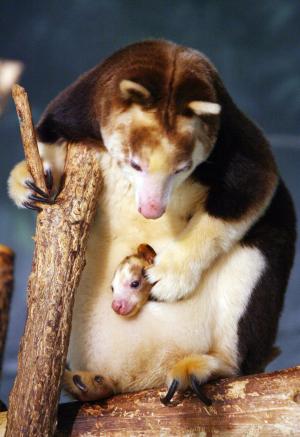
Matschie's Tree Kangaroo
Phylum : Chordata
Class : Mammalia
Infraclass : Marsupialia
Order : Diprotodontia
Family : Macropodidae
Genus : Dendrolagus
Species : D. matschiei

Body Length : 30in (76cm)
Weight : 20lbs (9kg)

IUCN Status : Endangered

The Matschie's Tree Kangaroo (named after German zoologist Paul Matschie) is a herbivorous marsupial found only on New Guinea's Huon Penninsula. Not much is known about their behavior in the wild, but they are relatively common in captivity.

Mother and Joey
Matschie's Tree Kangaroos have a whole mess of adaptations that let them live the arboreal, rainforest lifestyle. They have large front limbs and padded feet that help them to climb. They also have enormously long tails that act as counter-balances. Furthermore, the Kangaroos have fur on their necks and backs that grows in an opposite direction from the rest of their body. They can then hunch over while it's raining and have all the water run right off, keeping them dry.

Like all marsupials, pouches play a major role in reproduction. The female Kangaroos has a gestation period of only 44 days, and she gives birth to a Joey that is only an inch long. The Joey climbs up and into the pouch where he will stay without leaving for about 8 months. He will return to the pouch off and on for a few more months after that, and will finally leave his mother a year and a half after being born.

Matschie's Tree Kangaroos are on a population decline due to habitat loss and hunting.