Thứ Sáu, 7 tháng 10, 2011

Prionailurus viverrinus
On the outside the Fishing Cat may just look like a gigantic (up to 35lbs!) House Cat, but they are in fact very, very wild. These nocturnal felines are native to South and Southeast Asia and live in habitats that are close to water, blowing away the stereotype that all cats dread being wet.

Fishing Cats didn't get their name for nothing. They are excellent swimmers and primarily eat aquatic creatures, like amphibians, fish, and ducks. In order to snatch their water-dwelling meals, they stand in the shallows and scoop passing critters with their paws. They are also able to dive after prey as well!

In the wild, young Fishing Cats learn to hunt from their mothers, who they remain with until about 10 months of age. Interestingly, male Fishing Cats have helped to raise young in captivity.

Unfortunately, loss of habitat due to pollution and clearing has led Fishing Cat populations to decline, and they are now considered Endangered by the IUCN. They are also hunted in many places for their fur, and for ingredients in traditional medicines.

IUCN Status : Endangered
Location : South Asia
Size : Body length up to 31in (80cm), Weight up to 35lbs (16kg)
Classification : Phylum : Chordata -- Class : Mammalia -- Order : Carnivora
Family : Felidae -- Genus : Prionailurus -- Species : P. viverrinus
Thứ Năm, 6 tháng 10, 2011

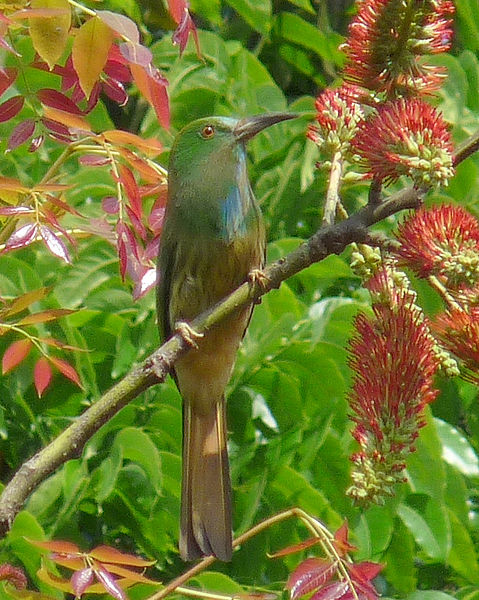
Nyctyornis athertoni
Meet the Blue-beared Bee-eater. And then say its name three times fast.

This bright bird is the largest of the Bee-Eaters, a family known for their consumption of... well... eating bees. In order to snack on their favorite prey, the Blue-beared Bee-eater harasses the nest until a swarm of guard bees shows up. As the bees pursue the bird, the bird feasts!

Blue-bearded Bee-eaters (man, that is even a marathon to type) are found in the forests of South Asia. They are named for the long feathers on their throat that puff out and look rather beard-like. These feathers also happen to be blue. Blue-bearded.

Blue-bearded Bee-eaters are common throughout their range, and have a rather large range at that. They are not currently at any risk.

IUCN Status : Least Concern
Location : South Asia
Classification : Phylum : Chordata -- Class : Aves -- Order : Coraciiformes
Family : Meropidae -- Genus : Nyctyornis -- Species : N. athertoni

Thứ Tư, 5 tháng 10, 2011

Sphyrna mokarran
Great Hammerheads are one of the many species of Hammerhead shark. They also happen to be the largest, hence the name.

These Sharks have a massive range and can be found swimming in tropical and subtropical oceans worldwide. They also migrate seasonally, chasing the cooler waters during the summer months. Great Hammerheads live mostly near coasts, and are not typically found at depths of greater than 300m.

Unlike many of the other Hammerhead species, Great hammerheads are solitary hunters. Stingrays are their favorite prey, but they also feed on bony fish and Cephalopods. Cannibalism has also been documented, as have attacks on humans.

Interestingly, Great Hammerheads give birth to live young. After an 11 month gestational period, the female will give birth to as many as 40 pups!

Illegal fishing, both targeted and bycatch, has hurt Great Hammerhead numbers in some areas. They are currently listed as Endangered by the IUCN.

IUCN Status : Endangered
Location : Tropical and subtropical oceans worldwide
Size : Length up to 11.5ft (3.5m)
Classification : Phylum : Chordata -- Class : Chondrichthyes -- Order : Carcharhiniformes
Family : Sphyrnidae -- Genus : Sphyrna -- Species : S. mokarran

Thứ Ba, 4 tháng 10, 2011

Chlidonias hybridus
The Whiskered tern is a bird with an incredible range and distribution. Populations can be found on four different continents! They are migratory, and live in different location based upon the season. In the far east of their range, for example, they often breed in Indonesia and spend the rest of their time in areas further south around Australia. Whiskered Terns can migrate as far as 5,000 miles one way!

Whiskered terns can be easily identified in their breeding plumage. They have a black cap, white cheeks, and a brilliant red beak and legs. During the rest of the year the color contrast is less stark, and the bill and feet are black.

They prefer to live near water, and feed on aquatic animals. Crustaceans, Amphibians, and Fish make up large portions of their diet, and they typically forage together in large groups. But that is not their only group activity! When threatened, an entire colony of Whiskered Terns will turn on and mob their attacker. Other foraging species like to nest near the Terns for the added protection.

Due to their massive distribution Whiskered Terns are not a currently threatened species.

IUCN Status : Least Concern
Location : Europe, Asia, Africa, Australia
Size : Body Length up to 9.5in (25cm)
Classification : Phylum : Chordata -- Class : Aves -- Order : Charadriiformes
Family : Sternidae -- Genus : Chlidonias -- Species : C. hybridus

Thứ Hai, 3 tháng 10, 2011

Mesocricetus auratus
Today's animal may look familiar, as they are one of the most popular small animals kept as pets. But did you know that in the wild Syrian Hamsters are becoming quite rare?

Syrian Hamsters were first identified in the early 19th century, and were first utilized as lab animals due to their ability to breed more readily. In fact, it is believed that all captive Hamsters in North America are descended from one litter that was captured and used for research in the 1930s.

In the 1940s Syrian Hamsters entered the pet world, and there are now over 40 varieties. They come in long and short haired versions, and in a massive number of color combinations. They are the most common hamsters kept as pets.

So is Syrian Hamsters are so popular as pets, why are they so Vulnerable in the wild? There are actually a numbers of factors. The first is that their range is very small. Less than 7,500 square miles (around 20,000 square km). Secondly, they are losing that small area to habitat encroachment. And third, they are considered to be agricultural pests, and are often baited by farmers. There are currently no conservation measures taking place throughout their native range.

IUCN Status : Vulnerable
Location : Syria
Size : Body Length up to 6in (15.5cm)
Classification : Phylum : Chordata -- Class : Mammalia -- Order : Rodentia
Family : Cricetidae -- Genus : Mesocricetus -- Species : M. auratus

Chủ Nhật, 2 tháng 10, 2011

Callimico goeldii
The Goeldi's Monkey, also called the Goeldi's Mormoset, is a curious little primate that is the size of a Marmoset, but exhibits characteristics of much larger Monkeys. It was one of the last New World Monkeys to be identified by science, and was named after its discovered, Swiss Naturalist Emilio Goeldi, in 1904.

One of the coolest facts about these guys is that they can horizontally jump 13ft (4m). That is an amazing distance considering that their body less is less than a foot!

Goeldi's Monkeys are social animals that live in family groups led by the monogamous mated pair. Their offspring will stay with the group for some time, helping to raise their younger brothers and sisters. Females will give birth to one infant at a time, and will exclusively care for it during the first 10-20 days of life. After that, the father and siblings will assist in raising the new member of the family.

Goeldi's Monkey
Sexual maturity is reached in about 9 months for females, and 17 for males, though the young Monkeys will often remain with their families past that point. When a partner or territory becomes available, the offspring may then leave the group to form a new one of their own.

Goeldi's Monkeys communicate through various means. They can project loud cries that can be heard hundreds of yards away, as well as quieter chips and noises to do things like greet and warn against danger. They also use body language and several different scent glands.

Unfortunately, Goeldi's Monkeys are becoming threatened throughout their range due to habitat loss. Some now live in protected wild areas, and captive breeding programs can be found in numerous zoos.

IUCN Status : Vulnerable
Location : Amazon Basin, South America
Size : Body Length up to 9in (23cm)
Classification : Phylum : Chordata -- Class : Mammalia -- Order : Primates
Family : Callitrichidae -- Genus : Callimico -- Species : C. goeldii

Thứ Bảy, 1 tháng 10, 2011

The Chestnut-breasted Malkoha is a large Cuckoo that lives in the countries of Indonesia, Malaysia  Myanmar, Thailand, Brunei, and the Philippines. Currently there are six recognized subspecies.

Phaenicophaeus curvirostris
They are very striking looking birds, and are relatively large for a Cuckoo. Males and females have near identical plumage, which is a dark greenish-blue across the head and back, with a chestnut colored underside. They also have red skin patches around their eyes, adding additional color contrast.

Chestnut-breasted Malkohas typically live in pairs, and have a rather unique breeding habit among Cuckoos. While many of their family members will force others birds to raise their young, these Malkohas actually do the incubating, feeding, and raising themselves!

Another interesting fact about Malkohas in general is that these birds don't fly all that much. They typically move about the trees by hopping from branch to branch.

Chestnut-breasted Malkohas have a large range and a stable population.

IUCN Status : Least Concern
Location : Southeast Asia
Size : Length up to 19in (49cm)
Classification : Phylum : Chordata -- Class : Aves -- Order : Cuculiformes
Family : Cuculidae -- Genus : Phaenicophaeus -- Species : P. curvirostris