Chủ Nhật, 7 tháng 4, 2013

There are a couple of species that go by the common name "Yellow Sac Spider," but the specific one that we will be talking about today is Cheirachanthium punctorium (what a mouthful!)

These spiders, which are found in Central Europe and Asia, grow to about 15mm in length. They get their name from their yellow coloration, and from their egg-laying behavior.

Females build large (compared to their bodies) egg sacs in the grass, and they defend these 4cm long pouches very aggressively. And their aggression should be taken somewhat seriously! Their bites can actually pierce human skin, and cause reactions similar to a wasp sting in most humans (though some people will of course react in worse way).

IUCN Status : Not Listed
Location : Europe, Asia
Size : Body length up to 15mm
Classification : Phylum : Arthropoda -- Class : Arachnida -- Order : Araneae
Family : Miturgidae -- Genus : Cheiracanthium -- Species : C. punctorium
Image : Rainer Altenkamp

Thứ Bảy, 6 tháng 4, 2013

One of my favorite movies ever, Jurassic Park, came out twenty years ago this month! And though it's not the most scientifically accurate movie ever, it does make some great comments about the Bird-Dinosaur evolutionary relationship.

Today's animal, Deinonychus, is an excellent example of that link, and (fun fact) it is also the inspiration for the Velociraptors in the movie! (Real Velociraptors were much smaller in size-- but have a much easier to pronounce name. At least the two were members of the same subfamily!) They lived during the Cretaceous period, around 115-108 million years ago, and their fossils have been found in western North America.

Deinonychus means "terrible claw," an appropriate name for them since they had massive claws on their feet that they used to slash at their prey. They also hunted in packs, as evidenced by the grouped fossils that have been found. (Sound similar to the movie Raptors?)

Deinonychus may have also had feathers, though that is up for some debate. No skin impressions have been found, but many other close relatives to Deinonychus, including Velociraptor and Microraptor, did most-assuredly have feathers. So it is likely that they did too!

Feathers or not, Deinonychus is incredibly important to our modern theories on Dinosaur-Bird evolution. John Ostrom, the Paleontologist who first extensively studied and named Deinonychus, used his work on the species to propose numbers theories that had never been brought up before. In the late 1960s he proposed that these fast, agile predators had to have been warm-blooded. And in the mid 1970s he compared the feet of Deinonychus to those of Birds, a hypothesis that eventually led to the near-universally accepted theory that Birds evolved from Dinosaurs!

Status : Extinct for 108 Million Years
Location : North America
Size : Length up to 11ft (3.4m)
Classification : Phylum : Chordata -- Class : Reptilia -- Order : Saurischia
Family : †Dromaeosauridae -- Genus : †Deinonychus -- Species : † D. antirrhopus
Image : Domser

Thứ Sáu, 5 tháng 4, 2013

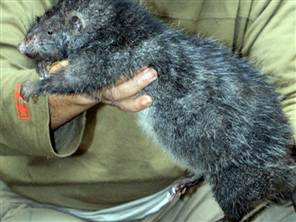
Papagomys armandvillei
Living isolated on an island can do funny things to a species. Some animals get smaller, to cope with the lack of resources. However... some actually get much larger (especially creatures that are normally small) because they don't have larger predators to contend with and can thus move into a slightly different ecological niche.

The Flores Giant Rat is and example of island gigantism. Th
ese monstrous rodents can grow 18in long, which is double the maximum size of a Brown Rat!

These Rats, like many of their kind, are very adaptable and can be found living in all types of forests, and at a variety of elevations within the Indoenesian island of Flores. They also have an adaptable diet-- they feed on fruits, leaves, insects, and a wide range of other plants and invertebrates.

Interestingly, for a Rat so large they aren't seen very often by scientists. Actually, most of what we know is from collected skeletal remains. The species is currently listed as Near Threatened, as they are hunted for food by the local human populations and by introduced dogs and cats.

IUCN Status : Near Threatened
Location : Flores, Indonesia
Size : Body length up to 18in (45cm)
Classification : Phylum : Chordata -- Class : Mammalia -- Order : Rodentia
Family : Muridae -- Genus : Papagomys -- Species : P. armandvillei
Image : Xenohistorian

Thứ Năm, 4 tháng 4, 2013

We've talked about a few different Hybrid animals in the past, and most of those are creatures that are completely man-made-- they would never hybridize in the wild. Today's animal is a bit different in that it can and has crossed before in wild conditions (though it is still rare to do so).

Khonoriks are crosses between European Mink and European Polecats. The only meet up in the wild in parts of Europe that have declining Mink populations. There is evidence of this happening at the turn of the 20th century, when warmer climates caused the Polecats to enter Mink ranges.

In 1978 the first captive bred Khonoriks were bred, by Dr. Dmitry Ternovsky in the Soviet Union. The fur produced by the hybrids was more valuable than that of the two parent species, but the breeding projects declined when Mink populations did, and are now more or less defunct.

Khonoriks are are roughly the same size as European Polecats, the larger of the two parent species. They have dark fur with pale ear tips, and blotchy facial masks. Additionally, they have the ability to swim (like Minks) and burrow (like Polecats), which lets them have a wide-ranging diet. As with most hybrids, the males are sterile though the females can be fertile.

Status : Hybrid
Location : Europe
Size : Length up to 18in (45cm)
Classification : Phylum : Chordata -- Class : Mammalia -- Order : Carnivora
Family : Mustelidae -- Genus : Mustela -- Species : M. putorius x M. lutreola
Image : Ferret Center

Thứ Tư, 3 tháng 4, 2013

Gigantactis vanhoeffeni
The name Gigantactis refers to a genus of deep sea fish that can be found in oceans all around the world. They live at depths of between 3,300 and 8,200 feet (1,000-2,500m).

Because they live in such deep, remote places, very little is known about them. So far there have been twenty separate species identified, all of which have different home ranges and sizes.

What is common to all twenty is sexual dimorphism and an elongated dorsal fin. In all species, the females are substantially larger than the males. For example, the largest of them can reach about 40cm long, while the largest males are only about 2.5cm! Huge difference!

The aforementioned dorsal fin is also a signature of the genus. They can grow longer than the body itself, and have a bioluminescent photophore attached at the end to attract meals. These strikingly long features are found only in the females though. Males have their own special anatomy-- they have a supercharged sensory organs that help them to find females!

IUCN Status : Not Listed
Location : Worldwide
Size : Length up to 16in (40cm), but varies
Classification : Phylum : Chordata -- Class : Actinopterygii -- Order : Lophiiformes
Family : Gigantactinidae -- Genus : Gigantactis
Image : PD

Thứ Ba, 2 tháng 4, 2013

Asian Elephant (living relative to the
Sulawesi Dwarf Elephants)
Did you know that back in the Pleistocene there were several species of Elephant that stood only a few feet tall? These animals were all found on islands around the world, and grew smaller in size due to insular dwarfism. Some were found on Cyrpus, Crete, and other Mediterranean isles, some way over in California's Channel Islands, and some on the many islands of Indonesia.

The Sulawesi Dwarf Elephant is a member of that last group. Fossils of this creature have been found on Java and Indonesia, and they date back to around 2 million years ago. One interesting distinction about the species is that they had functional lower tusks, though there is still much to be learned about them and about the species in general.

What we do know is that these Elephants truly were small! They stood only about 5ft at the shoulders, which is a massive difference from the 9ft height of the living Asian Elephants (the two species belong in the same genus).

Status : Extnict for 1.5 million years
Location : Madagascar
Size : Height up to 5ft (1.5m)
Classification : Phylum : Chordata -- Class : Mammalia -- Order : Proboscidea
Family : Elephantidae -- Genus : Elephas -- Species : †E. celebensis
Image : PLOS

Thứ Hai, 1 tháng 4, 2013

Scaphiophrye gottlebei
The Malagasy Rainbow Frog, also known as the Painted Burrowing Frog, is a small species found only near the Isalo Massif in Madagascar.

These colorful Amphibians grow to only 3-4cm in size, with the females being slightly larger than the males. They have bright red and green patterning on their backs, interspersed with black and grey. As tadpoles they are all black. These frogs have horny tubercles on their feet which help them to burrow underground. They are primarily terrestrial, and are actually poor swimmers.

As you may have guessed from the mention of their small range, the Malagasy Rainbow Frogs are endangered. Each year they are collected by the thousands-- their bright colors make them sought after in the illegal pet trade. Luckily most of their habitat is protected within a national park. And they do have a very fast reproduction rate, which also helps. However, because they live in only one area, an increase in hunting or habitat loss, or a natural disaster could wipe them all out.

IUCN Status : Endangered
Location : Madagascar
Size : Body length up to 4cm
Classification : Phylum : Chordata -- Class : Amphibia -- Order : Anura
Family : Microhylidae -- Genus : Scaphiophryne -- Species : S. gottlebei
Image : Franco Andreone