Thứ Năm, 3 tháng 3, 2011

What's Faster Than a Speeding Cheetah?By Robert E. Wells
Hardcover : 32 Pages
January 1, 1997

In this installment of Wells’ science book series for kids we take a look at the concept of speed. What’s Faster Than a Speeding Cheetah? starts out with the titular feline and compares it to other animals, before moving on to planes, rockets, and to concepts like the speeds of sound and light.

Wells combines his child-friendly text with whimsical illustrations and diagrams to create a cohesive, informative work. One of my favorite parts is the fact that the Cheetah, Falcon, and other animals from the beginning move through the rest of book, first as passengers on the aircraft, and then in space suits.

Recommended for ages 4-8, or anyone who just wants to look at a fun book about science.

Contains some additional information in back, along with a chart of how long it would take various animals/machines to travel from the Earth to the moon.
Ivory-Billed Woodpeckers by Audubon
Phylum : Chordata
Class : Aves
Order : Piciformes
Family : Picidae
Genus : Campephilus
Species : principalis

Length : 18-20in
Wingspan : 31in

IUCN Status : Critically Endangered, but quite possibly Extinct

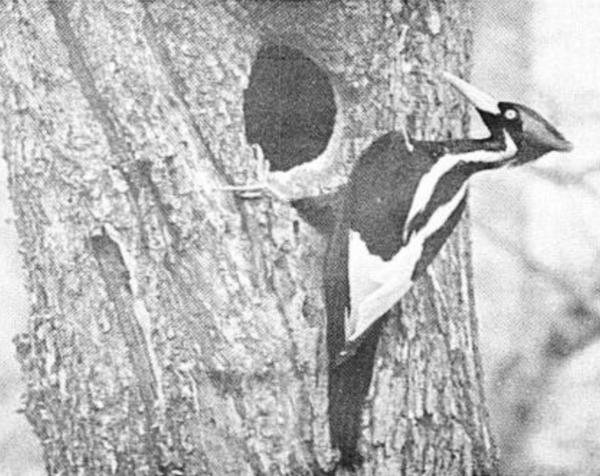
The Ivory-Billed Woodpecker is/was one of the largest of all the Woodpeckers. Now, I say "is/was" because the current status of this bird is unknown. It was previously thought to be extinct, but then in 2005 a few birds were sighted in Arkansas. However, despite years of effort, and searches over thousands of square miles, no other birds have been located.

Ivory-Billed Woodpeckers were found in the South-East United States, living in old growth forests. During the 19th century these habitats were destroyed, causing the birds to lose their homes. By the mid 20th century, they were believed to be extinct in the United States. Report in Cuba continued until the 1980s, but that population is now also believed to be gone.

Ivory-Billed Woodpecker circa 1935
Before they were lost, a decent amount of information was obtained about the behavior of the species. For example, pairs mate for life and share the responsibilities of raising their young.They feed off of beetle larvae, and excavate nests high up in trees. Ivory-Billed Woodpeckers also have distinctive calls and raps, which ornithologists have been listening for in their search for these rare birds.

The Cornell Lab of Ornithology continued to put together searches for the Ivory-Billed Woodpeckers, but no birds have turned up since the initial 2005 push. They suspended their searching in 2010. Other projects began in Florida, but they too came up relatively empty. Maybe they are still out there, maybe they aren't. It's another sad story of a species lost.

Thứ Tư, 2 tháng 3, 2011

A pair of Chinstraps
Phylum : Chordata
Class : Aves
Order : Sphenisciformes
Family : Spheniscidae
Genus : Pygoscelis
Species : antarcticus

Height : 28in (72cm)
Weight : 9-14lbs (3.5-5kg)

IUCN Status : Least Concern

Chinstrap Penguins are one of the most abundant of all the penguin species. It is estimated that there are over 7 million breeding pairs! Chinstraps live and breed in colonies and can be found in Antarctica and on islands in Antarctic Waters. The species is named for the thin black strip of feathers that runs under their beak.

Chinstrap Penguins feed off of fish and krill, and can dive down as far as 230ft (70m). Using their flippers they are able to swim at speeds of around 20mph (32kph), and their dives typically last for 20-30 seconds.


Adult and Chick
Chinstrap couples lay two eggs, which are incubated by both the male and female. Chinstraps are relatively unique among penguins in that they raise their chicks with equal care. Many other species prefer one chick over the other.

In recent years, Chinstrap Penguins have gained some notoriety due to a children's book titled And Tango Makes Three. It tells the real life story of Roy and Silo, two male Chinstraps who successfully incubated and raised a chick together. The book has been one of the most controversial in the past few years, and was the most challenged book of 2006, 2007, and 2008 according to the American Library Association.

Thứ Ba, 1 tháng 3, 2011

Javan Rhino caught on camera trap
Phylum : Chordata
Class : Mammalia
Order : Perissodactyla
Family : Rhinocerotidae
Genus : Rhinoceros
Species : sondaicus

Length : 6-11.5ft (1.8-3.5m)
Weight : 2,000-5,000lbs (900-2,250kg)

IUCN Status : Critically Endangered

The Javan Rhinoceros is perhaps the rarest large mammal in the entire world. There have been no individuals in captivity for over 100 years, and less than 60 living in the wild. These remaining Rhinos are found in two protected parks, Ujung Kulon National Park in Indonesia, and Cat Tien National Park in Vietnam.

These Rhinos are so rare and solitary that scientists are only able to study them through fecal matter and through videos caught by camera traps. Just yesterday a report was released by WWF-Indonesia stating that they had gotten footage of a handful of Rhinos this past November and December, including images of a calf. These images provide some hope, as they demonstrate that the breeding population is viable.

Javan Rhinoceros Browsing
One major threat to the Javan Rhinoceros is poaching. In China, their horns are used in traditional medicines and catch fetch prices as high as $30,000 a piece. Last year one of the few remaining Rhinos was lost to poaching, despite strict measures to guard and protect them.

Javan Rhinos feed by browsing. They even have a long upper lip that helps them to grasp and tear at branches. In regards to other anatomical information, their bodies are covered with skin that folds in a way that looks like they are covered in plates of armor.

Javan Rhinoceroses can live 30-45 years, though the oldest in captivity only made it to 20.

Thứ Hai, 28 tháng 2, 2011

Speckled Padloper Tortoise
Phylum : Chordata
Class : Sauropsida
Order : Testudines
Family : Testudinidae
Genus : Homopus
Species: signatus

Length : 4in (11cm)

IUCN Status: Near Threatened

The Speckled Padloper Tortoise is the smallest tortoise in the entire world! Found in South Africa, this tiny guy has a speckled shell whose carapace rarely grows longer than a third of a foot!

Their speckles help to keep them camouflaged in rocky areas, where they spend a great deal of their time hiding. Not much is known about their behavior in the wild, other than that females lay only one egg at a time and that the species is herbivorous.

Speckled Padloper Tortoises have several threats working against them. These include loss of habitat, introduction of highways, poaching for the pet trade, and the introduction of new predatory species. Their low birth rate has also made it difficult for this tiny species to survive through so many changes.

Chủ Nhật, 27 tháng 2, 2011

Scarlet Ibis
Phylum : Chordata
Class : Aves
Order : Ciconiiformes
Family : Threskiornithidae
Genus : Eudocimus
Species : ruber

Body Length : 24in (61cm)

IUCN Status : Least Concern

My family is pretty into the Oscars and all of the film awards shows that lead up to them. Tonight is the big event, and I wanted to write about a red animal to celebrate the red carpet. And what animal is more red than the striking Scarlet Ibis?

Scarlet Ibises are found in South America, and are the national bird of Trinidad and Tobago (which is quite impressive, considering the number of species there.)

Male Scarlet Ibis
Like Flamingos, Scarlet Ibises get their striking coloration from the food that they eat. They gain pigmentation from various small crustaceans and grow more and more red with age. Their long beaks and long legs allow them to wade through water and locate their prey.

Female Scarlet Ibises lay 2-3 eggs, which hatch after about 3 weeks. Both parents incubate the eggs and acre for the chicks. The young are a dull brown color. It will take about two years to reach a full, bright red.

Thứ Bảy, 26 tháng 2, 2011

Giant Huntsman Spider
Phylum : Arthropoda
Class : Arachnida
Order : Araneae
Family : Sparassidae
Genus : Heteropoda
Species : maxima

Legspan : 12in (30cm)
Body Size : 2in (4.7cm)

IUCN Status : Not Listed

The Giant Huntsman Spider is a newly identified species that was first discovered in the Mekong region in 2001. It has the largest legspan of any spider species yet uncovered (though since 2001 we've found over 1,000 new species in the Mekong alone, so who knows!)

Despite its scary huge size, the Giant Huntsman Spider is not dangerous to humans. They get their name from the fact that they stalk and hunt down their prey (insects, small vertebrates); they are also quite fast on their long, gangly legs.

Giant Huntsman Spiders are not venomous, and a bite from them will just give you a regular old spider bite.