Thứ Tư, 19 tháng 10, 2011

Illustration of Imperial Woodpeckers
A while back I wrote about the Ivory-Billed Woodpecker, a species from the southern United States that is believed to extinct.... though unconfirmed sightings pop up from time to time.

The same can be said for the Imperial Woodpecker. This relative of the Ivory-Billed (they belong to the same genus) has not been officially seen in its Mexican homeland since 1956.

Habitat destruction, a fragmented population, and hunting all led to the decline of this species. The last confirmed bird was seen in 1956, though numerous searches have been undertaken to find any living specimens. One search, in 1994-1995, lasted 11 months and turned up nothing. Unconfirmed reports have popped up over the years, with one of the most recent in 2005.

Unfortunately, not a whole lot is known about this rare and possibly gone-forever Woodpecker. If they were still around, they'd be the largest living Woodpecker species. Males sported red crests, while the females' were all black. They fed primarily on beetle larvae.

IUCN Status : Critically Endangered, Possibly Extinct since 1956
Location : Mexico
Size : Length up to 24in (60cm)
Classification : Phylum : Chordata -- Class : Aves -- Order : Piciformes
Family : Picidae -- Genus : Campephilus -- Species : C. imperialis

Thứ Ba, 18 tháng 10, 2011

Caprolagus hispidus
Today's animal is one of the rarest mammals in the entire world, but many people have never even heard of it! The Hispid Hare (which is actually technically a Rabbit) is an endangered species that had a population of only around 110 individuals as of 2001.

Hispid Hares were thought to be extinct in the early 1960s, but then an individual surfaced in 1966. They have a very small range that covers parts of India and Nepal, and their numbers are on the decline due to habitat loss within that range. They are also mistakenly hunted due to their resemblance to another, more common, Hare species. Hispid Hares have not done well in captivity.

Unfortunately, because they are so rare we know very little about the behavior of these Hares. They live in grassland areas, are herbivores, and they do not appear to dig burrows. They have been described as "slow moving."

As a final side note, let's quickly discuss the difference between Rabbits and Hares. For one, Hares are found within the genus Lepus. Secondly, young Hares are born more developed than young Rabbits are, because they are born above ground, not in burrows (meaning they have to fend for themselves more quickly). And thirdly, Rabbits tend to hide from predators, while Hares attempt to outrun them. Rabbits have also been domesticated. Hares have not.

IUCN Status : Endangered
Location : India and Nepal
Size : Length up to 21in (53cm), Weight up to 5.5lbs (2.5kg) 
Classification : Phylum : Chordata -- Class : Mammalia -- Order : Lagomorpha
Family : Leporidae -- Genus : Caprolagus-- Species : C. hispidus

Thứ Hai, 17 tháng 10, 2011

Chinese Alligator in Captivity
Did you know that there are only two species of Alligator in the entire world, and that they live in completely opposite hemispheres? The large American Alligator that we all know has a much smaller cousin, the Chinese Alligator, which grows to lengths of only about 5 ft! They are one of the smallest Crocodilians, and also one of the most rare.

Native only to China, the Chinese Alligator is Critically Endangered. It is estimated that there are only around 130 left in the wild! The severe drop in numbers is due to loss of habitat; the marshes that they live in are being converted to agricultural land. Luckily they have been bred successfully in captivity, and some have even been reintroduced back to the wild!

Chinese Alligators hunt at night and consume molluscs, fish, and other small water-living animals.

One interesting fact about these Alligators is that the female not only guards her 10-40 eggs every year, but she digs them out when they are ready to hatch and actually remains near her children throughout the winter.

IUCN Status : Critically Endangered
Location : China
Size : Length up to 5ft (1.5m)
Classification : Phylum : Chordata -- Class : Reptilia -- Order : Crocodilia
Family : Alligatoridae -- Genus : Alligator -- Species : A. sinensis

Chủ Nhật, 16 tháng 10, 2011

Nasua nasua
Meet the South American Coati, a curious looking member of the Raccoon Family that is native to the forests of it's namesake continent.

Coatis are gray or brown in color, and have the ringed tails that can also be found in their Raccoon cousins. They are diurnal, and live in groups that can number up to 30 individuals. They feed off of a huge variety of fruits, eggs, and invertebrates, and they use their long noses to help them overturn rocks and plants to find meals.

South American Coatis are both arboreal and terrestrial. They do most of their hunting on the ground, but interestingly they mate and give birth in trees!

Right now, South American Coatis are listed at the Least Concern level, due to their very wide range. However, populations are on the decline as threats of hunting and deforestation continue to affect them.

IUCN Status : Least Concern
Location : South America
Size : Length up to 3.3ft (1m)
Classification : Phylum : Chordata -- Class : Mammalia -- Order : Carnivora
Family : Procyonidae -- Genus : Nasua -- Species : N. nasua

Thứ Bảy, 15 tháng 10, 2011

Pheasant Pigeon
Pheasant Pigeons are large, terrestrial birds that can be found on New Guinea and nearby islands. They forage on the rainforest floors and build their nests on the ground. There are four recognized subspecies that vary by color and island location.

The subspecies have reddish-brown bodies with black heads and tails. The primary distinguishing feature between all four is the color of the nape of the neck. Green, white, gray, and black colored napes help to tell them all apart. 

The Pheasant Pigeons are rather interesting because they don't look especially pigeon-like, and because their behavior is more akin to that of their namesakes, the Pheasants. You see, there are no Pheasants in New Guinea, and the Pheasant Pigeons, which are the only species within their genus, have evolved to fill the niche that would have been occupied by Pheasants!

Though they are listed as being of Least Concern by the IUCN, Pheasant Pigeons are becoming rare in some parts of their range, and no global population survey has been undertaken. They are are also very few held in captivity.

IUCN Status : Least Concern
Location : New Guinea
Size : Length around 18in (46cm)
Classification : Phylum : Chordata -- Class : Aves -- Order : Columbiformes
Family : Columbidae -- Genus : Otidiphaps -- Species : O. nobilis

Thứ Sáu, 14 tháng 10, 2011

Fattail Scorpion
There are about eighteen species within the genus Androctonus. All of them can go by the common name of Fattail Scorpion. These arachnids live in the arid and semi-arid regions of Africa and the Middle East, and have venom that is strong enough to kill a human!

Fattail Scorpions get their name from the fact that "tail" is pretty thick, compared to those of other Scorpion types. Did you know that Scorpions do not eat solid food? They hunt insects, especially Crickets, and when they inject the venom their prey's insides turn to liquid, which the Scorpion then slurps up!

As previously mentioned, Fattail Scorpions are capable of killing people. One particular species, A. australis, is responsible for several deaths every year throughout their wide range, and has the highest number of deaths attributed to it overall among Scorpions. They often live near human habitation, and there is an anti-venom, but even those who receive fast treatment can experience lingering side-effects, including headaches and loss of feeling.

Interestingly, there are people who keep Fattail Scorpions as pets, but they are defiantly not recommend for beginners, due (obviously) to their dangerous and aggressive nature.

IUCN Status : Not Listed
Location : Africa and the Middle East
Size : Length up to 4in (10cm)
Classification : Phylum : Arthropoda -- Class : Arachnida -- Order : Scorpiones
Family : Buthidae -- Genus : Androctonus 

Thứ Năm, 13 tháng 10, 2011

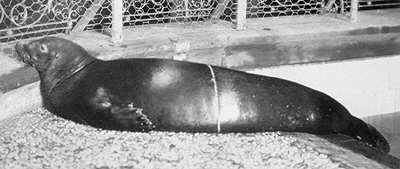
Captive Monacus tropicalis
The Caribbean Monk Seal is the only Pinniped to have ever gone extinct due to human involvement. They also have the distinction of being the only Caribbean Seals, and one of the very first animals described by Columbus in the 15th century (his crew killed and ate eight of them).

Caribbean Monk Seals once swam the waters of the Caribbean Sea and Gulf of Mexico. They were large seals, measuring nearly 3m long. Like with many Pinniped species, the males were larger than the females. They fed on fish, octopuses, and crustaceans.

Caribbean Monk Seals were hunted for their oil, and were killed my fishermen who didn't want to compete with the large predators. It didn't help that the seals were very slow on land, not very aggressive, and could be easily hunted. The last officially spotted Monk Seal was seen in 1952 at Seranilla bank between Jamaica and the Yucatan. Interestingly the species wasn't considered endangered by the US Government until 1967, when it was already way, way too late.

Spottings popped up here and there over the decades, but none could be scientifically confirmed. The IUCN listed them as extinct in 1996. In the 2000s, searches to locate any remaining Seals turned up nothing, and they were declared extinct by the US Government in 2008. Sadly, the two other Monk Seal species, found in Hawaii and the Mediterranean, are on the sharp decline towards extinction today.

IUCN Status : Extinct since the 1950s
Location : Caribbean Sea and Gulf of Mexico
Size : Length up to 8ft (2.5m)
Classification : Phylum : Chordata -- Class : Mammalia -- Order : Carnivora
Suborder : Pinnipedia -- Family : Phocidae -- Genus : Monachus -- Species : M. tropicalis